


2,900 Fired NYC Workers Get a Path Back
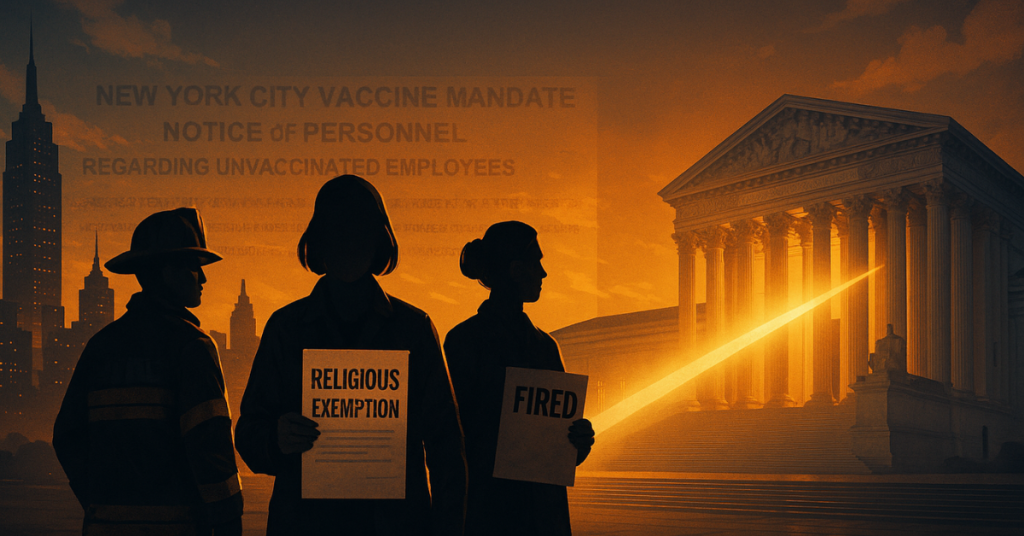
Roughly 2,900 New York City workers fired for refusing the city’s COVID-19 vaccine mandate — including employees whose requests for religious exemptions were denied — may be eligible to return to their jobs under a plan announced this month by Mayor Eric Adams. The proposal, however, offers no back pay, leaving many workers still pursuing legal action for financial restitution.
At the same time, a major lawsuit challenging the city’s religious-exemption process is awaiting a decision from the U.S. Supreme Court. The justices will meet on Dec. 5 to consider whether to hear Kane v. City of New York, a case brought by educators who argue their constitutional rights were violated when the city created what they call a discriminatory, two-tiered religious exemption system.
Supreme Court May Step In on Alleged “Denominational Discrimination”
John Bursch, lead attorney for the plaintiffs, told The Defender the Court should take the case to prevent governments from deciding which religious groups deserve protection.
“This case is about whether the government can play denominational favorites when granting religious exemptions,” Bursch said.
New York City granted vaccine exemptions to Christian Scientists and members of other “recognized” religions that publicly opposed vaccination. But educators whose objections were rooted in personal religious interpretation — or whose religious leaders supported vaccination, such as Catholics following Pope Francis — were almost always denied and forced to prove their exemption wouldn’t create an “undue hardship” for the city.
“That is religious discrimination, plain and simple,” Bursch said.
The lawsuit, originally filed in 2021 as Kane v. Blasio, challenges what plaintiffs describe as an unconstitutional system that favored certain religions over others. Plaintiff Michael Kane — a former special education teacher and director of advocacy for Children’s Health Defense (CHD) — said he was denied because city attorneys argued that since both the Dalai Lama and the Pope supported vaccination, he had “no rational basis” for a religious objection.
Kane said the city’s stance was “grotesque discrimination,” especially for people whose faith traditions blend multiple influences. CHD is funding the litigation.
Two religious liberty groups, Pacific Justice Institute and the Lorica Institute, filed amicus briefs urging the Supreme Court to take the case.
Sujata Gibson, who originally filed the lawsuit, said the Court must make clear that government officials “cannot be given unchecked discretion to decide whose religious faith is worthy of protection.”
A decision on whether the case will be heard could come as early as Dec. 8, or sometime in January 2026.
City Offers Reinstatement — But No Back Pay
On Nov. 5, the city published a proposed rule allowing fired workers — including teachers and firefighters — to apply for reinstatement. The offer would restore their former titles and salaries but does not compensate them for lost wages or benefits.
Some employees are pursuing back pay separately through ongoing litigation.
Importantly, City Hall clarified that returning workers will not be required to waive their right to sue.
Kane called the offer a “partial victory.”
“It gives people a path back to life,” he said, while allowing them to continue challenging what he describes as unconstitutional treatment.
Educators seeking reinstatement must email the city by Dec. 5.
Gibson said the offer, though welcome, falls far short of justice. “These workers lost wages, seniority and benefits due to an unconstitutional act,” she said. “Reinstatement without back pay is woefully incomplete justice.”
Mandate Fallout: Lost Jobs, Lost Homes, Ruined Families
Plaintiffs and advocates say the human toll of the mandate was severe.
“I know people who were made homeless because of this mandate,” Kane told Gothamist. Others lived out of their cars, drained retirement accounts, or saw their marriages collapse under financial pressure.
Workers who refused the vaccine were labeled with city “problem codes,” hindering future employment, benefits, and licensing — an issue highlighted in several related lawsuits.
Thousands of unvaccinated employees remain out of work to this day.
What Comes Next
If the Supreme Court agrees to hear Kane v. City of New York, it could become one of the most significant religious liberty cases of the post-pandemic era, potentially setting a national precedent on how governments evaluate personal vs. institutional religious beliefs.
If the Court declines, the 2nd Circuit’s ruling upholding most of the city’s actions will stand, and remaining challenges will continue piecemeal in lower courts.
For many of the 2,900 fired workers, the reinstatement plan offers a chance to resume their careers — but the broader legal battle over discrimination, compensation, and civil liberties is far from settled.