



Vatican Unveils the “Mona Lisa” of Medieval Bibles
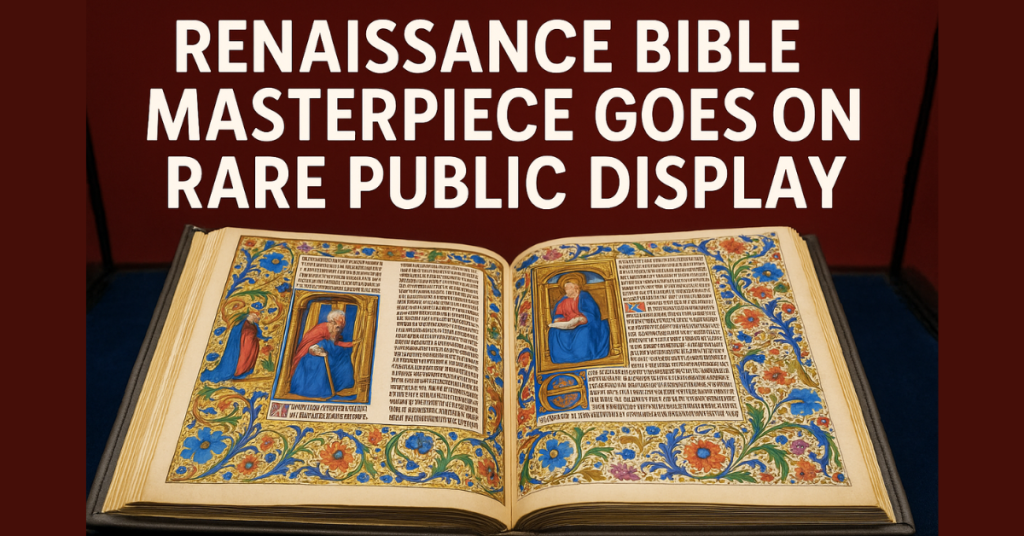
A 15th-century Bible hailed as one of the greatest masterpieces of Renaissance illumination went on display in Rome on Thursday as part of the Vatican’s Holy Year celebrations.
The Borso D’Este Bible — a lavish two-volume manuscript renowned for its gold leaf and ultramarine lapis lazuli miniatures — was unveiled inside the Italian Senate, where it will remain until Jan. 16. Usually locked away in a secure vault at the Gallerie Estensi in Modena, the Bible was transported to Rome under heavy security, with television cameras capturing workers carrying two large red crates from an unmarked van before unwrapping the bubble-covered volumes.
Commissioned by Duke Borso D’Este, the manuscript was created between 1455 and 1461 by calligrapher Pietro Paolo Marone and master illustrators Taddeo Crivelli and Franco dei Russi. Italy’s Culture Ministry calls it one of the highest achievements of miniature art, fusing sacred meaning, historical value, precious materials, and refined Renaissance aesthetics.
During its Roman exhibition, the Bible will sit behind humidity-controlled glass, while visitors can explore each page through touchscreen displays featuring ultra-high-resolution digital facsimiles.
Alessandra Necci, director of the Gallerie Estensi, describes the manuscript as “the Mona Lisa of illuminated books,” both for its artistic brilliance and its spiritual resonance. Archbishop Rino Fisichella, who oversees the Vatican’s Jubilee events, said he hopes the Bible’s beauty will inspire visitors to return home “and read their own.”
He called the manuscript’s splendor a “provocation” — a visual invitation to contemplate not only the art, but the divine message contained within the text.
Duke Borso D’Este commissioned the extravagant Bible partly as an expression of faith and partly as a statement of dynastic prestige. The manuscript remained with the Este family until 1859, when the last duke, Francesco V of Austria-Este, fled to Vienna with it. After the fall of the Austro-Hungarian Empire, the Bible remained in Habsburg hands until 1922, when Empress Zita decided to sell it.
Italian entrepreneur and cultural patron Giovanni Treccani traveled to Paris to purchase the manuscript in 1923 for 3.3 million French francs — a staggering sum at the time — and later donated it to the Italian state.
Today, the Bible is displayed in a carefully engineered case that keeps temperature and humidity constant to preserve its fragile parchment pages, which are highly sensitive to environmental shifts.
Please Support Our Sponsors:
American Alternative Assets: Uncover the truth behind market turbulence. The Bellweather Signal reveals 7 hidden economic indicators flashing red right now. Get the free report and learn how to protect your savings with gold and silver. Download it today at https://www.CloutGold.com
Discover LegiSector! Stay up-to-date on issues you care about with LegiSector’s state-of-the-art summarizing capabilities and customizable portals. Try now for a free trial…Learn more at https://www.legisector.com