



Trump Walks Back Call for Iranian Uprising
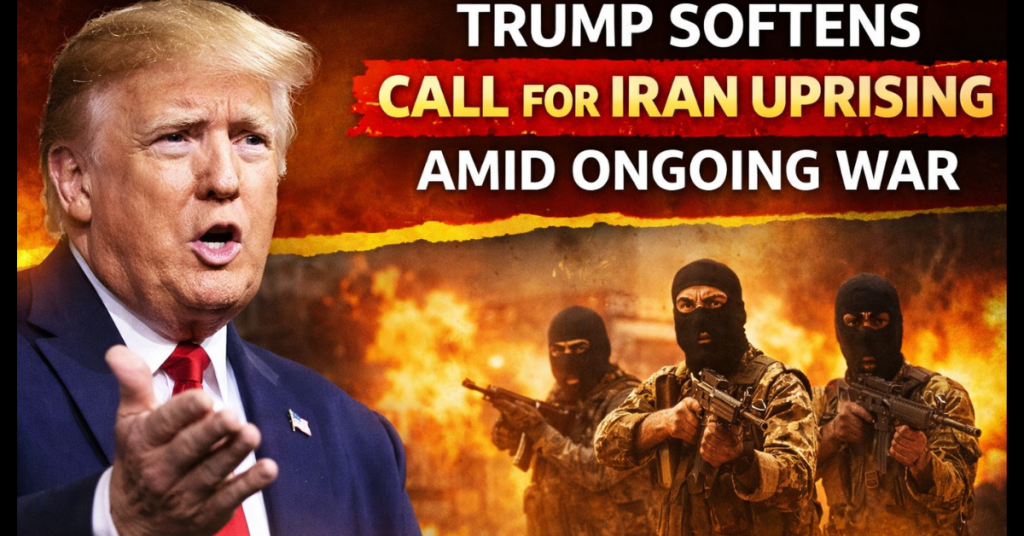
President Donald Trump is moderating earlier calls for Iranians to overthrow their government, acknowledging that an uprising inside the country may be far more difficult than previously suggested.
In a recent interview on Fox News Radio with Brian Kilmeade, Trump said that while weakening Iran’s leadership remains a goal of U.S. and Israeli military operations, the reality on the ground makes immediate regime change unlikely.
“You just mentioned to me a group of people that go around with machine guns and shoot them down,” Trump said, referring to Iran’s internal security forces. “Anybody protests, we’re going to kill you in the streets. That’s a big hurdle to climb for people that don’t have weapons.”
His remarks mark a shift from earlier rhetoric in which he encouraged Iranians to take control of their government once the conflict weakened the ruling regime.
War Has Severely Weakened Iran’s Military
The comments come as the war between the United States, Israel, and Iran continues to reshape the balance of power in the region.
According to U.S. officials, the campaign has dramatically degraded Iran’s military capabilities. Pentagon leaders say missile activity has dropped roughly 90 percent, and drone attacks have fallen by about 95 percent following extensive strikes on military infrastructure.
Trump has repeatedly claimed that Iran’s armed forces are “virtually gone,” arguing that the strikes have dismantled much of the regime’s ability to project power.
However, despite the damage to conventional forces, the Islamic Republic still maintains powerful internal security networks designed specifically to suppress domestic dissent.
The Basij Militia: The Regime’s Internal Shield
At the center of that system is the Basij, a paramilitary militia that operates under the control of Iran’s Islamic Revolutionary Guard Corps (IRGC).
The Basij was created after the 1979 Islamic Revolution and now maintains branches across cities, universities, workplaces, and neighborhoods throughout Iran.
Experts estimate the group’s total membership at around one million people, with tens of thousands serving in armed security units.
These forces have frequently been deployed to crush protests and maintain political control. Amnesty International and other human-rights groups have accused Basij units of using firearms, beatings, and other forms of violence against demonstrators.
Because many Basij members operate in plain clothes and are embedded in local communities, they are particularly effective at identifying and suppressing opposition movements.
Why Regime Change From Within Is So Difficult
Trump acknowledged that these internal security structures present a major obstacle to the type of popular uprising he once encouraged.
“Regimes are toppled from the inside,” Trump said in the interview. “We are creating the optimal conditions for that, but I can’t say with certainty that it will happen.”
His remarks reflect a broader strategic debate among policymakers and analysts: weakening a government militarily does not automatically translate into a political revolution.
History shows that authoritarian regimes often survive external pressure if they retain strong internal security forces and loyal ideological militias.
A Conflict Still in Flux
Meanwhile, the broader conflict continues to evolve. Iran now has a new Supreme Leader, Mojtaba Khamenei, following the reported death of his father earlier in the war.
The new leadership has vowed retaliation and threatened to escalate the conflict by targeting regional energy routes such as the Strait of Hormuz, a critical chokepoint for global oil supplies.
For now, Washington appears focused on maintaining military pressure while leaving the question of Iran’s political future unresolved.
As Trump himself put it, outside forces can weaken a regime—but the final outcome ultimately depends on the people living under it.