



Trump vs Spain: NATO Clash Erupts Over Iran War
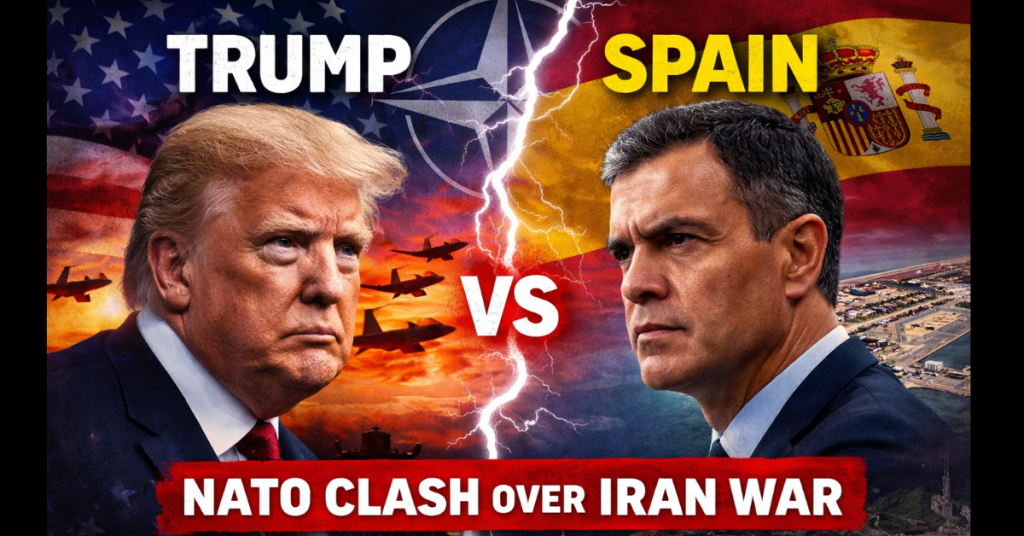
A sudden diplomatic clash erupted between Washington and Madrid this week after the White House said Spain had agreed to cooperate with the U.S. military following President Donald Trump’s threat to cut trade with the European country over its opposition to U.S.–Israeli strikes on Iran.
White House Press Secretary Karoline Leavitt told reporters that Spanish officials appeared to respond quickly after Trump warned there could be economic consequences if Madrid continued to resist U.S. military operations. According to Leavitt, Spain had “heard the president’s message loud and clear” and had agreed to coordinate with the U.S. military.
But within hours, Spanish officials publicly disputed that claim, exposing a widening rift between the NATO allies.
Spain Rejects Use of Its Bases
The dispute centers on U.S. access to military bases in southern Spain, including Naval Station Rota and Morón Air Base, which are jointly used by American and Spanish forces under a long-standing defense agreement.
Spain’s government had previously refused to allow those bases to be used in operations connected to the U.S.–Israeli strikes on Iran. Prime Minister Pedro Sánchez condemned the attacks as “dangerous” and “unjustified,” arguing that military action outside international legal frameworks risks escalating the conflict.
Spanish Foreign Minister José Manuel Albares reiterated that the bases would not be used for actions inconsistent with existing agreements or the United Nations Charter.
The refusal forced several U.S. aircraft that had been stationed in Spain to relocate to other bases in Europe as Washington prepared for operations connected to the conflict.
Trump Responds With Trade Threat
President Trump reacted sharply to Spain’s stance, threatening to sever trade ties with the country.
Speaking to reporters, Trump said he had instructed his Treasury secretary to consider halting commercial dealings with Madrid if Spain continued to deny the use of its bases for the Iran campaign.
“We’re going to cut off all trade with Spain,” Trump said, accusing the Spanish government of being uncooperative during a critical moment in the conflict.
The warning added an economic dimension to what had already become a tense geopolitical disagreement between the two NATO allies.
Spain Pushes Back
Spain’s leadership responded defiantly. Deputy Prime Minister María Jesús Montero declared that Spain “will not be vassals” to any foreign power, emphasizing that Madrid would make decisions based on its own national interests and international law.
Prime Minister Sánchez doubled down on Spain’s anti-war position in a televised address, warning that the escalating conflict in the Middle East could spiral into a wider global disaster.
Spanish officials also rejected the White House claim that their stance had changed. Foreign Minister Albares said the government’s position had “not changed one iota,” contradicting Washington’s suggestion that a deal had been reached.
A Wider Transatlantic Divide
The clash highlights growing disagreements between the United States and parts of Europe over the expanding conflict with Iran.
While some European countries have quietly supported U.S. operations or allowed logistical support, Spain has been one of the most outspoken critics of the strikes.
Madrid has framed its stance as a defense of international law and a lesson learned from past interventions in the Middle East, particularly the Iraq War, which remains politically controversial across Europe.
At the same time, the dispute underscores tensions within NATO about defense commitments and foreign policy priorities, with Trump repeatedly criticizing Spain for low military spending and for refusing to align more closely with U.S. strategy.
What Happens Next
Whether Spain ultimately allows limited logistical cooperation with U.S. forces remains unclear.
The White House insists Madrid has softened its position, but Spanish officials continue to deny any policy change.
For now, the disagreement illustrates how the widening conflict with Iran is not only reshaping the Middle East but also straining alliances across the Atlantic, forcing countries to choose between military cooperation with Washington and political pressure at home to avoid another prolonged war.