


Trump Orders Surprise Four-Day Christmas Weekend for Federal Workers
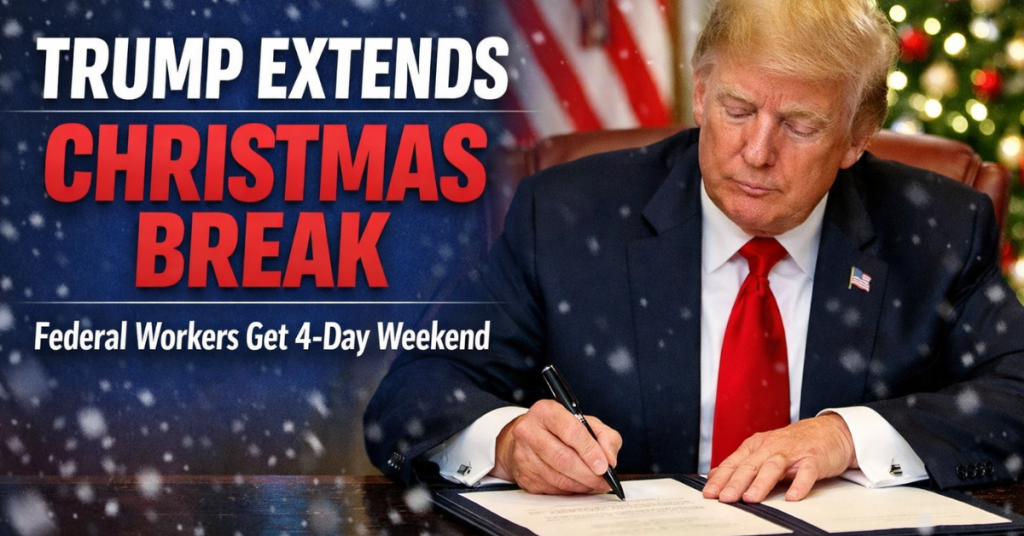
President Donald Trump signed a late-December executive order granting federal employees additional time off around Christmas, temporarily expanding the federal holiday calendar for 2025. The order designates Christmas Eve (Dec. 24) and Dec. 26 as federal holidays—creating a four-day weekend for many government workers when combined with Christmas Day.
The move applies only to federal agencies and only for this year, underscoring the difference between temporary presidential proclamations and permanent federal holidays established by Congress.
What the Order Does—and Doesn’t Do
Trump’s directive gives federal departments authority to close offices on Dec. 24 and Dec. 26, though agency heads retain discretion to require essential personnel to report for duty. The order does not mandate closures for private employers, state governments, or local municipalities.
In short:
-
Federal agencies: May close or operate on reduced staffing
-
Private businesses: Free to remain open
-
State and local offices: Unaffected unless they choose to mirror the policy
Why This Isn’t Unusual
While critics sometimes portray these proclamations as novel, presidents from both parties have issued similar holiday extensions. In 2014, Barack Obama designated Dec. 26 as a federal holiday when it fell on a Friday. Trump himself granted Christmas Eve off to federal workers during his first term in 2019 and 2020.
What’s different this time is the broader political context: Trump has repeatedly criticized what he sees as excessive non-working holidays, even as he selectively uses executive authority to grant short-term time off.
Permanent Holidays Require Congress
Despite the expanded break, neither Christmas Eve nor Dec. 26 becomes a standing federal holiday. Making a holiday permanent requires legislation passed by Congress and signed into law—something last done in 2021, when Juneteenth was added to the federal calendar.
Currently, the federal government recognizes 12 holidays in 2025, with two falling on the same date. Trump has also issued symbolic proclamations such as Victory Day for World War II (May 8) and Gulf of America Day (Feb. 9), though these are largely ceremonial.
What Stays Open
Even with federal offices closed or operating on limited schedules, most of the country will function normally:
-
Banks: Open Dec. 24 and Dec. 26; closed Christmas Day
-
U.S. Postal Service: Closed Dec. 25 only; mail runs Dec. 24 and 26
-
Retailers: Target, Walmart, Costco, and most major chains close only on Dec. 25
For most Americans, the extra holidays will be noticeable primarily through slower federal services rather than widespread closures.
Trump’s Ongoing Holiday Contradiction
The order also highlights a recurring tension in Trump’s rhetoric. He has repeatedly warned that too many paid holidays cost the economy billions and reduce productivity, arguing that Americans should prioritize work over ceremonial days off. Yet, when politically or culturally opportune—particularly around Christmas—he has shown a willingness to expand time off, at least temporarily.
That contradiction may be the point: the move reinforces Trump’s image as culturally traditional while stopping short of permanently expanding the federal holiday system he has criticized.