



Trump Eyes Ending Taxes on Gambling Winnings in Major Tax Shake-Up
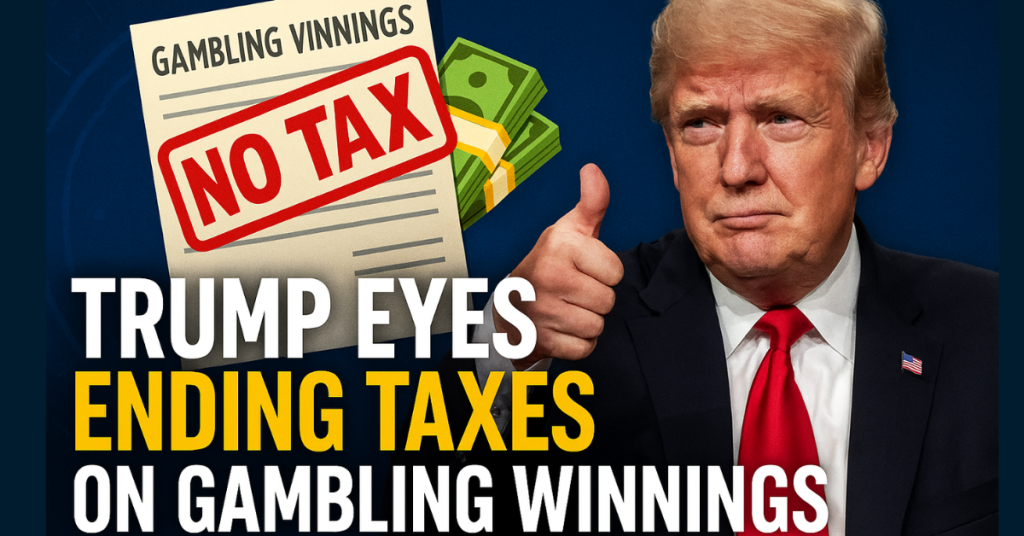
President Donald Trump signaled this week that he is considering a major tax change affecting millions of Americans: eliminating federal taxes on gambling winnings. The idea, floated during a press briefing aboard Air Force One, adds yet another item to Trump’s expanding list of proposed tax reforms as his administration pushes for a dramatic restructuring of the U.S. tax system.
Asked whether he would consider ending federal taxation of gambling earnings, Trump replied:
“No tax on gambling winnings—I don’t know. I’m gonna have to think about that.”
The remark comes on the heels of several recent tax cuts, including provisions in the newly signed One Big Beautiful Bill Act (OBBBA), which eliminated federal taxes on tips, Social Security income, and overtime pay. Trump has also repeatedly hinted at a far more sweeping ambition: the eventual elimination of income tax altogether.
Why It Matters
Gambling is no longer a niche activity. Nearly 60% of American adults gambled in the past year, with millions participating through casinos, sports betting, lotteries, raffles, and online platforms. And under current federal rules, every dollar won is considered taxable income.
Any move to eliminate federal taxes on gambling winnings would have enormous implications:
-
Taxpayers could see significant relief, especially high-frequency or high-stakes bettors.
-
Government revenue would drop, adding to the fiscal strain already projected by recent tax cuts.
-
The federal deficit—forecasted to grow by $3.4 trillion over 10 years due to OBBBA alone—could increase further.
These questions arise as Trump continues making the case that increased tariff revenue, foreign investment, and economic growth will offset tax cuts. Economists remain deeply divided on whether such projections are realistic.
How Gambling Income Is Taxed Today
Under current IRS rules:
-
Casinos issue a W-2G tax form when winnings exceed $600.
-
Winnings above $5,000 require 24% mandatory withholding, which can rise to 28% or 31% in some cases.
-
All gambling income must be reported on Form 1040, although losses may be deducted up to the amount of total winnings.
The IRS has been unequivocal:
“Gambling winnings are fully taxable.”
Eliminating this category of taxation would mark one of the largest single exemptions added to the federal code in decades.
Trump’s Broader Tax Agenda
Trump’s comments should be viewed in the context of a broader and increasingly ambitious tax agenda. In recent weeks he has reiterated his intention to cut, or even eliminate, income tax entirely:
“Over the next couple of years, I think we’ll substantially be cutting—and maybe cutting out completely—income tax,” Trump said.
“The money we’re taking in is going to be so large.”
Economists have been skeptical.
Michael Graetz, tax law professor at Columbia University, argued that replacing income tax with tariffs or consumption-based revenue is “not feasible” and would shift the tax burden downward onto lower- and middle-income Americans.
He added that the idea the U.S. could grow its way out of the revenue gap is “laughable.”
Others, like economist and former Trump adviser Stephen Moore, take a more optimistic view:
“Even if he’s wrong by a factor of ten, we’re still talking $2 trillion.”
The Political and Fiscal Road Ahead
Eliminating taxes on gambling winnings would dovetail with Trump’s broader attempt to rebrand the GOP as the party of working-class tax relief—especially as recreational gambling becomes more mainstream. But the proposal faces formidable obstacles:
1. Fiscal Constraints
The federal government is carrying the largest debt load since World War II. Interest payments alone are reaching historic highs.
2. Legislative Resistance
Even with Republican support, large tax eliminations require complex budget negotiations and reconciliation pathways.
3. Economic Uncertainty
Projected tariff revenues, investment surges, and growth estimates remain disputed among economists.
4. Administrative Overhaul
Abolishing gambling taxes would require changing withholding rules, reporting thresholds, and IRS compliance structures.
Still, Trump’s comments suggest the administration is at least weighing the move—and testing public reaction.
What Happens Next
For now, there is no formal proposal to eliminate gambling taxes, but Trump’s openness signals that the idea is on the table as part of a broader push to restructure federal taxation. The White House has not yet commented further.
As the administration continues its campaign for aggressive tax reform, proposals like this—once considered fringe—are rapidly becoming part of the national conversation.
Whether the numbers add up remains the defining question.