



The Election That Could Break Pennsylvania
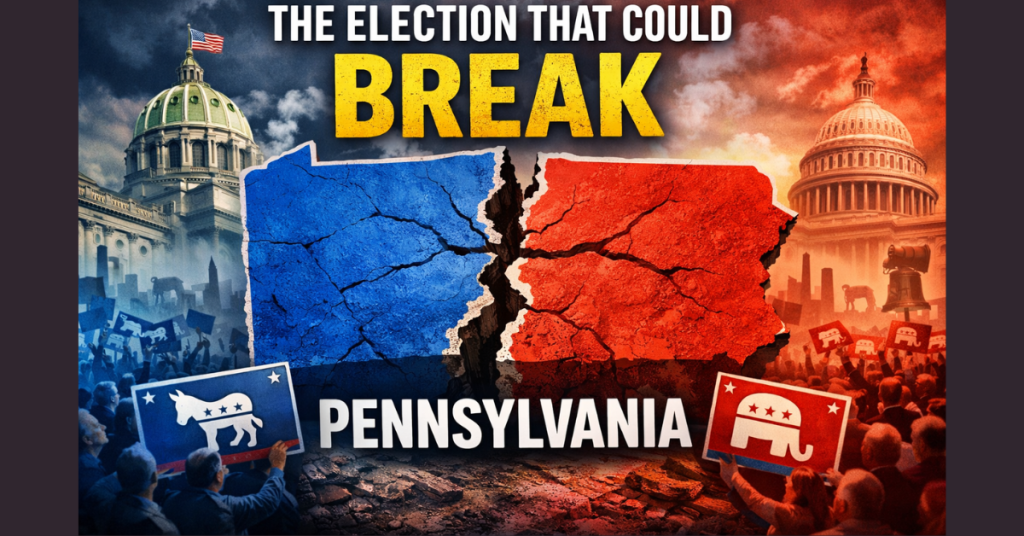
Pennsylvania is balanced on a knife’s edge. The state House of Representatives is controlled by Democrats by a single seat. The state Senate is controlled by Republicans by two. At the national level, Republicans hold a narrow majority in the U.S. House, one that would flip with the loss of just three seats. In Pennsylvania alone, three Republican members of Congress won their races in 2024 by less than two percentage points.
Add to that a Democratic governor seeking reelection while openly eyeing a presidential run in 2028, and a likely Republican challenger who is the highest vote-getter in Pennsylvania history, and the picture comes into focus. Pennsylvania is once again the keystone state—not just symbolically, but structurally.
Either party could emerge with a clean sweep. Or the state could remain what it has so often been: stubbornly purple, divided between institutions, regions, and voting blocs. Which outcome prevails will depend on fault lines that are already visible.
A Legislature on a Hair Trigger
Control of Pennsylvania’s legislature is technically settled—but only on paper.
Democrats hold the House by one seat, Republicans the Senate by two. In practical terms, that means a handful of districts will determine whether one party can govern coherently or whether divided government continues. Out of 229 legislative seats statewide, perhaps a dozen will command the attention of national donors, party committees, and outside interest groups.
Those seats will not be cheap. In 2024, a single state House race near Johnstown drew nearly $9 million in combined spending because it would decide chamber control. That level of spending is likely to be repeated, if not exceeded, in 2026.
The targets are predictable: Republican seats in areas trending blue, Democratic seats in areas trending red, and districts that continue to oscillate between the two. Most Pennsylvanians will be spared the deluge of ads and door-knockers. A few communities will not.
The Governor’s Race Looms Large
Hovering above every other contest is the race for governor.
Josh Shapiro enters the cycle as a strong incumbent. He has never lost an election, built his career by investing early in suburban Democratic realignment, and remains one of the most prolific fundraisers in American politics. His approval ratings are solid, though critics note they rest more on image than on a signature policy legacy.
That may not matter. In an era where perception often outweighs governance, Shapiro’s strengths align neatly with the moment. He enjoys campaigning—perhaps more than governing—and has shown little interest in downplaying his national ambitions. Whether Democratic voters want a 2028 presidential contender or not, Shapiro appears intent on becoming one.
His likely Republican opponent, State Treasurer Stacy Garrity, would represent his most formidable challenge yet. Garrity brings two credentials Shapiro does not: private-sector experience and military service, including deployments in the Middle East. That profile mirrors a broader trend across both parties, as veterans increasingly emerge as preferred candidates in swing races.
The contrast between the two candidates will be sharp, and personal. Garrity is expected to raise questions about a long-simmering scandal involving a former Shapiro cabinet member and top aide dating back to his time as Attorney General. Shapiro has insisted he had no knowledge of the misconduct or missing emails connected to the case. Until recently, the story received limited attention outside Pennsylvania political media. A recent national profile has pushed it into wider view.
How Shapiro responds—and how voters receive that response—remains an open question.
Registration Is Shifting, But Turnout Still Rules
Voter registration trends offer both encouragement and caution to Republicans.
A generation ago, Democrats held a registration advantage of roughly one million voters statewide. Today, that gap has narrowed to around 100,000—and closer to half that among active voters. Republicans have steadily gained ground, while the fastest-growing segment of the electorate consists of independents and no-party voters.
And yet, Republicans continue to lose statewide races, often by comfortable margins.
The reason is simple and frustrating: registration does not equal turnout. Republicans have won Pennsylvania races when Democrats held far larger registration advantages than they do today. But Democrats maintain a structural edge in mobilization, especially in high-salience elections.
Nowhere is that clearer than in voting method trends.
The Mail-In Pendulum
When Pennsylvania introduced no-excuse mail-in voting, Democrats dominated it. In 2020, the ratio of Democratic to Republican mail ballots was nearly five to one. By 2024, Republicans had narrowed that margin to under 2.5 to one, a shift that contributed to a statewide GOP sweep that year. On Election Day itself, Republicans outperformed Democrats by more than 700,000 votes.
Then came the reversal.
In the following cycle, Democrats surged late with mail-in ballots, pushing their advantage back above three to one. For the first time in the modern mail-in era, Democrats also outperformed Republicans on Election Day. Overall Democratic turnout exceeded Republican turnout by nine percent.
The lesson is uncomfortable for both parties. Democrats remain highly motivated, particularly when national stakes or opposition to Donald Trump are present. Republicans, meanwhile, continue to wrestle with a structural problem: a sizable portion of their electorate shows up only when Trump himself is on the ballot.
Whether the GOP can convert Trump-only voters into consistent midterm participants may be the single most important variable in 2026.
Small Margins, Big Consequences
Pennsylvania’s importance extends well beyond its borders. With the U.S. House majority resting on a handful of seats, even modest shifts in turnout or messaging could reshape national power. The same is true at the state level, where legislative control will determine everything from redistricting influence to budget priorities.
And yet, as intense as the battle will be for operatives and donors, most Pennsylvanians will experience it only indirectly. The war will be fought over a narrow strip of political terrain, while the rest of the state watches from a distance.
That is both a relief and a warning. Time and again, Pennsylvania elections have been reshaped by forces no one anticipated at the outset: a pandemic, a cultural backlash, an economic shock, a defining national issue that reframes every local race.
Those wild cards are impossible to predict. But history suggests there will be one.