
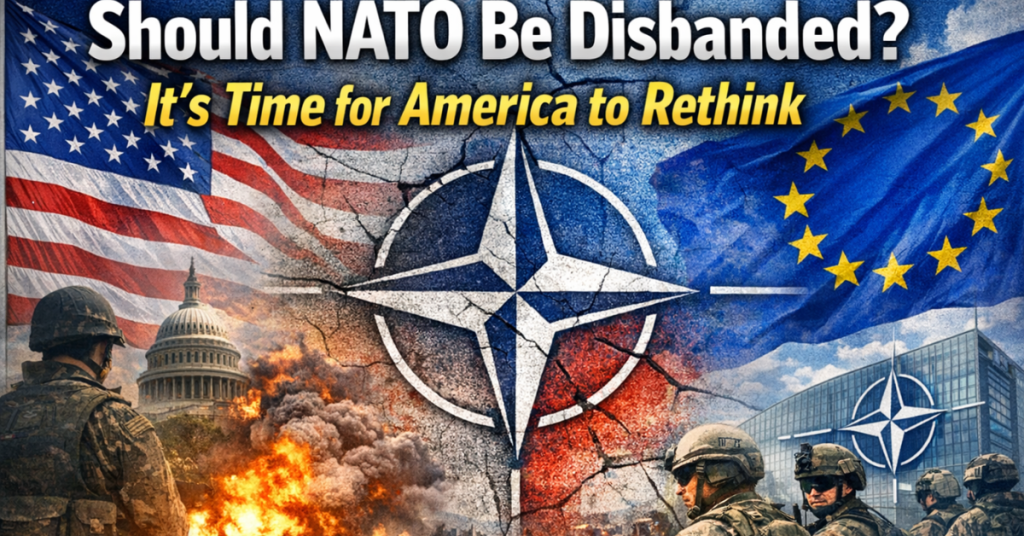
Should NATO be disbanded? It’s Time for America to Rethink – or Leave
The North Atlantic Treaty Organization, better known as NATO, was born out of necessity. In 1949, it served a clear and urgent purpose: to deter and, if necessary, defeat the expansion of the Soviet Union and its communist sphere of influence across Europe.
That world no longer exists. The global order is undergoing a significant realignment, reshaping alliances and national priorities
The Soviet Union collapsed in 1991. The Warsaw Pact dissolved soon after. Yet NATO not only endured—it expanded, evolved, and in many ways, lost the clarity of mission that once defined it. What remains today is an alliance increasingly out of sync with the geopolitical realities and national interests of the United States.
A Coalition Without a Common Cause
During the Cold War, NATO was unified by a single existential threat. Today, that unity is gone. NATO, like the USSR and the Warsaw pact, was a relic of the Cold War.
The alliance has grown from 12 founding members to over 30 nations, many with divergent priorities, domestic pressures, and strategic outlooks. What was once a tight, disciplined coalition has become a sprawling bloc struggling to maintain cohesion. It failed to adapt to a changing world order and events on the ground.
The United States still bears the overwhelming burden—militarily, financially, and strategically. For decades, Washington underwrote Europe’s defense while many European nations underinvested in their own. It wasn’t until pressure from President Donald Trump that NATO members began moving—reluctantly—toward the agreed benchmark of spending 2% of GDP on defense. Even now, the imbalance remains glaring.
Expansion and Escalation
One of the most contentious post-Cold War developments has been NATO’s steady expansion eastward.
While no formal, binding treaty prohibited expansion, many Western officials in the early 1990s suggested informally that NATO would not move “one inch eastward” beyond a reunified Germany. Whether misunderstood or ignored, the perception in Moscow was clear: the West had broken its word.
Since then, NATO has admitted multiple former Soviet-aligned states and openly discussed potential membership for countries like Ukraine and Georgia.
To Russia, this was not defensive—it was encroachment. With the specter of NATO membership for a former Soviet republic right on their border, and a weak US administration under President Biden, Putin saw this as an opportunity to invade.
This does not justify the actions of Vladimir Putin, whose invasion of Ukraine in 2022 was brutal and destructive. He is rightly viewed as an authoritarian leader who has and continues to sacrifice tens of thousands of his own citizens in a grinding war.
But acknowledging that reality does not mean ignoring the broader strategic missteps that helped create the conditions for conflict.
A Failure to Learn from History
After World War I, the victors imposed punitive measures on Germany that crippled its economy and humiliated its people—fertile ground for the rise of Adolf Hitler and the outbreak of World War II. History doesn’t repeat exactly—but it often rhymes.
Rather than integrating post-Soviet Russia into a stable European security framework, the West often treated it as a defeated adversary to be contained. NATO expansion reinforced that perception, feeding resentment and nationalist sentiment within Russia.
Again, this does not excuse aggression—but it does challenge the narrative that the current crisis emerged in a vacuum. Arrogant global elites in European capitals, alongside entrenched U.S. political figures – Cold War hawks within the intelligence establishment – still beat their chests, elevating Putin into a perpetual bogeyman while cynically weaponizing the label ‘Russian asset’ against anyone advocating a rational policy toward Russia, especially President Trump.
The Ukraine Reality Check
Russia’s earlier seizure of Crimea in 2014 and its ongoing war in Ukraine demonstrate both its willingness to act—and its limitations. Years into the conflict, Russia has failed to decisively conquer Ukraine, despite expectations of a rapid victory. This raises an obvious question:
If Russia cannot subdue Ukraine—a neighboring country with deep historical, cultural, and linguistic ties—how credible is the claim that it poses an imminent threat to the entirety of Europe? This is not to dismiss the fears of Eastern European nations, but to question whether NATO’s current scale and posture are proportionate to the threat.
Diverging Interests
Perhaps the most significant issue is not military—it’s political.
Recent tensions between the United States and its NATO allies underscore just how strained the alliance has become. In early 2026, European nations—including Denmark, France, and Germany—quietly deployed forces to Greenland amid fears sparked by President Donald Trump’s rhetoric about acquiring the territory, a move widely seen as a symbolic deterrent to a fellow NATO member rather than any external threat.
At the same time, major European powers—including the UK and Germany—refused U.S. requests to help secure the Strait of Hormuz during the Iran conflict, insisting “this is not our war” and favoring diplomacy over military involvement. Trump, in turn, blasted NATO allies as “cowards” and a “paper tiger” highlighting long-standing frustrations over defense spending, reliance on Russian energy—particularly by Germany—and what he views as chronic imbalance in burden-sharing.
Taken together, these episodes reflect a growing reality: when the United States calls, its NATO partners increasingly hesitate—raising a fundamental question about whether the alliance still functions as a true two-way security pact.
The United States and Europe are no longer aligned as they once were. On issues ranging from mass immigration and energy policy to global governance and military intervention, the gap has widened.
European nations have, at times, pursued policies that directly contradict U.S. interests—while still relying on American protection.
The contradiction is stark: some NATO members continue to engage economically with Russia, even as they call for stronger military action against it and support for Ukraine. Others decline to support U.S.-led operations abroad while expecting full American commitment under NATO’s Article 5. An alliance cannot function indefinitely as a one-way street. As the saying goes, with friends like these……
(It has been reported that some countries, such as the UK, are considering some form of assistance, if only due to pressure from the United States, following public rebuke from its president.)
The Burden of Article 5
At the heart of NATO is Article 5—the principle that an attack on one member is an attack on all. In theory, it’s a powerful deterrent. In practice, it’s a massive liability.
It obligates the United States to potentially enter war on behalf of nations whose policies, priorities, or actions it does not control. It also creates dangerous gray areas—particularly when dealing with complex regional conflicts or unpredictable actors within the alliance itself.
In November 2022, NATO faced a tense moment when a missile landed in Poland, immediately raising fears it could trigger Article 5 and a direct conflict with Russia. For hours, leaders debated the implications of what was initially treated as a possible Russian strike on NATO territory. It was later confirmed the missile was actually a stray Ukrainian air-defense projectile.
What’s striking is how quickly escalation entered the conversation—how casually the prospect of a broader, even nuclear, conflict was weighed as if it were routine.
Furthermore, consider Turkey, a longtime NATO member whose geopolitical trajectory has raised serious questions. Its tensions with other allies—and its posture toward partners like Israel—highlight the risks of maintaining a rigid collective defense structure in an increasingly fluid world.
A Changing Global Order
The world is no longer defined by a simple East-versus-West calculus.
Today’s challenges are multipolar: rising powers, regional conflicts, economic competition, cyber warfare, and ideological fragmentation. The strategic focus of the United States is increasingly shifting toward Asia and the challenge posed by China—a theater where NATO offers limited utility.
Meanwhile, Europe faces its own internal pressures and external threats that may be better addressed through regional solutions rather than reliance on a U.S.-led alliance.
Time for a New Approach
None of this means abandoning alliances altogether. But it does mean recognizing when an institution has outlived its original purpose.
NATO, in its current form, is a relic of a bygone era—overextended, misaligned, and increasingly counterproductive. It has become, in many ways, a bureaucratic and strategic inertia machine: too large to adapt, too entrenched to reform meaningfully.
The United States should consider a phased withdrawal or a fundamental restructuring—replacing NATO with more flexible, interest-based coalitions that reflect today’s realities, not yesterday’s fears. Alliances should serve national interests—not the other way around.
If NATO can no longer do that, then it may be time to disband and let it go.
Subscribe to DailyClout so you never miss an update!