

• My Account
  • Communities
  • BillCam
  • About Us
  • Shop
0
DailyClout

Help fund independent journalism.

  • Sign In
  • Home
  • Opinion
    • Outspoken
    • The Drew Allen Show on DailyClout
    • Heart & Mind
    • Investigate Everything
    • Emerald & Naomi
    • Generation Rogue
    • The Liberty Lobbyist
    • The Shannon Joy Show on DailyClout
    • Man in America on DailyClout
    • The Sarah Westall Show on DailyClout
  • Submissions
  • Events
  • Our Story
  • Shop
  • Become a Member!
  • Donate

DailyClout Latest News

SECRET TEST? U.S. Says China Went Nuclear in 2020
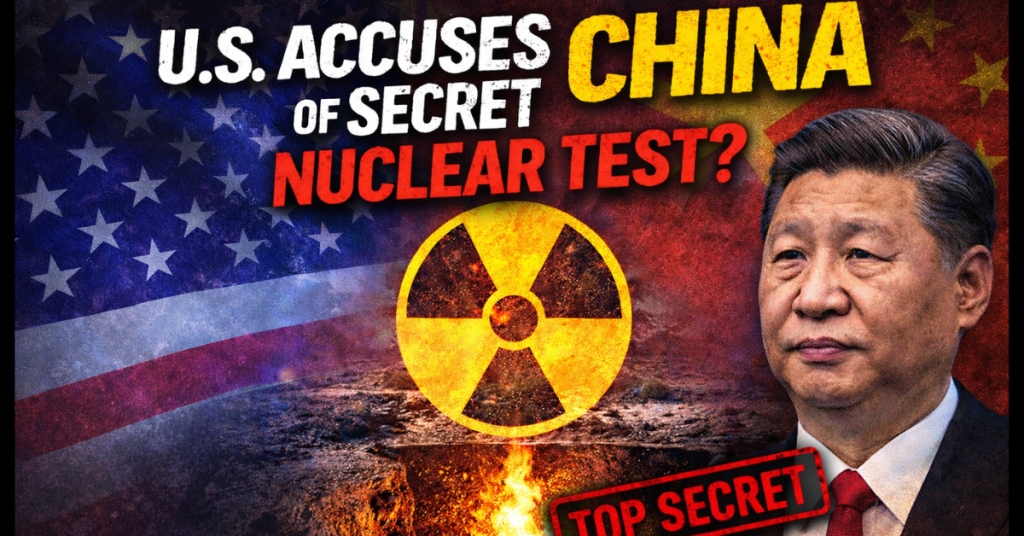
February 18, 2026 • by DailyCloutIn a startling escalation of great-power tensions, the United States government has publicly released fresh intelligence advocating its long-standing allegation that the People’s Republic of China secretly conducted an underground nuclear weapons test in June 2020 — a claim Beijing vehemently denies and independent experts say remains unproven. According to Assistant Secretary of State for Arms Control and Nonproliferation Christopher Yeaw, seismic data from a remote monitoring station in Kazakhstan detected a magnitude-2.75 seismic event on June 22, 2020, with an epicenter roughly 450 miles from Lop Nur, China’s principal nuclear test site. Yeaw told an audience at the Hudson Institute in Washington that the characteristics of the event are “very little possibility … other than an explosion, a singular explosion,” and that its signature was inconsistent with natural earthquakes or routine mining blasts. The seismic record is at the core of the controversy, but it is far from conclusive. The Comprehensive Nuclear-Test-Ban Treaty Organization (CTBTO), which oversees a global seismic monitoring network, confirmed the detection of two small seismic signals separated by about 12 seconds on that date, but stated that the data were “too weak to assess the cause of these events with confidence.” Its monitoring apparatus is calibrated to identify underground nuclear explosions with yields of roughly 500 tons of TNT or more — far above the strength of the 2020 signals. Independent seismic analysts also warn that seismic readings alone cannot definitively distinguish a clandestine underground nuclear detonation from other types of small seismic disturbances. Ben Dando, head of seismology and verification at Norway’s NORSAR monitoring organization, told NPR that the weak signal, recorded at only one station, “could be interpreted in multiple ways,” and that “we can’t really confirm or deny whether a nuclear test took place at this point.” China’s denial and global reactions China has forcefully rejected the U.S. allegations. Beijing complains that Washington is engaging in political manipulation to justify its own strategic posture. In a press conference, Foreign Ministry spokesperson Lin Jian called the accusations “completely groundless.” Chinese embassy representatives have accused the U.S. of pursuing nuclear hegemony while neglecting its own commitments under international treaties, demanding restraint and transparency. The Kremlin has also publicly weighed in, stating that neither China nor Russia has carried out secret nuclear tests — an apparent counterpoint to the U.S. claim and a sign of broader geopolitical alignment on the issue. Kremlin spokesman Dmitry Peskov said Moscow does not believe either country has initiated clandestine nuclear detonations. Why 2020 matters — and why evidence is disputed If true, the alleged June 2020 test would mark a violation of the global norm against nuclear explosive detonations — and a major shift in how nuclear compliance is monitored. Both China and the U.S. have signed the Comprehensive Nuclear-Test-Ban Treaty (CTBT), which bans all nuclear explosions, though neither has ratified it and the treaty has not formally entered into force. China’s last official nuclear test occurred in 1996, and the U.S. ceased explosive testing in 1992. U.S. officials suggest China might have used seismically “decoupling” methods — detonating a device inside a large underground chamber — to reduce the shockwave’s detectable amplitude and obscure its yield. Thomas DiNanno, Under Secretary of State for Arms Control and International Security, has asserted that China’s activities went beyond rule-bound subcritical experiments and included “yield-producing” tests that caused self-sustained nuclear chain reactions underground. Experts caution that such decoupling techniques make verification exceedingly difficult. Seismic signals from small, contained explosions can resemble benign industrial blasts or natural micro-earthquakes, and the CTBTO’s seismic sensors are not calibrated to definitively identify very low-yield tests. This makes independent verification a persistent challenge — one that global monitoring bodies have struggled with for decades. The broader context: arsenal expansion and treaty erosion The dispute arises amid a period of deteriorating nuclear arms control frameworks. The New START treaty — the last U.S.–Russia bilateral arms-limitation agreement — expired in early February 2026, and efforts to negotiate a replacement that includes China have stalled. The Pentagon estimates that China’s arsenal has grown from roughly 200 warheads in 2019 to more than 600 today, with projections of exceeding 1,000 by the end of this decade — a rapid buildup that has intensified strategic anxiety in Washington. China’s Lop Nur site has also shown signs of increased activity and expansion in recent years, including new infrastructure, excavation, and potential containment shafts that analysts say could facilitate underground testing. Satellite imagery reviewed over multiple years indicates a significant transformation of the once-modest complex into a more extensive facility potentially capable of supporting advanced weapons work. U.S. intelligence and political leaders are pushing for China’s inclusion in future arms control negotiations alongside Russia and the United States. They argue that failing to address suspected clandestine testing undermines the credibility of global non-proliferation norms and may require the U.S. to reconsider its own moratorium on explosive nuclear testing. Critics of renewed U.S. testing warn that doing so could usher in a new era of nuclear competition, eroding decades of restraint. What’s next: verification, diplomacy, and risk The evidence for China’s alleged 2020 nuclear test remains contested. Seismic data, even when combined with geopolitical analysis, falls short of a definitive conclusion — and global monitoring bodies explicitly caution against drawing firm judgments from limited observations. As the great-power rivalry intensifies, the debate over nuclear testing, treaty compliance, and verification will likely shape diplomatic and security discourse for years to come. Sources: Reuters: US reveals new details of alleged Chinese nuclear test — https://www.reuters.com/world/china/us-reveals-new-details-alleged-chinese-nuclear-test-2026-02-17/ NPR: U.S. releases new details on alleged secret Chinese nuclear test — https://www.opb.org/article/2026/02/17/u-s-shares-new-details-on-alleged-chinese-nuclear-test/ ANI via Big News Network: After China refutes it, US releases new details — https://www.bignewsnetwork.com/news/278874725/after-china-refutes-it-us-releases-new-details-of-alleged-nuclear-testing-in-2020 Independent analysis: US Accuses China Of Secret Nuclear Test In 2020 — evrimagaci.org Wikipedia: Nuclear weapons of China / Lop Nur — https://en.wikipedia.org/wiki/Nuclear_weapons_of_China

In a startling escalation of great-power tensions, the United States government has publicly released fresh intelligence advocating its long-standing allegation that the People’s Republic of China secretly conducted an underground nuclear weapons test in June 2020 — a claim Beijing vehemently denies and independent experts say remains unproven.

According to Assistant Secretary of State for Arms Control and Nonproliferation Christopher Yeaw, seismic data from a remote monitoring station in Kazakhstan detected a magnitude-2.75 seismic event on June 22, 2020, with an epicenter roughly 450 miles from Lop Nur, China’s principal nuclear test site. Yeaw told an audience at the Hudson Institute in Washington that the characteristics of the event are “very little possibility … other than an explosion, a singular explosion,” and that its signature was inconsistent with natural earthquakes or routine mining blasts.

The seismic record is at the core of the controversy, but it is far from conclusive. The Comprehensive Nuclear-Test-Ban Treaty Organization (CTBTO), which oversees a global seismic monitoring network, confirmed the detection of two small seismic signals separated by about 12 seconds on that date, but stated that the data were “too weak to assess the cause of these events with confidence.” Its monitoring apparatus is calibrated to identify underground nuclear explosions with yields of roughly 500 tons of TNT or more — far above the strength of the 2020 signals.

Independent seismic analysts also warn that seismic readings alone cannot definitively distinguish a clandestine underground nuclear detonation from other types of small seismic disturbances. Ben Dando, head of seismology and verification at Norway’s NORSAR monitoring organization, told NPR that the weak signal, recorded at only one station, “could be interpreted in multiple ways,” and that “we can’t really confirm or deny whether a nuclear test took place at this point.”

China’s denial and global reactions

China has forcefully rejected the U.S. allegations. Beijing complains that Washington is engaging in political manipulation to justify its own strategic posture. In a press conference, Foreign Ministry spokesperson Lin Jian called the accusations “completely groundless.” Chinese embassy representatives have accused the U.S. of pursuing nuclear hegemony while neglecting its own commitments under international treaties, demanding restraint and transparency.

The Kremlin has also publicly weighed in, stating that neither China nor Russia has carried out secret nuclear tests — an apparent counterpoint to the U.S. claim and a sign of broader geopolitical alignment on the issue. Kremlin spokesman Dmitry Peskov said Moscow does not believe either country has initiated clandestine nuclear detonations.

Why 2020 matters — and why evidence is disputed

If true, the alleged June 2020 test would mark a violation of the global norm against nuclear explosive detonations — and a major shift in how nuclear compliance is monitored. Both China and the U.S. have signed the Comprehensive Nuclear-Test-Ban Treaty (CTBT), which bans all nuclear explosions, though neither has ratified it and the treaty has not formally entered into force. China’s last official nuclear test occurred in 1996, and the U.S. ceased explosive testing in 1992.

U.S. officials suggest China might have used seismically “decoupling” methods — detonating a device inside a large underground chamber — to reduce the shockwave’s detectable amplitude and obscure its yield. Thomas DiNanno, Under Secretary of State for Arms Control and International Security, has asserted that China’s activities went beyond rule-bound subcritical experiments and included “yield-producing” tests that caused self-sustained nuclear chain reactions underground.

Experts caution that such decoupling techniques make verification exceedingly difficult. Seismic signals from small, contained explosions can resemble benign industrial blasts or natural micro-earthquakes, and the CTBTO’s seismic sensors are not calibrated to definitively identify very low-yield tests. This makes independent verification a persistent challenge — one that global monitoring bodies have struggled with for decades.

The broader context: arsenal expansion and treaty erosion

The dispute arises amid a period of deteriorating nuclear arms control frameworks. The New START treaty — the last U.S.–Russia bilateral arms-limitation agreement — expired in early February 2026, and efforts to negotiate a replacement that includes China have stalled. The Pentagon estimates that China’s arsenal has grown from roughly 200 warheads in 2019 to more than 600 today, with projections of exceeding 1,000 by the end of this decade — a rapid buildup that has intensified strategic anxiety in Washington.

China’s Lop Nur site has also shown signs of increased activity and expansion in recent years, including new infrastructure, excavation, and potential containment shafts that analysts say could facilitate underground testing. Satellite imagery reviewed over multiple years indicates a significant transformation of the once-modest complex into a more extensive facility potentially capable of supporting advanced weapons work.

U.S. intelligence and political leaders are pushing for China’s inclusion in future arms control negotiations alongside Russia and the United States. They argue that failing to address suspected clandestine testing undermines the credibility of global non-proliferation norms and may require the U.S. to reconsider its own moratorium on explosive nuclear testing. Critics of renewed U.S. testing warn that doing so could usher in a new era of nuclear competition, eroding decades of restraint.

What’s next: verification, diplomacy, and risk

The evidence for China’s alleged 2020 nuclear test remains contested. Seismic data, even when combined with geopolitical analysis, falls short of a definitive conclusion — and global monitoring bodies explicitly caution against drawing firm judgments from limited observations. As the great-power rivalry intensifies, the debate over nuclear testing, treaty compliance, and verification will likely shape diplomatic and security discourse for years to come.

Sources:

  • Reuters: US reveals new details of alleged Chinese nuclear test — https://www.reuters.com/world/china/us-reveals-new-details-alleged-chinese-nuclear-test-2026-02-17/

  • NPR: U.S. releases new details on alleged secret Chinese nuclear test — https://www.opb.org/article/2026/02/17/u-s-shares-new-details-on-alleged-chinese-nuclear-test/

  • ANI via Big News Network: After China refutes it, US releases new details — https://www.bignewsnetwork.com/news/278874725/after-china-refutes-it-us-releases-new-details-of-alleged-nuclear-testing-in-2020

  • Independent analysis: US Accuses China Of Secret Nuclear Test In 2020 — evrimagaci.org

  • Wikipedia: Nuclear weapons of China / Lop Nur — https://en.wikipedia.org/wiki/Nuclear_weapons_of_China

Spread the Word

Subscribe to DailyClout so you never miss an update!

Spread the Word

  • Please support DailyClout.io. Our research, our uncompromising, fact-based journalism, our compelling opinion pieces and videos, our BillCam platform that lets you pass good bills and stop bad bills, and our lawsuits to preserve medical freedom and secure accountability for wrongdoers, have all helped to keep America and countries around the world safer and freer. We need your donations to keep fighting for you and your loved ones. We cannot do any of it without you and your generous support. Please give what you can as a one-time donation, or please, if you can, send us a monthly recurring donation. Please put resources behind the values you support, and that we do so much to help you defend.

    Thank you.

  • $0.00

Previous StoryWatchdog group sues FBI for alleged Tom Homan “bribe tape” under FOIA

Leave your comment Cancel Reply

You must be logged in to post a comment.

This site uses Akismet to reduce spam. Learn how your comment data is processed.

Recent Posts

  • Copy of Copy of Copy of Copy of Copy of Copy of Copy of Copy of Copy of Copy of Copy of Copy of Copy of Copy of Copy of Copy of Copy of Copy of Copy of Copy of Copy of strategy (6)
    SECRET TEST? U.S. Says China Went Nuclear in 2020 Wednesday, 18, Feb
  • Copy of Copy of Copy of Copy of Copy of Copy of Copy of Copy of Copy of Copy of Copy of Copy of Copy of Copy of Copy of Copy of Copy of Copy of Copy of Copy of Copy of strategy (5)
    Watchdog group sues FBI for alleged Tom Homan “bribe tape” under FOIA Wednesday, 18, Feb
  • Copy of Copy of Copy of Copy of Copy of Copy of Copy of Copy of Copy of Copy of Copy of Copy of Copy of Copy of Copy of Copy of Copy of Copy of Copy of Copy of Copy of strategy (4)
    U.S. State Department Revokes Over 100,000 Visas in Broad Enforcement Campaign Tuesday, 17, Feb
  • Copy of Copy of Copy of Copy of Copy of Copy of Copy of Copy of Copy of Copy of Copy of Copy of Copy of Copy of Copy of Copy of Copy of Copy of Copy of Copy of Copy of strategy (3)
    IDF Escalates Strikes in Lebanon Amid Rising Tensions with Hezbollah and Iran Tuesday, 17, Feb
  • Copy of Copy of Copy of Copy of Copy of Copy of Copy of Copy of Copy of Copy of Copy of Copy of Copy of Copy of Copy of Copy of Copy of Copy of Copy of Copy of Copy of strategy (2)
    AAP Hit With RICO Lawsuit Alleging Decades-Long Vaccine Safety Fraud Tuesday, 17, Feb

Blog Archive

Subscribe to Our Free Newsletter

  • About Us
  • Advertise With DailyClout
  • Become a Member
  • BillCam
  • Communities
  • Contact Us
  • Donate
  • Submissions
  • Substack
  • Privacy Policy
View Cart Checkout Continue Shopping
Do you really want to logout of DailyClout?
Yes

You are now leaving DailyClout...