



Russiagate Just Hit the Supreme Court
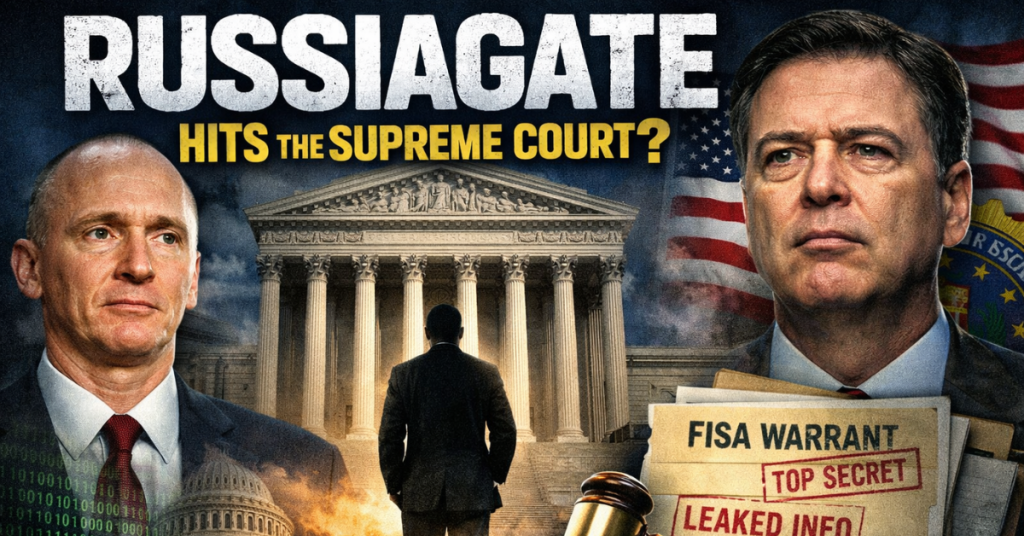
Nearly a decade after the Trump-Russia investigation dominated headlines, one of its most controversial figures is asking the nation’s highest court to decide whether federal officials can be held personally accountable for surveillance abuses.
And the justices are now quietly considering whether to take the case.
Dr. Carter Page, a former foreign-policy adviser to Donald Trump’s 2016 campaign, has petitioned the U.S. Supreme Court to revive his lawsuit against senior FBI and Justice Department officials — including former FBI Director James Comey — over the government’s use of secret surveillance warrants during the Crossfire Hurricane investigation.
If accepted, the case could reopen unresolved constitutional questions left behind by Russiagate.
The Case Behind the Petition
Page became a central figure in the FBI’s counterintelligence probe into alleged Russian election interference. Investigators obtained multiple surveillance warrants against him under the Foreign Intelligence Surveillance Act (FISA) — a powerful national-security tool designed for espionage cases.
Years later, a Justice Department Inspector General investigation concluded the FBI made significant errors and omissions in those warrant applications, including reliance on disputed intelligence and failures to disclose exculpatory information to the secret FISA court.
Although the government acknowledged serious procedural failures, no senior officials were held financially liable.
Page argues that outcome leaves Americans without meaningful recourse when surveillance powers are misused.
What Page Is Asking the Court to Decide
After lower federal courts dismissed his claims, Page filed a petition with the Supreme Court in December 2025 seeking review of the case Page v. Comey.
His legal team contends the ruling effectively grants federal officials immunity even when courts later determine surveillance applications contained false or misleading information.
At stake is a larger constitutional question:
Can citizens sue government officials for damages when national-security surveillance violates their rights?
Supporters of the petition say the answer will determine whether oversight of intelligence agencies has real consequences — or merely internal reprimands.
Why This Matters Beyond One Lawsuit
The controversy surrounding the Page warrants became one of the defining disputes of the Russiagate era. Congressional investigations, inspector general reports, and bipartisan reform proposals all pointed to weaknesses in the FISA process, particularly when investigations intersect with domestic politics.
Critics argue the system allows secret courts, classified evidence, and limited adversarial review — conditions that make errors difficult to challenge in real time.
Civil-liberties advocates across the political spectrum have warned that without accountability mechanisms, surveillance authorities granted for counterterrorism and espionage could expand beyond their original intent.
What Happens Next
The Supreme Court has not yet decided whether it will hear the case during its 2025–2026 term.
The federal government has requested additional time to respond, pushing the next procedural deadline into mid-March. After that, the justices will privately decide whether the dispute raises issues significant enough for full review.
If the Court accepts the case, it could become the most consequential judicial examination yet of the investigative tactics used during the Trump-Russia probe — and of the legal protections Americans have when intelligence agencies get it wrong.
For now, the question hangs unresolved:
Was Russiagate simply a flawed investigation — or a constitutional line crossed without consequence?
The Supreme Court may soon decide whether the country finally gets an answer.