



Offshore Wind Paused as Classified Reports Raise Red Flags
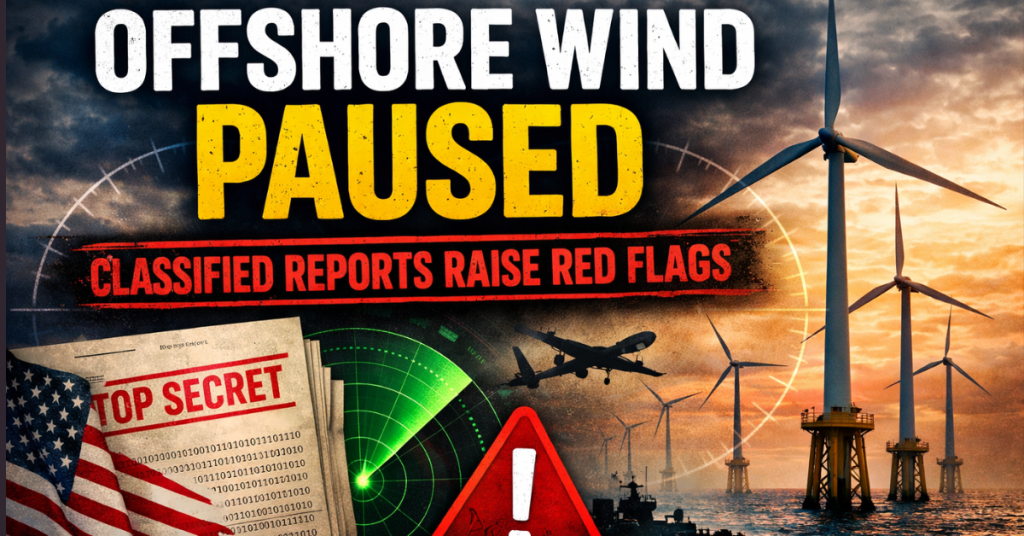
The Trump administration has ordered a pause on major offshore wind leases currently under construction, citing classified national security assessments that raise alarms about radar interference, coastal vulnerability, and emerging adversary technologies near U.S. population centers.
The decision, announced by the Department of the Interior, halts construction on at least five large offshore wind projects along the East Coast while federal agencies reassess their security implications.
Interior Secretary Doug Burgum said the move reflects a shift in priorities.
“Today’s action addresses emerging national security risks, including the rapid evolution of adversary technologies and the vulnerabilities created by large-scale offshore wind projects near our East Coast population centers,” Burgum said, adding that the administration “will always prioritize the security of the American people.”
Radar Interference and False Targets
Concerns about offshore wind are not new. For years, defense analysts, maritime authorities, and federal agencies have warned that massive turbine arrays can interfere with radar systems critical to national defense, shipping safety, and coastal surveillance.
Multiple federal reports have found that offshore wind turbines create radar clutter, producing false targets and reducing detection capability for real ones. This is especially problematic for identifying low-profile vessels, drones, or small craft operating near U.S. shores.
A 2024 Department of Energy analysis found that while radar thresholds can be adjusted to reduce turbine-related interference, doing so increases the risk of missing actual targets altogether—a tradeoff that defense officials consider unacceptable in high-risk maritime zones.
According to the Interior Department, the pause follows the completion of classified assessments by the Department of Defense and other agencies examining how offshore wind infrastructure could be exploited or degraded during conflict or hybrid warfare scenarios.
Projects Affected by the Pause
The suspension immediately impacts several high-profile developments, including Vineyard Wind, which drew national attention after a turbine blade failure in the summer of 2024 scattered debris across beaches in Nantucket, New York, and New England.
That incident significantly eroded public confidence in the offshore wind industry and amplified scrutiny of its environmental and safety record.
Other projects affected include:
-
Empire Wind off Long Island
-
Revolutionary Wind
-
Sunrise Wind
-
Coastal Virginia Offshore Wind
Empire Wind had already faced a temporary halt earlier this year before construction was briefly allowed to resume. Monday’s announcement reimposes a stop for the duration of the federal review.
Environmental and Maritime Safety Concerns Converge
Environmental groups opposed to offshore wind development say the security findings validate long-standing warnings.
ACK 4 Whales, a Nantucket-based nonprofit, has focused primarily on the impact of offshore wind on marine life, particularly the endangered North Atlantic right whale. But the group has also raised repeated alarms about radar interference and navigational hazards.
“Our organization has long cited the very real threat from radar interference caused by these enormous turbines,” said Val Oliver, president of ACK 4 Whales. “This poses dangers to fishermen, mariners, and now—clearly—to national security itself.”
A Broader Reassessment of Energy Policy
The pause reflects a broader reassessment of offshore wind as a strategic asset rather than a purely environmental or economic issue. While previous administrations framed offshore wind as a climate priority, defense planners have increasingly questioned whether placing vast, fixed infrastructure along the U.S. coastline creates vulnerabilities that outweigh projected energy benefits.
The Interior Department said the pause will allow federal agencies to work with leaseholders to determine whether identified risks can be mitigated—or whether some projects may ultimately prove incompatible with national security needs.
For now, construction remains frozen, signaling a rare moment where energy policy, environmental risk, and national defense concerns converge—and where security considerations appear to be taking precedence.