



MIT Announces New “Breakthrough” mRNA Delivery Particle
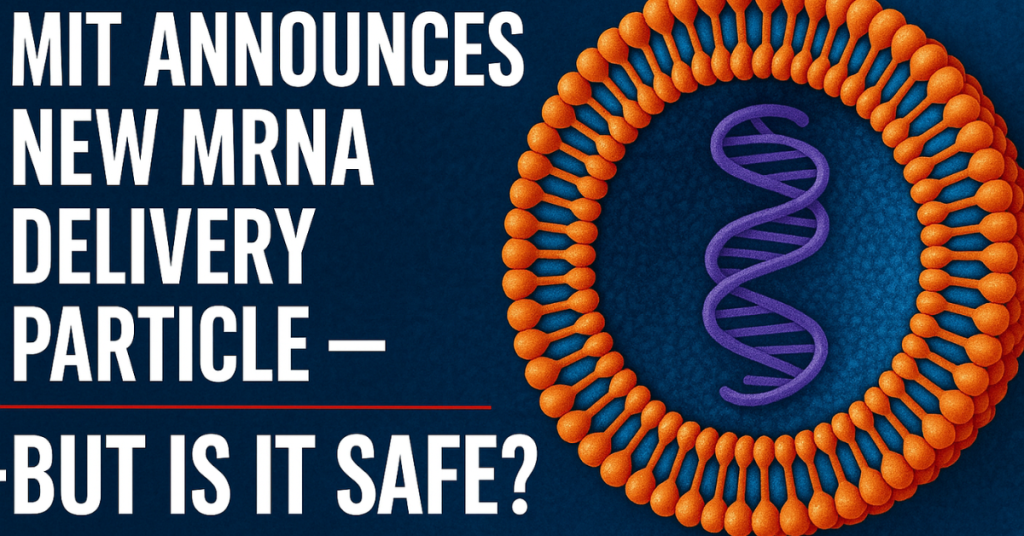
MIT researchers are calling it a breakthrough. A new lipid nanoparticle, they say, could make mRNA vaccines far more “efficient” — delivering the same immune response at just one percent of the current dose. The study, funded by Sanofi and the National Institutes of Health, was published this week in Nature Nanotechnology.
On paper, the idea sounds appealing: a cheaper, more potent vaccine. But for those paying attention to the last few years of mRNA experimentation, this announcement raises as many questions as it answers.
A Smaller Dose — or a More Concentrated Delivery?
The new delivery system, developed by MIT’s Koch Institute for Integrative Cancer Research, is designed to wrap fragile mRNA molecules in a new lipid nanoparticle called AMG1541. Researchers claim this structure helps mRNA survive longer in the body and penetrate cells more effectively — which means far less of it is needed to generate an immune response.
But is that necessarily safer?
“The goal is to make nanoparticles that can give a safe and effective vaccine response but at a much lower dose,” said Professor Daniel Anderson, the senior author on the study. The claim rests on animal testing alone. In mice, the new particles produced the same antibody levels as Moderna’s COVID-19 lipid formulation, but using just 1/100 of the dose.
The Industry’s Race to “Optimize” the Platform
Behind the scientific jargon is a clear commercial motive: reduce manufacturing costs and expand the reach of mRNA-based vaccines across a broader range of diseases — flu, COVID, HIV, and more. The team openly acknowledges that their project was bankrolled by pharmaceutical giant Sanofi, a company already heavily invested in mRNA development.
This “optimization” narrative has become familiar since the pandemic. Pharmaceutical and research institutions continue to refine the delivery systems, fine-tune lipid chemistry, and adjust dosages — but the underlying questions about long-term safety, immune imprinting, and biodistribution remain unanswered.
MIT’s study touts the new particle’s ability to “degrade faster” after delivering its cargo, supposedly reducing side effects. Yet such claims are speculative until human trials confirm them. What “faster degradation” means inside complex human tissue remains uncertain — and whether this technology might increase uptake in unintended organs, as seen with previous mRNA formulations, is not addressed.
An Uncomfortable Partnership Between Academia and Industry
Perhaps most concerning is how the study’s funding and affiliations reflect the growing merger between academia, government, and Big Pharma. MIT’s Koch Institute receives extensive government and corporate grants. The research was underwritten by the National Institutes of Health, Sanofi, and other institutional backers with deep financial stakes in vaccine technology.
That doesn’t invalidate the science — but it does shape its direction. When the primary incentive is efficiency, not transparency, we risk repeating the same cycle of innovation without adequate oversight that defined the last wave of “emergency use” medicine.
“Better” Is Not Always Safer
If these new nanoparticles do make it to market, they’ll likely be promoted as safer, cleaner, and more “biodegradable.” But this language should ring familiar — it’s the same reassurance that accompanied the first rollout of mRNA vaccines, before reports of inflammation, autoimmune reactions, and adverse events forced a reevaluation.
Once again, the public is being asked to trust that new nanotechnology is the solution to the problems created by the last round of nanotechnology.