



Meta Bets on Nuclear Power to Feed AI’s Explosive Energy Appetite
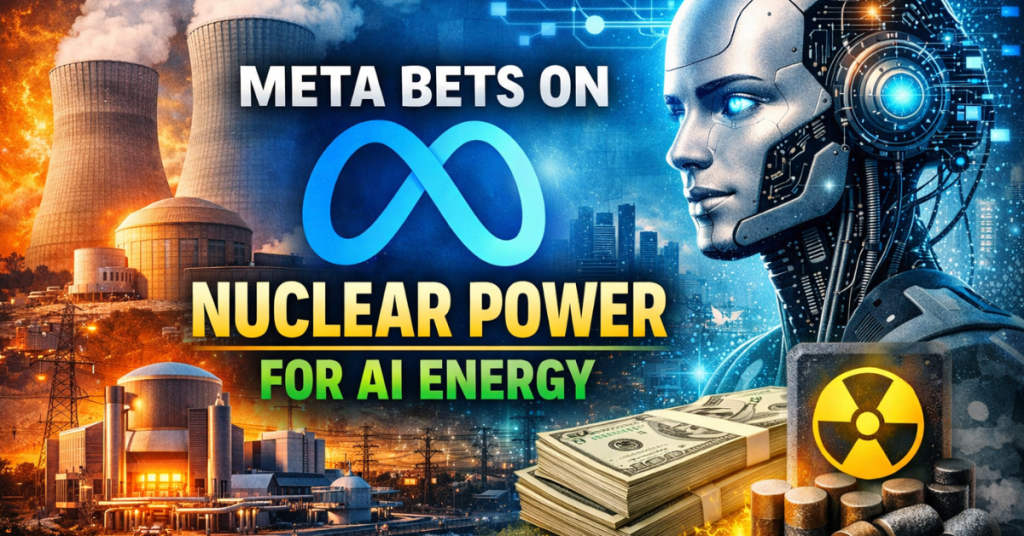
Meta is making one thing unmistakably clear: artificial intelligence isn’t just a software race anymore—it’s an energy race.
This week, the Facebook parent unveiled a sweeping nuclear-power strategy that would position it as an anchor customer for both new reactor development and expanded output from existing nuclear plants across the United States. The goal is straightforward but ambitious: secure city-scale, carbon-free electricity to power the next generation of AI data centers.
Why Meta Is Turning to Nuclear
Modern AI systems don’t just run on clever algorithms. They run on electricity—vast amounts of it. Training large models and operating hyperscale data centers requires continuous, reliable power that renewables alone often can’t guarantee without massive storage infrastructure.
That’s where nuclear comes in.
Unlike wind or solar, nuclear power offers:
-
24/7 baseload generation
-
Minimal land footprint
-
Near-zero carbon emissions
-
Long operational lifespans
For companies racing to deploy advanced AI, reliability is no longer optional—it’s existential.
The Players: Oklo, TerraPower, and Vistra
Meta’s plan spans both future reactors and existing plants.
On the development side, Meta is backing projects from Oklo and TerraPower, two companies focused on next-generation nuclear technology. TerraPower, founded by Bill Gates, has long argued that advanced reactors—particularly small modular reactors (SMRs)—are key to meeting future energy demand without ballooning emissions.
Meta says it hopes the first of these new reactors could come online between 2030 and 2032, a timeline that underscores just how far ahead Big Tech is planning its energy needs.
In parallel, Meta has struck an agreement with Vistra to purchase electricity from—and help expand—the output of three existing nuclear plants in Ohio and Pennsylvania. This move allows Meta to secure near-term power while waiting for next-generation reactors to be built.
A Shift in Corporate Energy Strategy
For years, major tech firms emphasized renewables as the centerpiece of their clean-energy strategies. Meta itself has poured billions into wind and solar contracts. But AI has changed the calculus.
The intermittent nature of renewables makes them difficult to scale for always-on workloads like AI training and inference. Nuclear, once politically radioactive, is suddenly being reframed as a pragmatic solution to a hard physical constraint: electricity must be available when the servers are running—not when the sun shines.
This isn’t just a Meta story. Across Silicon Valley, nuclear power is quietly reentering conversations that were previously dominated by batteries and offsets.
Economic and Political Implications
Meta’s move could have ripple effects well beyond its own data centers.
By acting as an anchor customer, Meta helps de-risk nuclear projects that might otherwise struggle to attract financing. That, in turn, could accelerate a broader revival of the U.S. nuclear industry—one that policymakers from both parties increasingly view as strategically important for energy security, grid stability, and emissions reduction.
At the same time, the timeline highlights a tension: AI demand is surging now, while nuclear solutions take years to deploy. Until new reactors come online, companies like Meta will continue juggling power constraints, public scrutiny, and regulatory hurdles.
The Bigger Picture
What Meta’s nuclear bet ultimately reveals is a sobering reality: the digital economy is no longer weightless. The future of AI depends not just on chips and code, but on steel, concrete, uranium—and decades-long infrastructure decisions.
In the race to build smarter machines, electricity may prove to be the most valuable resource of all.