



Israel Moves to Cripple Hezbollah as Regional War Expands
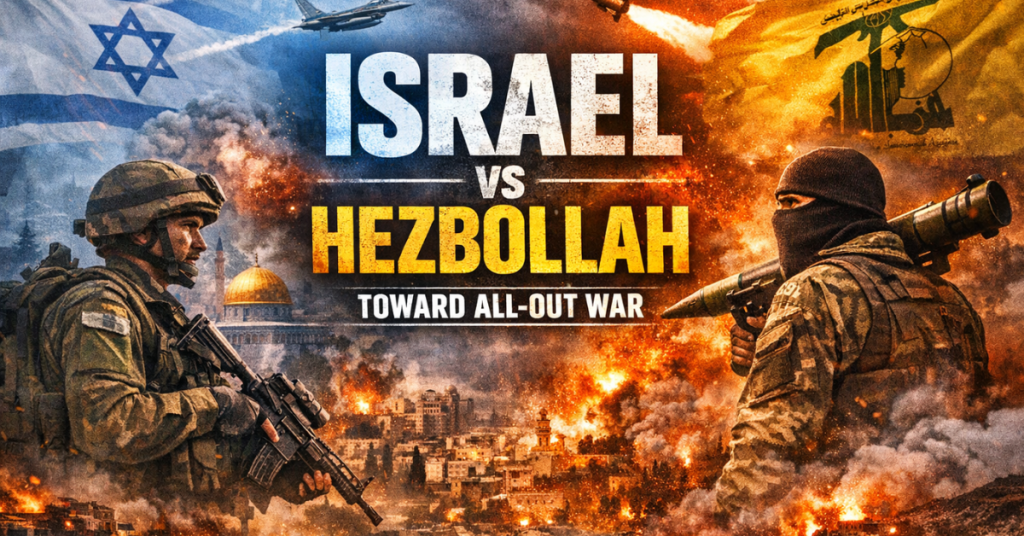
After more than two years of grinding conflict across multiple fronts, Israel appears to be escalating toward a decisive phase: the systematic degradation—if not outright dismantling—of Hezbollah’s military threat in Lebanon.
What began as a contained regional struggle has now hardened into something far more dangerous. The latest round of Hezbollah-Israel fighting did not arise in isolation, but rather as a direct consequence of the broader war that erupted on February 28 between the United States, Israel, and Iran. Within days, the conflict expanded.
On March 2, Hezbollah formally entered the war.
Framing its actions as both retaliation and solidarity, the Iranian-backed group launched rockets and drones into northern Israel following reports that Iran’s Supreme Leader, Ali Khamenei, had been killed. What initially appeared to be a symbolic gesture—an expected show of allegiance to Tehran—quickly escalated into sustained cross-border warfare.
That escalation has now drawn Lebanon fully into the conflict.
From Symbolic Support to Sustained War
Early assessments suggested Hezbollah’s involvement might remain limited—calibrated strikes designed to signal support for Iran without triggering a full-scale confrontation. That expectation has proven wrong.
Instead, Hezbollah has demonstrated an ability to maintain persistent operational tempo, launching coordinated rocket barrages, deploying drones, and testing Israeli air defenses in ways that suggest a deeper reservoir of capability than many analysts anticipated.
This is particularly significant given Hezbollah’s heavy losses in the 2024 conflict with Israel, which was widely believed to have severely degraded its infrastructure, leadership networks, and weapons stockpiles.
Yet the group has not collapsed.
Rather, it has adapted.
Hezbollah’s Resilience Raises Strategic Stakes
Israeli planners now face a more complicated reality. Despite prior setbacks, Hezbollah appears to retain:
- Functional command and control structures
- A diversified arsenal, including rockets, drones, and anti-armor systems
- The ability to coordinate sustained attacks across the border
This resilience has likely forced a shift in Israeli strategy—from containment to eradication.
Military analysts increasingly believe Israel is no longer aiming merely to deter Hezbollah, but to fundamentally dismantle its capacity to operate as a coherent fighting force.
That is a far more ambitious—and dangerous—objective.
The Risk of a Northern War
A full-scale campaign against Hezbollah would represent one of the most significant escalations in the region in decades.
Unlike previous limited exchanges, a broader offensive into Lebanon could trigger:
- Large-scale civilian displacement
- Direct Iranian intervention, either overtly or through proxy escalation
- Expanded involvement from other regional actors
Hezbollah is not Hamas. It is more heavily armed, more deeply embedded, and more strategically integrated into Iran’s regional network.
Any attempt to eliminate it would likely come at a high cost.
A War Within a War
What is unfolding now is not a separate conflict, but a secondary front in a larger war increasingly defined by great-power competition.
Iran’s alliance with Hezbollah represents one of its most effective tools for projecting power beyond its borders. Weakening that alliance is not just a tactical objective for Israel—it is a strategic imperative.
At the same time, the broader geopolitical context cannot be ignored. As tensions with Iran intensify, the conflict is increasingly intersecting with global rivalries, particularly involving China’s economic and strategic interests in the region.
In that sense, the fight against Hezbollah is not just about Lebanon.
It is about reshaping the balance of power across the Middle East.
What Comes Next
Israel now appears to be approaching a critical decision point.
Does it continue managing the threat through limited strikes and deterrence—or does it move decisively to eliminate Hezbollah as a military force?
The answer will determine not only the future of Lebanon, but the trajectory of the wider regional war.
Because if Hezbollah is truly targeted for destruction, the conflict will not remain contained.
It will expand.
And once it does, there may be no easy way to bring it back under control.