


How a CCP-Linked Financier Is Rewriting World War II
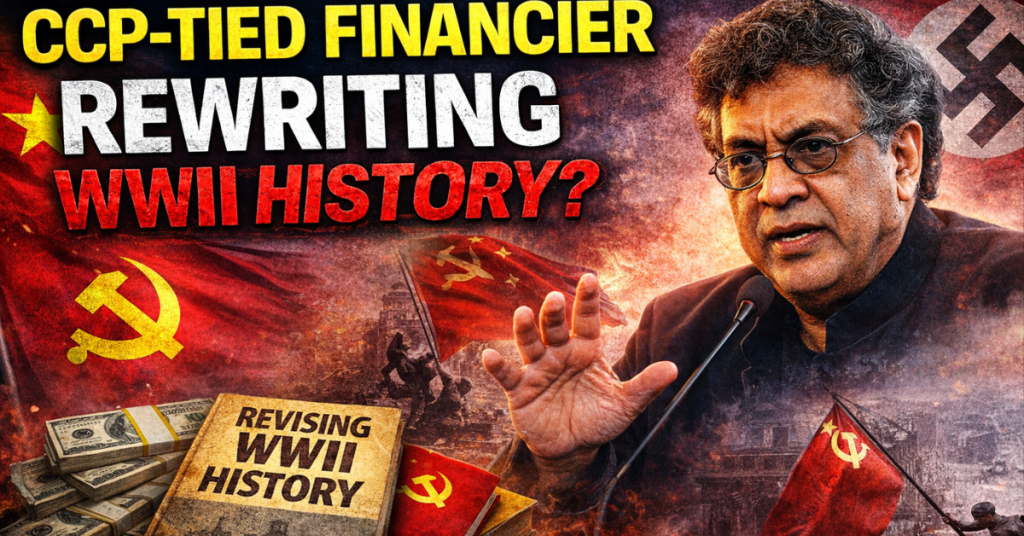
A sprawling activist network tied to a wealthy Marxist businessman is drawing renewed scrutiny after reports revealed efforts to reshape the historical narrative of World War II—aligning closely with messaging promoted by the Chinese Communist Party (CCP).
At the center of the controversy is Neville Roy Singham, a reclusive but influential figure whose funding network has supported a range of far-left organizations operating in the United States and abroad. According to multiple reports, Singham has collaborated with CCP-linked institutions while promoting a revisionist interpretation of WWII that challenges the traditional understanding of Allied victory.
Reframing the War
In a lengthy report unveiled at a CCP-backed forum in Shanghai, Singham argued that Western accounts of WWII are fundamentally misleading. He claimed that the defeat of fascism was not driven by American industrial power or British leadership, but by “socialist leadership and mass heroism” rooted in the Soviet Union and Communist China.
This framing goes further than simple reinterpretation. It directly challenges the legitimacy of the U.S.-led international order that emerged after WWII, which Singham described as a “lie” built on distorted history.
His stated goal is not merely academic. By reshaping how the war is understood, Singham argues that it becomes possible to dismantle the ideological foundation of Western global leadership and replace it with what he calls a new “multipolar” world order aligned with China’s strategic vision.
Controversial Claims and Historical Disputes
The report has sparked backlash from historians and analysts due to several controversial claims.
Among them is the assertion that the Soviet Union’s pact with Nazi Germany in 1939 was a necessary defensive move rather than a strategic collaboration. Historians widely dispute this characterization, noting that the Molotov–Ribbentrop Pact enabled the joint division of Eastern Europe and facilitated the outbreak of WWII.
Singham also drew comparisons between Winston Churchill and Adolf Hitler, arguing that both represented different expressions of the same underlying system. This equivalence has been rejected by mainstream scholarship, which points to Nazi Germany’s role in initiating the war and carrying out the Holocaust.
His report further claims that Communist forces in China played the dominant role in resisting Japanese aggression, a position contradicted by many historical accounts showing that Nationalist forces under Chiang Kai-shek bore the brunt of the fighting.
A Strategic Narrative Shift
Critics argue that these interpretations are not isolated academic positions but part of a broader strategic effort.
U.S. defense and intelligence assessments have long warned that China seeks to challenge American global influence across multiple domains—not only militarily and economically, but also ideologically.
By promoting a version of history that elevates socialist systems and diminishes Western contributions, such narratives can reshape global perceptions of legitimacy and power.
Singham himself has been explicit about this objective, stating that changing the story of WWII is essential to advancing a new international framework more favorable to China’s leadership.
The Funding Network
Singham’s influence extends beyond academic discourse.
Investigations have linked his financial network to activist organizations engaged in political advocacy, protest movements, and media campaigns. Some of these groups operate within the United States, raising questions among lawmakers about foreign influence and compliance with transparency laws.
Congressional Republicans have called for further investigation into the network’s activities, including potential violations of the Foreign Agents Registration Act (FARA).
Meanwhile, Singham has denied any formal ties to the Chinese government, stating that his views are independently held and not directed by any political authority.
Information Warfare in the Modern Era
The controversy highlights a growing concern among policymakers: that geopolitical competition is increasingly being fought through information and narrative control.
Rather than traditional propaganda alone, modern influence campaigns often operate through decentralized networks of academics, activists, and media platforms—blurring the line between independent scholarship and strategic messaging.
In this context, the debate over WWII history is not merely about the past. It is about shaping the ideological framework that will define the future global order.
Sources
https://justthenews.com
https://www.nytimes.com
https://www.thediplomat.com
https://www.taipeitimes.com
https://www.history.com
https://www.britannica.com
https://www.ushmm.org
https://www.heritage.org