



HHS Erases Levine’s Name From Official Portrait Amid Policy Reversal
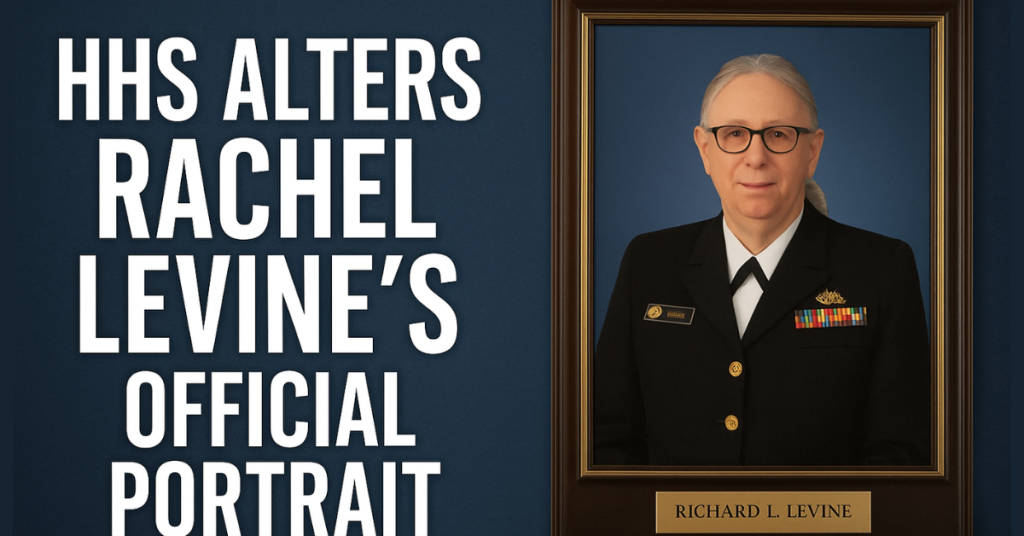
A quiet but symbolically charged change inside a federal building has reignited debate over gender identity, public health policy, and the politicization of government institutions.
On the seventh floor of the Hubert H. Humphrey Building in Washington, D.C., a hallway displays official portraits of past leaders of the U.S. Public Health Service Commissioned Corps, a uniformed service housed within the Department of Health and Human Services (HHS). Among those portraits is that of Adm. Rachel Levine, who served as assistant secretary for health during the Biden administration and oversaw the Public Health Corps as a four-star admiral.
Levine’s portrait, which has hung in the hallway since shortly after her Senate confirmation in 2021, was recently altered. According to photographs obtained by NPR and confirmation from HHS, the name displayed beneath the portrait has been changed to reflect Levine’s former name rather than her current legal name.
Levine was the first openly transgender person to be confirmed by the U.S. Senate for a federal office requiring confirmation. Her role placed her in charge of the Commissioned Corps of the U.S. Public Health Service, making the portrait both a personal and institutional symbol.
Dispute Over the Change
Adrian Shanker, who served as deputy assistant secretary for health policy under Levine and now acts as her spokesperson, said the alteration occurred during the recent federal shutdown. He characterized the decision as discriminatory.
“During the federal shutdown, the current leadership of the Office of the Assistant Secretary for Health changed Admiral Levine’s photo to remove her current legal name and use a prior name,” Shanker said. “This is an act of bigotry against her.”
Levine herself declined to engage in a public dispute over the issue, telling NPR that she considered it an honor to have served as assistant secretary for health and describing the alteration as “petty.”
HHS Response
HHS did not specify who ordered the change or the precise internal process behind it. However, spokesperson Andrew Nixon offered a statement explaining the department’s broader posture under the current administration.
“Our priority is ensuring that the information presented internally and externally by HHS reflects gold standard science,” Nixon wrote. “We remain committed to reversing harmful policies enacted by Levine and ensuring that biological reality guides our approach to public health.”
That response signals that the decision is being framed by department leadership not as a personal matter, but as part of a wider shift in policy direction following the change in administration.
The current assistant secretary for health, Adm. Brian Christine, a urologist from Alabama, was confirmed by the Senate in October. HHS has not indicated whether similar changes will be made to other portraits or displays within the building.
Internal Reaction
At least one HHS staff member, who requested anonymity due to fear of professional retaliation, described the alteration as “disrespectful” and said it reflects a broader effort to erase transgender individuals from public recognition.
Others inside the department, however, view the change as consistent with the administration’s stated emphasis on biological sex in federal health policy, particularly in areas such as medical research, public health data collection, and regulatory guidance.
Shanker described the action as unprecedented and urged current leadership to focus on public health challenges rather than symbolic disputes. He cited Levine’s work during her tenure on COVID-19 response, opioid addiction, HIV/AIDS, and rising syphilis rates.
Political Context
The portrait alteration comes amid a broader national shift in federal policy toward transgender issues following President Trump’s return to office. During the 2024 campaign, transgender policy was a central theme in Republican advertising, with some ads directly featuring Levine as a symbol of what critics described as ideological capture of public institutions.
Since taking office, the administration has moved to reverse or roll back a range of policies affecting transgender and intersex individuals across multiple agencies. These actions have included changes to military service rules, passport designation policies, and federal guidance on gender identity in education and health care.
President Trump has frequently framed transgender ideology as a threat to public safety and social stability, language that has drawn both strong support from conservatives and sharp criticism from civil rights groups.
Symbolism and Precedent
While the alteration of a portrait nameplate may seem minor in isolation, critics argue that it carries symbolic weight, particularly given Levine’s historical status as the first transgender official confirmed to a senior federal health role. Supporters of the change counter that government institutions should reflect current scientific and legal interpretations rather than personal identity claims.
There is no publicly documented precedent for renaming a former official’s portrait after they leave office, particularly when the name change involves a legally recognized identity. HHS has not clarified whether the decision reflects a new formal policy or an isolated action.
As the administration continues to reshape federal health policy, the incident underscores how cultural and scientific disputes increasingly intersect with bureaucratic practices. Whether viewed as corrective, disrespectful, or merely symbolic, the alteration of Levine’s portrait illustrates how even quiet changes inside government buildings can become flashpoints in America’s broader political and cultural debates.