



Georgia Judge Throws Out Trump Election Case in Stunning Reversal
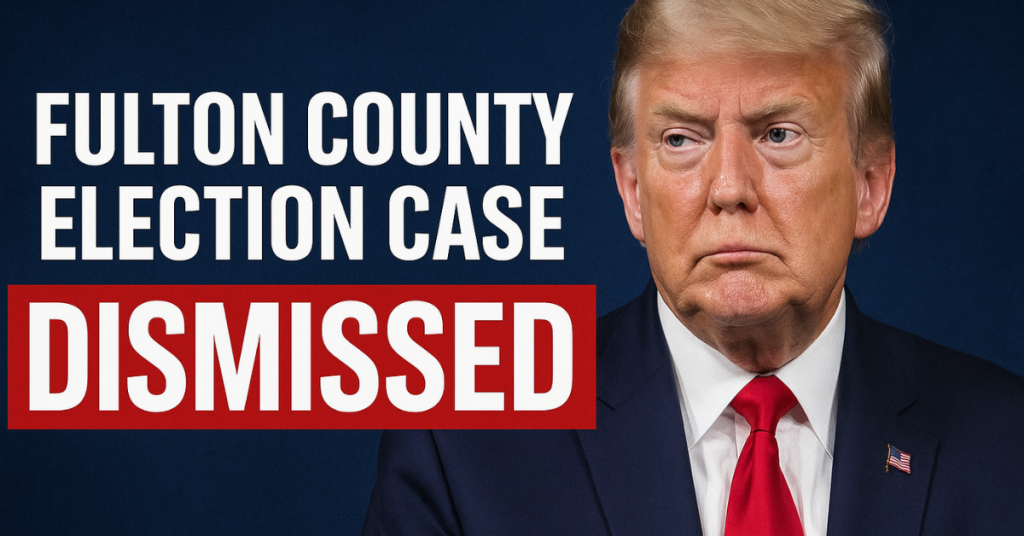
The Fulton County election-interference case against former President Donald Trump and several co-defendants has been formally dismissed, after the special prosecutor assigned to the case asked the court to drop it.
Pete Skandalakis, executive director of the Prosecuting Attorneys’ Council of Georgia, took over the case earlier this month after Fulton County District Attorney Fani Willis was disqualified. In his filing, Skandalakis wrote that continuing the prosecution would not serve the people of Georgia.
“In my professional judgment, the citizens of Georgia are not served by pursuing this case in full for another five to ten years,” he said.
Within minutes of his request, Judge Scott McAfee dismissed the case outright.
“This case is hereby dismissed in its entirety,” McAfee wrote.
Background of the Case
Trump and 18 others pleaded not guilty in August 2023 to a sweeping racketeering indictment alleging efforts to overturn Georgia’s 2020 election results. The indictment stemmed from Trump’s January 2, 2021 phone call urging Georgia Secretary of State Brad Raffensperger to “find” enough votes to win the state.
Prosecutors originally alleged that Trump and his allies pressured state officials, spread false claims of fraud, and harassed a Georgia election worker in an effort to remain in power.
Several defendants—including Sidney Powell, Kenneth Chesebro, Jenna Ellis, and Scott Hall—accepted plea deals in exchange for future testimony.
The case unraveled after DA Fani Willis was removed following allegations of an improper personal relationship with a prosecutor she had hired. The Prosecuting Attorneys’ Council was then tasked with appointing an independent prosecutor. After being unable to find anyone willing to take the case, Skandalakis accepted the assignment himself.
Reaction to the Dismissal
Trump attorney Steve Sadow celebrated the decision, calling it the end of “political persecution.”
“This case should never have been brought,” Sadow said. “A fair and impartial prosecutor has put an end to this lawfare.”
A spokesperson for Rudy Giuliani—who was also charged and later disbarred over his post-election efforts—praised the decision as a “complete repudiation” of partisan claims against him.
Why the Case Was Dropped
In a 22-page explanation, Skandalakis wrote that the allegations, even if troubling, did not amount to a viable criminal prosecution—particularly under Georgia’s RICO statute.
He noted several key problems:
• Practical impossibility of prosecuting a sitting president.
He wrote that there is “no realistic prospect” of compelling a sitting president to appear in a Georgia courtroom and that even an after-term trial would be logistically unworkable.
• Many alleged “overt acts” were not criminal.
He said actions like arranging calls, issuing statements, tweeting, or attending hearings were insufficient to sustain racketeering charges without stronger context.
• Severing Trump’s case from others would be “futile and unproductive.”
• The case belonged in federal court, not state court.
He argued the alleged conduct originated in Washington, D.C., and should have been handled federally.
• Claims against several defendants could not meet the burden of proof.
He said the electors lacked criminal intent and that allegations against figures like Mark Meadows and Jeffrey Clark fell short of “proof beyond a reasonable doubt.”
Another Election-Interference Case Ends
The dismissal closes out the second of two major election-interference cases Trump faced related to 2020. The federal case brought by Special Counsel Jack Smith was also dismissed after Trump’s reelection, due to Justice Department policy shielding sitting presidents from prosecution.
Skandalakis’ Final Word
He acknowledged his decision would be controversial, but said his responsibility was to the law—not politics.
“The role of a prosecutor is not to satisfy public opinion,” he wrote. “My assessment has been guided solely by the evidence, the law, and the principles of justice.”