



Federal Judges Are Above the Law: Why the Judiciary Needs Accountability
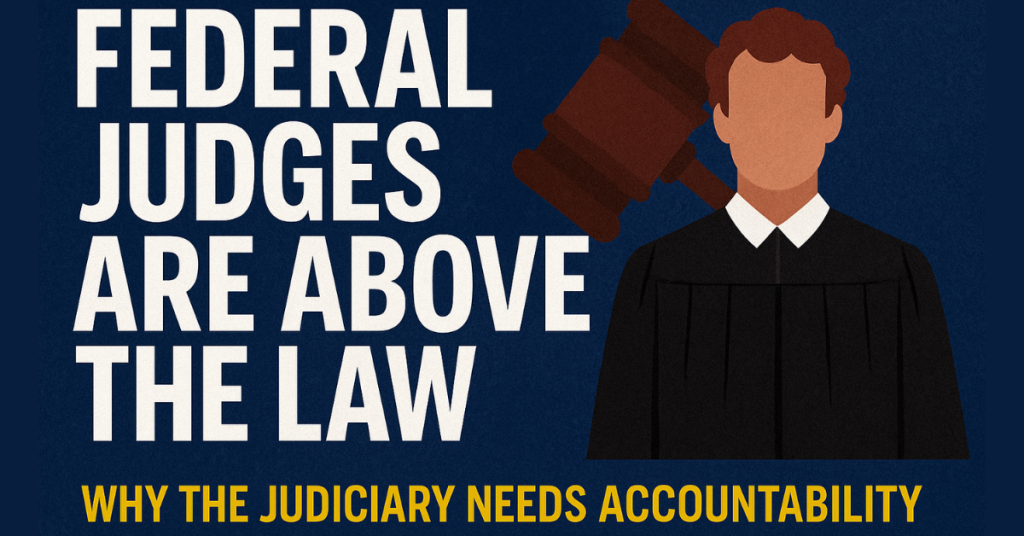
While judges often speak of democracy and fairness from the bench, behind chambers doors their conduct is ungoverned. Federal judges are exempt from all federal anti-discrimination laws, including Title VII of the Civil Rights Act of 1964. This legal loophole leaves not only 1,700 federal judges unaccountable, but also more than 30,000 judicial employees — clerks, staff, and federal public defenders — without workplace protections.
The implications are staggering. These are the very individuals who rule on matters of national importance and shape the rights of millions of Americans, yet they themselves operate outside the laws they interpret.
A Broken System of Judicial Immunity
Judicial clerkships are highly prestigious first jobs for law graduates. Clerks work side by side with judges on legal research, court decisions, and case preparation. But beneath the prestige lies a troubling reality:
-
Isolated, hierarchical workplaces that are ripe for abuse.
-
Enormous power imbalances between judges and clerks.
-
No legal protections against harassment, discrimination, or retaliation.
When misconduct occurs, clerks are trapped. Judges police themselves, meaning complaints are decided by the accused judge’s colleagues — a system akin to Congress “self-policing” its own members.
A Firsthand Account of Abuse
Many clerks discover this reality the hard way. After experiencing harassment, discrimination, and retaliation from a judge, one former law clerk discovered that she could not sue or seek redress because clerks are exempt from federal anti-discrimination laws. Filing a complaint led nowhere: the system is designed to protect judges, not their staff.
This pattern is common. Law schools often gloss over these risks, preferring to promote clerkships as prestigious opportunities while avoiding the collection of negative feedback about judges.
The Judiciary Accountability Act
In 2022, advocates testified in support of the Judiciary Accountability Act (JAA). This legislation would finally extend anti-discrimination, anti-harassment, and whistleblower protections to judicial employees — protections already granted to staff in the legislative and executive branches in 1995.
The JAA is the first serious effort to address judicial misconduct through legal reform. Without it, clerks and judicial staff remain uniquely vulnerable compared to nearly every other worker in the United States.
The Legal Accountability Project (LAP)
To confront this systemic abuse, the Legal Accountability Project (LAP) was launched. This nonprofit advocates for clerkship transparency and accountability. Its flagship initiative is the Clerkships Database, described as a “Glassdoor for Judges.”
-
Nearly 2,000 reviews of 1,200 federal and state judges.
-
Coverage across every state, every federal circuit, and most U.S. District Courts.
-
Anonymous review options to protect clerks from retaliation.
LAP’s data shows that nearly 30% of clerkship experiences are negative — almost double the judiciary’s official claim of 16%. In 2023 alone, at least 106 law clerks were mistreated, but only three filed formal complaints.
Why Transparency Matters
The Clerkships Database has already helped nearly 2,500 law students and recent graduates identify supportive judges — and avoid abusive ones. Judges themselves are beginning to adjust management styles, realizing that negative feedback can no longer be silenced.
LAP’s work proves that accountability through transparency is the most effective tool for reform. While Congress debates the Judiciary Accountability Act, LAP is already creating change by giving clerks a voice and shining a light on misconduct long hidden by judicial immunity.
The Path Forward
The American judiciary cannot remain the only branch of government where workplace protections do not apply. The Judiciary Accountability Act would level the playing field, provide whistleblower protections, and end the culture of silence that shields abusive judges.
Until then, organizations like the Legal Accountability Project are the frontline defenders of fairness and accountability in the courts. For democracy to function, judges must not only interpret the law — they must live under it.
DailyClout.IO will continue to follow this story. Follow Naomi Wolf on Outspoken for exclusive content.
Sources and further reading: