



Europe’s Silent Collapse: Mass Migration, Terror, and a Decade of Denial
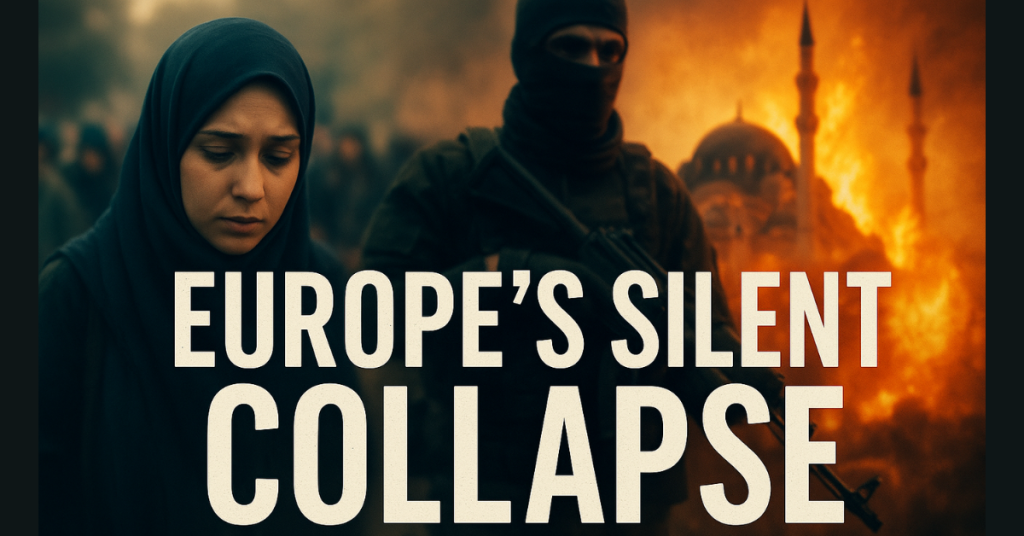
Western Europe is bent, suffering in a state of uneasy quiet as violence increasingly erupts from within. Numbed by years of stabbings, truck attacks, sexual assaults, and terror plots, both its leaders and much of its public have grown accustomed to a reality that would have been unthinkable just a generation ago. What was once regarded as an emergency is now treated as background noise.
Yet at the ten-year mark of the 2015 migrant crisis—and on the anniversaries of some of Europe’s most devastating Islamist terror attacks—an unexpected allied voice has spoken plainly about what many Europeans have been told not to say: mass migration has profound consequences for public safety, civil order, and human rights.
That voice came from the U.S. Department of State.
A Break From Decades of Denial
In a striking departure from decades of Western orthodoxy, the State Department recently instructed U.S. embassies abroad to begin reporting on the public-safety and human-rights impacts of mass migration. The guidance states plainly that “mass migration is a human rights concern,” noting that Western nations have endured crime waves, terror attacks, sexual assaults, and the displacement of communities as a result of open-border policies.
More pointedly, it warned that mass migration poses an existential threat to Western civilization and undermines the stability of key American allies.
This acknowledgment marks a historic shift. For years, European leaders insisted that such concerns were exaggerated, immoral, or rooted in prejudice. Now, a major Western power is openly recognizing what millions of Europeans have experienced firsthand: policies sold as humanitarian have come with severe and lasting costs.
A Decade of Bloodshed Remembered
Those costs are difficult to ignore as Europe marks a grim series of anniversaries.
November 13, 2025, marked ten years since the Bataclan massacre and the coordinated ISIS attacks that killed 130 people in Paris. Vienna recently reflected on the November 2, 2020, jihadist shooting that once again brought Islamist terror into the heart of a European capital. January marked a decade since the Charlie Hebdo attacks.
These were not isolated events. They were milestones in a sustained pattern of violence that emerged alongside Europe’s decision to open its borders at scale in 2015—and to largely refuse honest reckoning afterward.
“Europe Is Not the Same Place Anymore”
President Donald Trump has been unusually blunt in addressing this reality. In interviews, speeches, and in the 2025 National Security Strategy, he has argued that mass immigration is a central driver of Europe’s civilizational decline.
“Europe is not the same place anymore,” Trump said in a recent interview, describing immigration as the root cause of the decay facing many European nations. Speaking before the United Nations, he warned European leaders directly: “You’re destroying your countries. They’re being destroyed. Europe is in serious trouble.”
For years, such statements were dismissed as inflammatory. Yet the facts on the ground increasingly reinforce the concern.
Crime Statistics Tell the Story
Across Western Europe, foreign nationals are dramatically overrepresented in violent crime, particularly in countries that accepted large numbers of unvetted migrants.
In the United Kingdom, more than 104,000 foreign nationals were convicted of crimes between 2021 and 2023, including over 38,400 convictions for violent offenses, sexual assault, drug crimes, and theft—despite foreign nationals comprising just 9.3% of the population. In 2024 alone, foreign nationals accounted for roughly one-quarter of all sexual offense arrests.
Germany’s 2023 Police Crime Statistics show that 41% of suspects nationwide were non-German citizens. Violent crime by foreign nationals rose more than seven times faster than among German citizens year over year.
In France, foreigners committed 41% of violent crimes on public transportation, with North African nationals accounting for nearly half of those offenses. In Paris, nearly two-thirds of robberies, assaults, and sexual attacks on public transit were committed by foreign nationals.
Spain recorded nearly 80,000 arrests of African foreign nationals in 2024, while murders committed by foreigners rose 69% over the past decade.
This is not a temporary “wave” of violence. It is a structural transformation of public safety—and one that has been normalized through repetition and silence.
Silence Enforced by Fear
For ten years, Europe’s political class has largely escaped accountability. The cost has been borne by ordinary citizens: families mourning victims of attacks, women assaulted, Christians targeted in churches, and neighborhoods transformed into parallel societies governed by informal Islamist norms.
Raising these issues has often come at a price. Journalists, academics, and politicians who point out patterns of migrant crime or Islamist violence risk accusations of Islamophobia or xenophobia. The result is widespread self-censorship and a refusal to acknowledge reality.
Nowhere is this clearer than in the U.K. grooming gang scandals, where authorities delayed action for years not due to lack of evidence, but out of fear of being labeled racist. The victims paid the price for political cowardice.
By directing embassies to report on the “human rights implications” of mass migration, the U.S. State Department is implicitly recognizing that these violations include not only migrant welfare, but also the rights of native populations to safety, free speech, and equal protection under the law.
A Choice Europe Can No Longer Avoid
As Europe enters the second decade after the 2015 migration crisis, it faces a stark decision.
It can continue down a path of denial—treating terror attacks, crime waves, and cultural fragmentation as unavoidable facts of modern life. Or it can reclaim sovereignty, enforce the rule of law, and confront the consequences of policies that have profoundly altered its civil society.
If it chooses the former, there will be more anniversaries. More memorials. More preventable tragedies explained away by leaders who refuse to connect cause and effect.
The question is no longer whether Europe has been changed. It is whether its leaders are willing to admit how—and whether they are prepared to act before the next decade leaves even less left to save.