



DOJ Sues Fulton County for 2020 Ballots as Election Transparency Fight Reignites
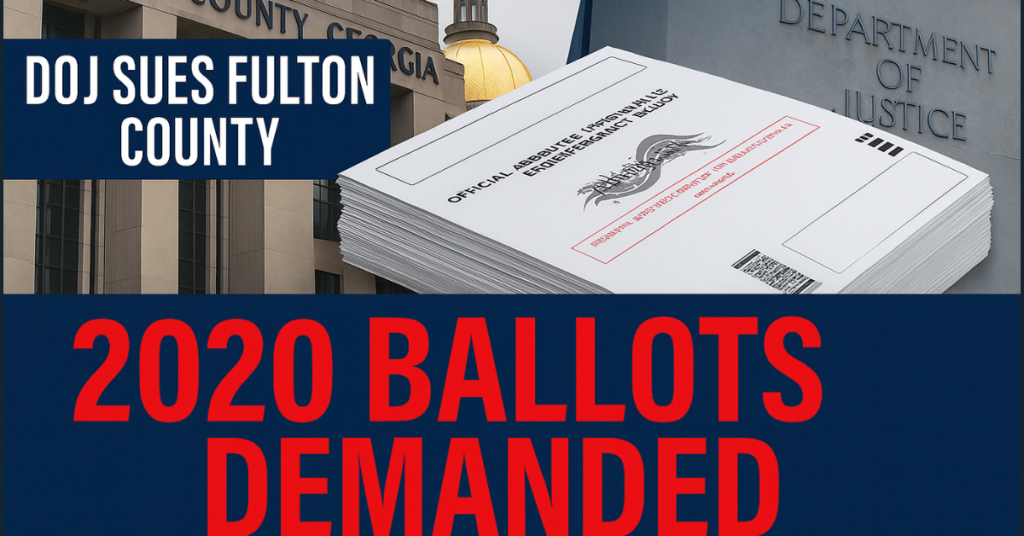
The U.S. Department of Justice’s Civil Rights Division filed a lawsuit Friday against Fulton County, Georgia, seeking access to ballots and election records from the 2020 presidential election, reopening a long-running and deeply contentious debate over election transparency, federal authority, and voter privacy.
The lawsuit, filed in U.S. District Court in Atlanta, demands that Fulton County produce all used and void ballots from the 2020 election, as well as absentee ballot signature envelopes, digital files, and other records held by the county’s Board of Registration and Elections. The Justice Department alleges that Fulton County Superior Court Clerk Ché Alexander violated federal law by refusing to provide the requested materials.
According to the complaint, Alexander failed to comply with lawful federal requests for election records, prompting the Justice Department to seek judicial enforcement.
The Fulton County Election Board did not immediately respond to requests for comment.
Georgia Officials Clash Over Access to Records
The federal lawsuit follows a July 30 resolution passed by Georgia’s State Election Board urging the state attorney general to enforce “compliance with voting transparency” laws and ensure access to election records. In October, Georgia’s attorney general sent a formal demand letter to Fulton County seeking the records.
Alexander responded by stating that the records were “under seal” and could not be released without a court order, setting the stage for the federal legal challenge now underway.
Fulton County has been at the center of election controversies since 2020, when President Donald Trump and several allies alleged widespread fraud in the county, a Democratic stronghold in the Atlanta metropolitan area. Those claims became a focal point of national scrutiny following Trump’s narrow loss in Georgia.
Republican Secretary of State Brad Raffensperger ultimately certified Democrat Joe Biden’s statewide victory after a full audit and two recounts, including a hand count of nearly five million ballots. State and federal officials later maintained that no evidence emerged showing fraud sufficient to alter the outcome.
A Complicated Legal and Political History
The Fulton County dispute is inseparable from the broader legal battles that followed the 2020 election. Trump’s former attorney, Rudy Giuliani, faced defamation lawsuits from two Fulton County election workers after falsely accusing them of pulling illegal ballots from “suitcases” and repeatedly scanning them at Atlanta’s State Farm Arena. Giuliani later acknowledged the allegations were unfounded.
More recently, election interference and racketeering charges brought by Fulton County District Attorney Fani Willis against Trump, Giuliani, and others were dismissed last month, a development that reshaped the legal landscape surrounding the election fallout.
Despite those dismissals, Friday’s lawsuit signals that the Trump administration is not prepared to close the chapter on 2020 election oversight.
“States have the statutory duty to preserve and protect their constituents from vote dilution,” said Assistant Attorney General Harmeet Dhillon in a statement announcing the suit.
“At this Department of Justice, we will not permit states to jeopardize the integrity and effectiveness of elections by refusing to abide by our federal elections laws. If states will not fulfill their duty to protect the integrity of the ballot, we will.”
Aarew Election Lawsuits Expand Nationwide
The Fulton County case is part of a far broader national legal effort. On the same day, the Justice Department announced it had filed federal lawsuits against four additional states—Colorado, Hawaii, Massachusetts, and Nevada—alleging they failed to comply with federal election law by refusing to provide full statewide voter registration lists upon request.
The DOJ says the requested data includes voters’ full names, dates of birth, residential addresses, and either their driver’s license numbers or the last four digits of their Social Security numbers.
State officials have pushed back forcefully.
Colorado Secretary of State Jena Griswold, a Democrat currently running for attorney general, rejected the DOJ’s demand outright.
“We will not hand over Coloradans’ sensitive voting information to Donald Trump,” Griswold said. “He does not have a legal right to the information. I will continue to protect our elections and democracy, and look forward to winning this case.”
The Colorado lawsuit came just one day after Trump announced on social media that he was pardoning Tina Peters, a former Colorado county clerk serving a nine-year state sentence for granting unauthorized access to voting equipment during a probe of the 2020 election. The pardon was symbolic, as presidents do not have authority to pardon state convictions.
18 States Now Sued Over Voter Rolls
With the addition of the four new lawsuits, the Justice Department has now sued 18 states nationwide over access to voter registration data. States targeted include California, Michigan, Minnesota, New York, New Hampshire, Pennsylvania, Delaware, Maryland, New Mexico, Rhode Island, Vermont, Oregon, Maine, and Washington.
Indiana and Wyoming have fully complied by providing complete statewide voter rolls. Ten other states have provided only publicly available versions that exclude Social Security and driver’s license information.
In Nebraska and South Carolina, voters themselves have filed lawsuits in state court to block election officials from sharing private voter data with the federal government.
Immigration Enforcement Raises New Concerns
Civil liberties advocates and state officials have raised additional alarms over how the voter data could be used. As part of the Trump administration’s broader crackdown on illegal immigration, voter information obtained by the Justice Department may be shared with the Department of Homeland Security to identify potential noncitizens on voter rolls.
Some states have already conducted such audits. Michigan, Louisiana, and Georgia have worked with DHS to review their voter rolls for noncitizens, with officials reporting that confirmed cases of noncitizen voting were extremely rare.
Nonetheless, critics argue that mass data sharing risks chilling lawful voter participation and exposing sensitive personal information, while supporters say the effort is necessary to ensure confidence in election integrity.
A Debate Far From Over
The Fulton County lawsuit underscores a central tension that has defined post-2020 election politics: how to balance transparency and oversight with privacy, federalism, and public trust.
For supporters of the Justice Department’s actions, access to ballots and voter rolls is a legal obligation and a prerequisite for election integrity. For opponents, the lawsuits represent federal overreach and a continued politicization of election administration.
As courts begin weighing these cases across the country, the outcomes are likely to shape election law, voter data protections, and federal-state relations well beyond the next election cycle.