



DOJ Dumps 30,000 Epstein Files—Warns Trump Claims Are False and Sensationalized
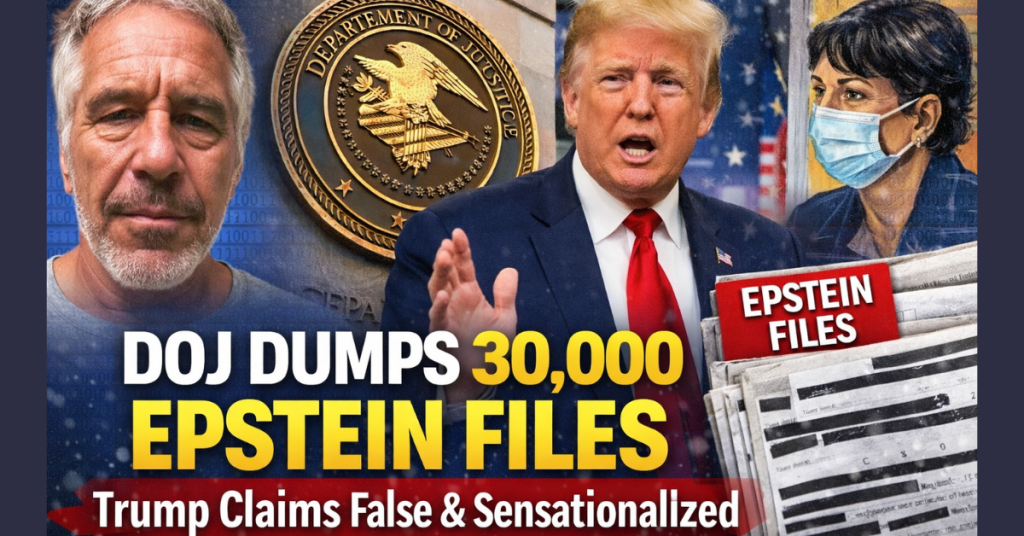
The U.S. Department of Justice has released its eighth tranche of documents related to the late convicted sex offender Jeffrey Epstein, adding nearly 30,000 pages to the public record while explicitly cautioning the public against drawing sensational conclusions.
In a rare and pointed statement accompanying the release, the DOJ said the documents include “untrue and sensationalist claims” submitted to the FBI shortly before the 2020 election—specifically allegations involving Donald Trump. According to the department, the claims were investigated and found to be unfounded, noting that had they carried credibility, they would have already been politically weaponized.
The DOJ emphasized that the release is driven not by validation of every claim in the files, but by legal obligations and a broader commitment to transparency—while still applying required redactions to protect Epstein’s victims.
A Pattern of Raw, Unverified Material
The newly released documents highlight a recurring issue with Epstein-related disclosures: they often contain raw investigative material, not established facts. Tips, emails, media clippings, and third-party claims are preserved in federal files regardless of their veracity. The DOJ made clear that inclusion in the documents does not equate to corroboration.
This distinction has been repeatedly blurred in public discourse, where the mere presence of a name is frequently portrayed as evidence of wrongdoing. The department’s warning appears aimed at curbing that pattern as media outlets focus on the most provocative excerpts.
Epstein’s Death: Acknowledged Failures, Few Answers
Among the most consequential material in the release is an after-action review of Epstein’s 2019 death at the Metropolitan Correctional Center in New York. Epstein died while awaiting trial on federal sex trafficking charges, an event that has fueled widespread suspicion and public distrust.
The review documents a “significant breakdown in basic correctional practices and communication,” reinforcing earlier findings that systemic failures—rather than a single act of malice—created the conditions under which Epstein died. While the report stops short of alleging criminal conspiracy, it confirms profound institutional negligence.
Flight Logs, Emails, and Context Gaps
Several media outlets have highlighted internal emails referencing flight records associated with Epstein’s private jet. One January 2020 email from a redacted assistant U.S. attorney notes that Trump appeared on at least eight flights between 1993 and 1996, some alongside Epstein associate Ghislaine Maxwell.
However, the same email also notes that some flights included Trump’s then-wife and children—details often omitted in abbreviated media summaries. The documents do not allege criminal conduct related to these flights, nor do they suggest Trump was implicated in Epstein’s trafficking operation.
The files also include a 2021 email referencing a forensic review of a phone belonging to former Trump advisor Steve Bannon, which reportedly contained an image of Trump and Maxwell. Again, the DOJ does not attribute evidentiary significance to the image itself.
References vs. Relevance
A keyword search of the records reveals hundreds of mentions of Trump, but the DOJ and multiple outlets acknowledge that most references stem from media reports, third-party materials, or tangential mentions, not investigative findings focused on him.
This underscores a central challenge of large-scale document dumps: quantity is often mistaken for implication. High-profile names appear frequently in sprawling investigative archives simply because Epstein moved within elite social and political circles for decades.
Transparency Without Narrative Closure
The DOJ’s latest release advances public access but offers little in the way of definitive resolution. It confirms systemic failures surrounding Epstein’s death, exposes the breadth of unverified material collected by investigators, and highlights how proximity can be misinterpreted as proof.
By explicitly warning that some claims are false, the department appears to be drawing a line between transparency and insinuation—a distinction often lost in the rush for scandal. As more Epstein-related records enter the public domain, the documents may raise new questions, but they continue to provide context without closure, and allegations without substantiation remain just that.