



Colorado Appeals Court Orders Re-Sentencing of Tina Peters
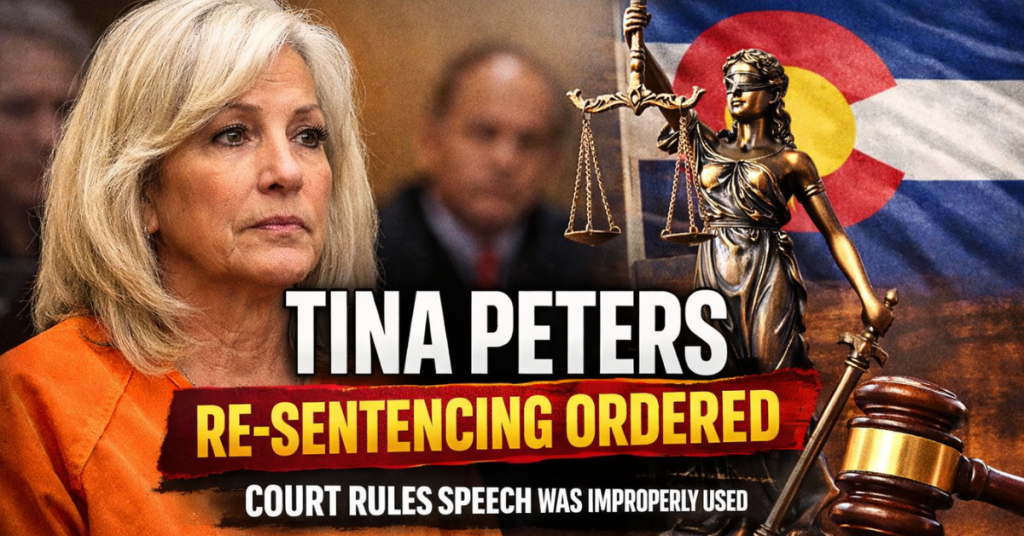
A Colorado appeals court has ordered that former Mesa County Clerk Tina Peters be re-sentenced, reopening one of the most closely watched election-related criminal cases stemming from the aftermath of the 2020 election.
The ruling does not overturn Peters’ convictions. Instead, it focuses narrowly on how her sentence was determined — and whether the court crossed a constitutional line in doing so.
Convictions Stand, Sentence in Question
Peters, now 70, was convicted in 2024 on multiple felony and misdemeanor counts tied to her handling of election equipment. The charges included:
- Attempting to influence a public servant (three counts)
- Conspiracy to commit criminal impersonation
- Official misconduct
- Violation of duty
- Failure to comply with election security requirements
Prosecutors argued that Peters improperly allowed an outside consultant access to Mesa County’s election system during a scheduled software update, leading to unauthorized copying of sensitive data.
She was sentenced to nearly nine years in prison.
That conviction remains intact.
Appeals Court: Speech May Have Been Improperly Considered
The key issue on appeal was not whether Peters committed the underlying acts, but whether the sentencing judge relied on her public statements about election fraud when determining punishment.
According to the Colorado Court of Appeals, that is exactly what happened.
In its ruling, the court stated that the trial judge “obviously erred” by factoring in Peters’ continued promotion of election fraud claims — speech that may be protected under the First Amendment.
The decision sends the case back to a lower court for re-sentencing, instructing the judge to exclude any consideration of protected speech.
This distinction is critical. Courts can punish unlawful actions, but not political viewpoints — even controversial ones — when determining a sentence.
State Officials Push Back
Colorado Attorney General Phil Weiser responded quickly, defending the original outcome.
Weiser said the sentence had been “fair and appropriate,” emphasizing that Peters’ actions, not her beliefs, put election systems and public trust at risk.
He added that regardless of any adjustment to her sentence, Peters remains a convicted felon who violated her responsibilities as an election official.
Trump’s Involvement and Legal Limits
The case has drawn national attention in part due to involvement from Donald Trump, who has publicly called for Peters’ release.
However, the appeals court reaffirmed a key legal boundary: presidential pardons do not apply to state-level convictions.
That means even if Trump were to attempt clemency, it would have no effect on Peters’ case under Colorado law.
Bigger Implications
The ruling highlights a tension that continues to shape post-2020 legal battles:
- Where does criminal conduct end and protected political speech begin?
- Can courts consider a defendant’s public rhetoric when determining punishment?
The appeals court’s answer, at least in this case, is clear: speech alone — even if widely disputed or controversial — cannot be used to increase a criminal sentence.
What Happens Next
Peters will return to a lower court for re-sentencing. The judge must now reconsider her punishment without factoring in her public statements about election fraud.
Her convictions remain unchanged, but her prison term could be reduced depending on how the court recalculates the sentence.
The outcome will likely be closely watched, not just in Colorado, but nationally, as similar legal questions continue to emerge in politically charged cases.