



Intelligence Officials Allege Russia Hoax Was Fabricated
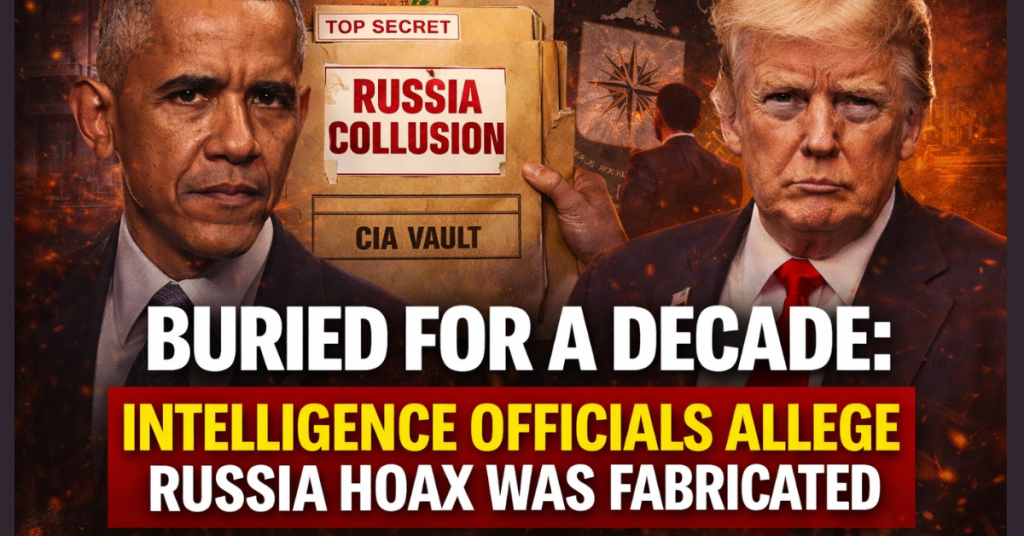
A group of former U.S. intelligence officials has made explosive allegations that challenge one of the most consequential political narratives of the last decade: the claim that Donald Trump’s 2016 election victory was the product of a covert Russian operation.
According to statements now circulating from roughly 20 former CIA and FBI personnel, internal intelligence assessments questioning the foundations of the so-called “Russia collusion” narrative were allegedly compiled, suppressed, and classified during the Obama administration—and never disclosed to the public or to congressional investigators at the height of the controversy.
If accurate, the claims suggest that dissenting intelligence analyses were sidelined while a politically damaging narrative took hold across media, federal agencies, and the broader public discourse.
Allegations of Intelligence Manipulation
The officials allege that senior figures within the intelligence community—under the administration of Barack Obama—approved or tolerated the withholding of assessments that cast doubt on claims of coordinated collusion between the Trump campaign and the Russian government.
According to these accounts, a classified intelligence product questioning the evidentiary basis of the Russia allegations was reportedly stored in a secure CIA archive and remained inaccessible for years, even as multiple investigations unfolded.
The accusations do not claim that Russia engaged in no activity whatsoever related to U.S. elections, but rather that the leap from interference to conspiracy was not supported by the intelligence available at the time.
The Origins of the Russia Narrative
The Russia investigation dominated U.S. politics from 2016 through 2019, shaping congressional inquiries, media coverage, and public trust in democratic institutions. It culminated in the appointment of Special Counsel Robert Mueller, whose final report found no evidence of a criminal conspiracy between the Trump campaign and Russia—though that conclusion did little to quell political division.
Former intelligence officials now argue that the damage was already done long before the Mueller report was released.
They contend that intelligence was selectively framed, dissenting views were marginalized, and uncertainty was publicly presented as near-certainty—creating the impression of a settled case long before investigative facts justified it.
Implications for Federal Institutions
If these allegations are substantiated, they raise profound questions about the politicization of intelligence agencies, particularly the Central Intelligence Agency and the Federal Bureau of Investigation.
Critics argue that intelligence agencies are granted extraordinary powers precisely because they are expected to operate above partisan politics. The deliberate suppression of contradictory intelligence—if proven—would represent a breach of that trust and could permanently erode confidence in national security institutions.
Supporters of the original investigations counter that intelligence work is inherently probabilistic and that classification decisions are often driven by source protection, not political intent. They also argue that intelligence officials acted in good faith based on the information available at the time.
Renewed Scrutiny and Political Fallout
The allegations are already fueling renewed calls for declassification and congressional oversight, particularly from lawmakers aligned with Donald Trump, who has long claimed the Russia investigation was a politically motivated effort to undermine his presidency.
Legal experts note that proving deliberate fabrication or suppression would require documentary evidence and sworn testimony, not merely retrospective accounts. Still, they acknowledge that the claims—coming from multiple former officials rather than a single whistleblower—are unlikely to fade quickly.
A Broader Reckoning
Beyond partisan consequences, the controversy points to a deeper institutional problem: what happens when intelligence becomes a tool of narrative rather than analysis.
Whether the allegations ultimately withstand scrutiny or not, they underscore the lingering scars left by the Russia investigation era—an episode that reshaped media credibility, public trust, and the relationship between intelligence agencies and democratic accountability.
As pressure mounts for transparency, one question looms large: what other intelligence judgments, once buried, may yet come to light?