



Troops on Alert as Protests Raise Insurrection Act Questions
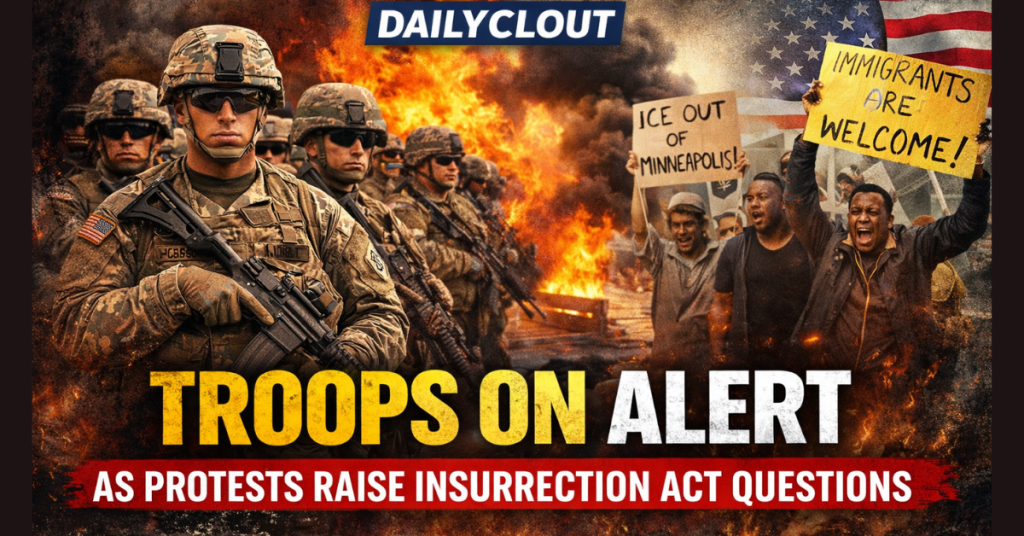
The Pentagon has placed roughly 1,500 active-duty U.S. Army soldiers on prepare-to-deploy status for a potential mission to Minnesota as protests intensify around federal immigration operations in the Minneapolis–St. Paul area, according to multiple reports citing U.S. officials. Federal officials emphasize that no deployment is imminent, but the contingency planning has re-ignited debate over when—and whether—the Trump administration could invoke the Insurrection Act to use active-duty forces on American soil.
What’s happening in Minnesota
The troop standby order comes amid heightened demonstrations connected to a surge of federal immigration enforcement activity in the Twin Cities. Reuters reports that tensions escalated following the fatal shooting of Renee Good by an ICE officer in Minneapolis, which became a central flashpoint for protests and political dispute between federal and state leaders.
Minnesota state authorities have also taken steps of their own. Coverage indicates Gov. Tim Walz mobilized the Minnesota National Guard (with reporting noting mobilization orders while emphasizing it was not necessarily deployed on city streets at the time of reporting).
The judge’s limits on federal agents
Parallel to the street protests, legal challenges have moved quickly through federal court. Reporting from Bloomberg and CBS Minnesota indicates a federal judge issued restrictions on how federal agents can respond to demonstrators—guardrails that, as described in press coverage, include limits on certain crowd-control tactics and constraints on detaining or arresting peaceful protesters or observers absent adequate legal justification.
The ACLU has also announced a lawsuit alleging unconstitutional enforcement practices such as warrantless arrests and racial profiling, framing the dispute not only as a policy conflict but as a constitutional one.
Why the Insurrection Act is at the center of the controversy
Under ordinary circumstances, active-duty troops are restricted from domestic law enforcement roles by the Posse Comitatus Act and related doctrine. The major statutory exception most often cited is the Insurrection Act, now codified in 10 U.S.C. §§ 251–255, which creates pathways for a president to use the armed forces or federalize National Guard units under defined conditions.
Legal and policy references commonly summarize the Act this way:
-
Section 251 generally contemplates federal aid when requested by a state (typically via the governor or legislature).
-
Sections 252 and 253 can allow deployment without state request in scenarios involving enforcement of federal law or interference with constitutional rights and governance—an area that civil-liberties groups argue is vulnerable to overbroad interpretation.
-
Section 254 includes a requirement for a proclamation ordering people to disperse before force is used under the Act.
In recent days, President Trump has publicly referenced the possibility of invoking the Act in response to disorder related to immigration protests, while also signaling at points that it may not be needed “right now,” according to reporting.
What the Pentagon’s “standby” posture does—and does not—mean
Placing troops on standby does not itself authorize domestic law enforcement. It is, however, a signal that the federal government is preparing for rapid escalation if the White House determines the situation meets statutory thresholds—or if federal officials pursue alternative legal rationales for using troops in protective roles around federal property.
Reporting from the Associated Press describes the standby force as coming from the Army’s 11th Airborne Division and notes the order was tied to the possibility of an Insurrection Act invocation. Reuters similarly frames the posture as contingency planning amid unrest and political friction between the administration and Minnesota leadership.
The constitutional tension: federal authority vs. civil liberties
The current dispute is effectively a three-way tension among:
-
Federal enforcement authority (immigration operations and protection of federal personnel/property),
-
State and local control (public safety, policing priorities, and de-escalation strategies), and
-
Civil liberties protections (First Amendment protest rights and Fourth Amendment constraints on stops, searches, and arrests).
Civil-liberties advocates argue that federal tactical responses to protests can chill lawful speech and assembly—concerns that appear to be reflected in the judge’s restrictions reported by multiple outlets.
Supporters of a tougher federal posture argue the government has a duty to protect agents and maintain order when local leadership is unwilling or unable to do so—an argument that historically has been made during past domestic deployments, though each episode carries its own facts and legal posture.
Historical context: a rarely used power with high stakes
Modern uses of the Insurrection Act are rare. Reporting notes its last invocation is widely associated with the 1992 Los Angeles unrest, reinforcing why even the threat of invocation generates intense political and public scrutiny.
Policy organizations have warned for years that the statute’s breadth can create risks of politicized or expansive deployment, particularly when the triggering conditions are debated and when deployments occur over state objections.
What to watch next
Key near-term indicators will include:
-
Whether protests remain largely peaceful or escalate into sustained violence,
-
Whether federal agencies modify tactics to comply with the court’s injunction,
-
Whether the administration issues formal steps that precede Insurrection Act use (including the dispersal proclamation requirement), and
-
Whether Minnesota’s National Guard role expands, potentially reducing the administration’s argument that federal military deployment is necessary.
For now, officials describe the troop posture as precautionary. But the legal and political stakes remain high: invoking the Insurrection Act would represent a major escalation in the federal response, with significant consequences for civil-military norms and constitutional protections in domestic protest situations.