



Sweden’s Elder Care Rape Scandal
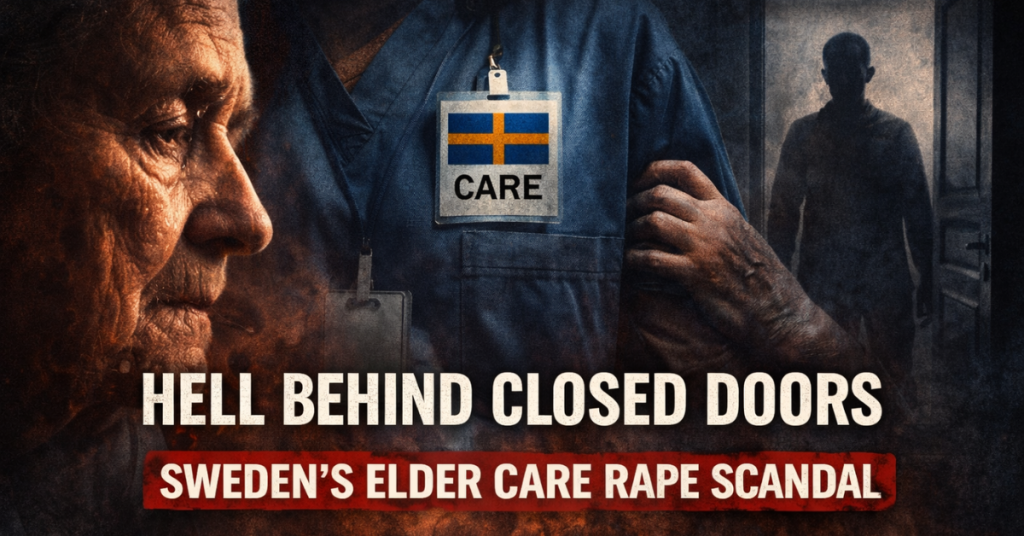
Sweden is confronting a disturbing reality that challenges one of the country’s most cherished assumptions: that the welfare state’s care system is, by default, a place of safety. A recent compilation of police reports indicates that nearly 400 rapes of women over age 60 have been reported to Swedish police since 2021, a figure that has shocked criminologists and reignited scrutiny of home-care services (hemtjänst) and elder-care environments where victims may be isolated, frail, and unable to report abuse.
This is not merely a crime story. It is a systems story—about oversight gaps, staffing realities, reporting barriers, and the consequences of letting “trusted care” operate with too little verification and too few safeguards.
What the reported numbers do—and don’t—mean
Multiple Swedish outlets citing police-region analysis (including statements attributed to police-region criminologist Anders Östlund) report 398 police reports of rape involving women over 60 from 2021 to late 2025.
Two essential clarifications often get lost in viral retellings:
-
These are police reports, not a count of convictions. A police report can be unsubstantiated, difficult to prove, or later reclassified—yet it still signals the scale of concern.
-
Authorities and journalists repeatedly warn of a likely “dark figure”—underreporting—because older victims may have dementia, mobility limitations, fear of retaliation, dependence on caregivers, or difficulty being believed.
In other words: the documented figure is alarming on its face, and it may not represent the full scope.
Why elder-care settings are uniquely vulnerable
The pattern described in Swedish reporting points to a scenario that is structurally different from most public perceptions of rape: alleged assaults occurring indoors, often in private residences or care environments, sometimes involving a caregiver role.
Elder-care has several built-in risk factors:
-
Asymmetry of power: victims may rely on caregivers for bathing, toileting, medication, and basic daily survival.
-
Low visibility: work often occurs behind closed doors, sometimes with staff working alone.
-
Documentation gaps: care notes aren’t designed for forensic accountability.
-
Fragmented responsibility: municipalities, private contractors, and staffing agencies can dilute clear lines of supervision.
When those safeguards fail, the harm is not only physical—it is institutional: the state’s promise of dignity in old age is broken.
Oversight, reporting, and the “Lex Sarah” reality
Sweden’s elder-care system includes formal channels for reporting “serious incidents” and misconduct, including Lex Sarah reporting to the Health and Social Care Inspectorate (IVO). IVO’s own statistics show the system receives a large volume of Lex Sarah notifications annually.
But reporting mechanisms are only as strong as the incentives and culture around them. Separate reports and local investigations show municipalities have had to conduct external reviews and “action packages” after abuse scandals—evidence that the system can be reactive rather than preventive.
The Swedish government has also moved to expand reporting obligations related to serious deficiencies in care settings starting in 2026—an implicit acknowledgment that current processes have not been sufficient.
The question of foreign-born perpetrators and what the evidence can support
Your prompt raises a claim about “overrepresentation of foreign-born perpetrators.” Here’s what can responsibly be said with available sourcing:
-
Some Swedish and international research finds a statistical association between immigrant background and rape convictions in Sweden across extended time periods, even after adjustment—while also stressing that such findings do not explain causality by themselves (e.g., differences in age distribution, socioeconomic factors, and policing/charging patterns can influence outcomes).
-
At the same time, Sweden’s routine crime reporting has long been constrained in how it handles offender-origin data, and it is not correct to imply that “authorities refuse” to discuss it across the board without showing specific official statements or datasets for the elder-care subset. (This is exactly where misinformation thrives: people jump from a handful of high-profile cases to sweeping demographic claims.)
If a publication wants to address offender background, the safest journalistic approach is: stick to verified court cases, clearly label what is known, and avoid generalizations that outrun the data.
What reforms are being debated—and what would actually reduce risk
Swedish coverage has focused heavily on the need for stronger controls in home-care and elder-care settings—especially where staff are alone with vulnerable clients.
A serious prevention package would typically include:
-
Stronger pre-employment screening (criminal background checks where permitted; verification of identity, credentials, and employment history)
-
Limits on solo visits for high-risk tasks (bathing/intimate care), especially for clients with dementia
-
Body-worn alarms / audit trails (not surveillance everywhere, but accountable records of who was present and when)
-
Mandatory rapid escalation protocols when families report concerns
-
Specialized training in safeguarding, boundaries, and recognizing abuse indicators
-
Independent reporting channels for staff and families, plus whistleblower protections
None of these reforms require denying due process or scapegoating groups. They require treating elder-care like what it is: a high-trust environment that must be built on verifiable trust, not assumed trust.
The moral test Sweden can’t outsource
Even if one sets aside the debates that dominate social media—immigration, politics, culture war—the core scandal remains: elderly women, at the end of life, are among the most defenseless people in society. If systems meant to protect them can be exploited, then the system is not “equal” or “humane” by design—it is humane only when the safeguards are real, enforced, and continuously audited.
This story deserves sustained coverage precisely because it forces a modern welfare state to answer a timeless question: Who protects the people who can’t protect themselves—and what happens when the protector is the threat?