


How Venezuela Became a Narco-State by Design
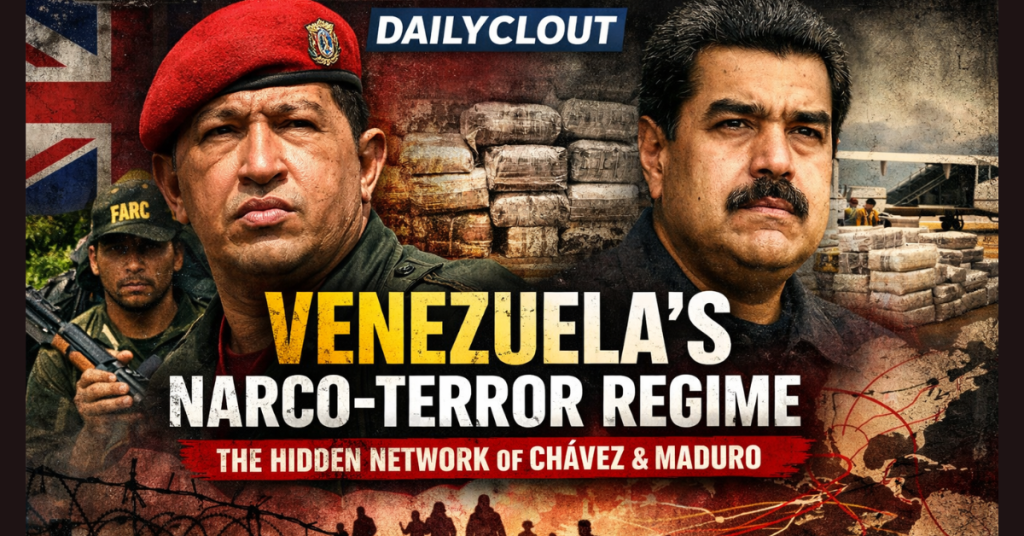
For more than two decades, Venezuela’s political collapse has been explained almost entirely through the lens of socialism, corruption, and U.S.–Latin America tensions. That story is incomplete. A fuller picture requires examining the international networks, intelligence relationships, and criminal alliances that shaped the rise of Hugo Chávez and later Nicolás Maduro—and how those networks continue to destabilize the region today.
Chávez Before Power: A Globalized Project
After leading a failed coup in 1992, Chávez emerged not as a sidelined radical but as a courted political asset. Reporting from Venezuelan press in the mid-1990s documented Chávez’s unusually warm relationship with diplomats from the United Kingdom, including repeated contacts with British Embassy officials while he was still formally outside power.
At the same time, Chávez cultivated ties with Fidel Castro, Cuba’s intelligence services, and insurgent groups operating in Colombia. This combination—Western diplomatic access paired with revolutionary militancy—positioned Chávez as a uniquely useful figure in post–Cold War geopolitics: anti-American in rhetoric, but embedded in global systems rather than isolated from them.
The FARC Connection Was Policy, Not Accident
Once in office in 1999, Chávez made his foreign policy explicit. He aligned Venezuela with Colombia’s largest armed insurgent movement, the Revolutionary Armed Forces of Colombia (FARC), which by then was already one of the world’s most powerful cocaine-financed organizations.
This was not covert tolerance—it was public legitimization. Chávez repeatedly called on governments to recognize the FARC and the ELN as “belligerent forces,” a move that would grant political status to narco-terrorist armies operating across borders. In 2008, Venezuela’s National Assembly formally passed a resolution endorsing this position.
Security analysts, including officials from Colombia and the U.S., later documented:
-
Safe havens for FARC units inside Venezuelan territory
-
Weapons transfers and logistical cooperation
-
Drug trafficking corridors protected by Venezuelan security forces
These networks outlived Chávez himself.
Maduro: The Continuation, Not a Break
Maduro’s rise was not organic. He served as Chávez’s foreign minister, vice president, and hand-picked successor, inheriting both power and alliances. Under Maduro, Venezuela’s role as a transit hub for cocaine bound for the U.S. and Europe expanded dramatically, according to U.S. Treasury and DEA assessments.
This is where the issue intersects directly with the U.S. southern border. Venezuelan state corruption, cartel cooperation, and mass migration pressures form a single destabilization loop:
-
Narco-state economics collapse domestic stability
-
Millions flee Venezuela
-
Criminal networks exploit migration routes northward
-
Drug flows and human trafficking increase
Maduro’s regime is no longer merely authoritarian—it functions as a criminalized state apparatus with international reach.
British Geopolitics and the “Managed Chaos” Model
Critics of Anglo-American imperial policy have long argued that state fragmentation, drug proliferation, and non-state armed actors are not accidental outcomes but tools. The British Empire historically relied on:
-
Opium and narcotics economies
-
Proxy militias and insurgents
-
Weak states dependent on external financial systems
Venezuela under Chávez and Maduro fits this model disturbingly well. Whether through naïveté or design, Chávez embedded Venezuela into a continental narcotics and insurgency network that undermined national sovereignty—not just Venezuela’s, but Colombia’s, Peru’s, Ecuador’s, and beyond.
A Warning That Was Ignored
Political economist Lyndon LaRouche repeatedly warned that Chávez misunderstood the historical role of British imperial strategy in the Americas. He argued that aligning with narco-guerrillas and global financial interests would not liberate Latin America, but enslave it through drugs, debt, and disorder.
History has largely vindicated that warning. Venezuela today is poorer, less sovereign, and more violent than at any point in its modern history—while its ruling elite remains protected by international networks.
Why This Still Matters
This is not ancient history. The Maduro regime remains in power, protected by foreign financial channels, intelligence relationships, and criminal enterprises. Its impact is felt:
-
At the U.S. southern border
-
In the cocaine supply devastating American cities
-
In the normalization of narco-politics across Latin America
Understanding Venezuela’s collapse requires moving beyond slogans and sanctions toward a serious reckoning with how global power networks cultivate, protect, and weaponize instability.
Venezuela was not simply “lost to socialism.” It was captured by a transnational system that thrives on chaos—and exports it northward.