



New Documents Expose FBI Concerns Over Mar-a-Lago Search
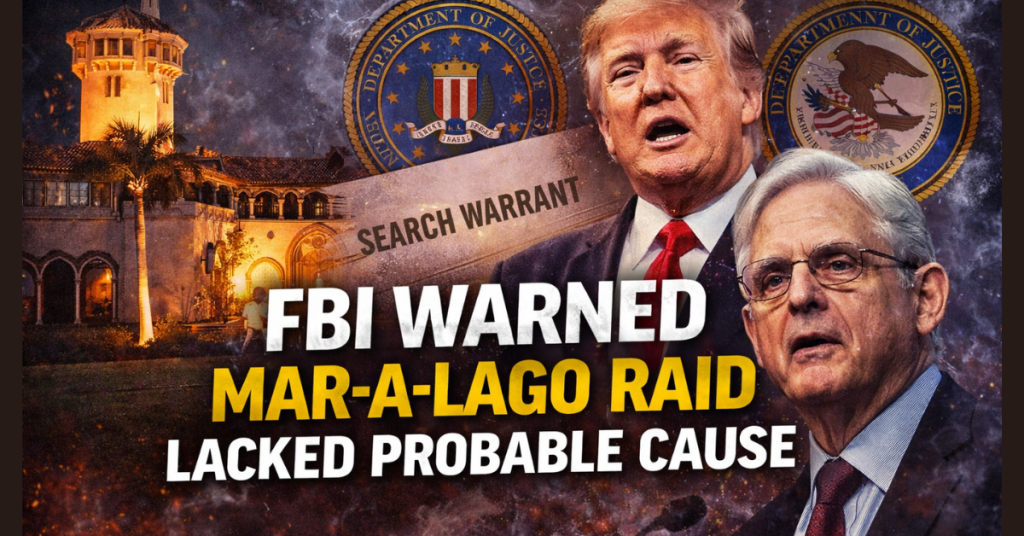
Newly declassified internal FBI and Department of Justice documents show that FBI agents in 2022 repeatedly questioned whether there was sufficient evidence—or “probable cause”—to justify the high-profile FBI search of former President Donald Trump’s Mar-a-Lago estate in Florida, only for the Biden DOJ to proceed anyway, according to records turned over this week to Congress. Just The News
The documents, obtained by media outlets and released to congressional committees, indicate that investigators from the FBI’s Washington Field Office repeatedly expressed skepticism about whether evidence of criminal wrongdoing was strong enough to support a search warrant. One memo from June 1, 2022 states that investigators had conducted numerous interviews and had “very little” to show “related to who might be culpable for mishandling the documents.” The memo additionally noted concerns that some information used to justify a warrant was from a single, uncorroborated source and possibly outdated. Just The News
By July of that year, agent correspondence included statements that the FBI offices involved did not believe they had probable cause to search key areas of Mar-a-Lago, including Trump’s private office and bedroom, because there was uncertainty over whether additional classified records were present and tied to criminal violations. “We are not in agreement for probable cause on the search warrant,” one redacted agent email read, describing ongoing debate between field offices and DOJ attorneys over the warrant’s scope. Just The News
Despite these concerns, DOJ’s Counterintelligence and Export Control Section (CES) maintained that the search warrant met the legal standard and pushed the effort forward. The memos also reference Justice Department officials drafting versions of search warrant applications and preparing logistics for carrying them out. Just The News
The search itself took place on August 8, 2022, when FBI agents executed a court-authorized warrant at Mar-a-Lago to look for classified documents that Trump was accused of retaining after leaving office. Previous reporting and court filings publicly showed that the FBI seized large quantities of government records containing classification markings, including highly sensitive materials related to national security. Wikipedia
Under federal law, a judge may only issue a warrant when there is probable cause to believe that evidence of a crime will be found at the location in question, a standard rooted in the Fourth Amendment and defined in precedent as a “fair probability” of wrongdoing. Congress.gov
For the Trump team and Republicans in Congress, the newly disclosed internal FBI reservations reinforce criticisms that the raid was politically motivated and legally weak. Senate Judiciary Committee Chairman Chuck Grassley (R-Iowa) tweeted that the records show the FBI “did not believe it had probable cause” and called the raid “a miscarriage of justice.” Just The News
The declassification came as Jack Smith, the special counsel appointed in late 2022 to pursue classified documents and other charges against Trump, prepared to testify before Congress. Democrats, for their part, are seeking release of even more complete versions of Smith’s final report. A related legal dispute has also emerged over whether aspects of the special counsel’s investigation should remain classified. Just The News
Trump’s classified documents case produced an indictment in June 2023, alleging he willfully retained and improperly stored sensitive government records. But in July 2024, a federal judge dismissed that case on procedural grounds related to Smith’s appointment, and the prosecution was not pursued further after Trump won the 2024 election. Wikipedia
Critics argue that the newly released internal emails highlight deeper internal conflicts within the FBI and DOJ over how aggressively to pursue the investigation and whether the legal standards for a search were met before seeking and executing a warrant. Supporters of the raid counter that the court’s approval and subsequent document seizures demonstrate that law enforcement acted appropriately in response to credible evidence of potential criminal violations.