



Big Tech on Trial: Did Social Media Design Addict Teens?
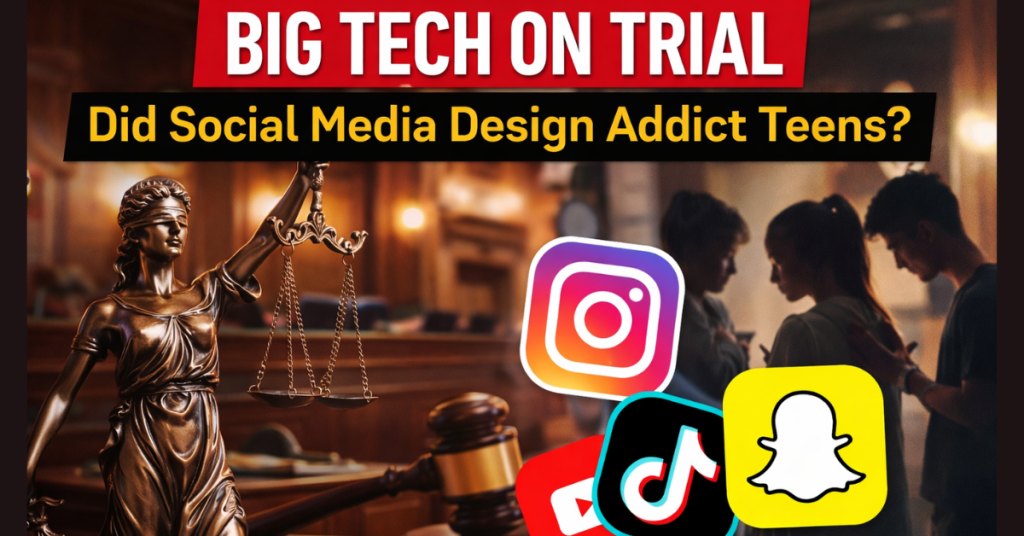
Jury selection is now underway in Los Angeles County Superior Court for what plaintiffs’ attorneys are calling the first major bellwether trial over whether leading social-media platforms—Instagram (Meta), TikTok, YouTube (Google), and Snapchat (Snap)—were engineered to be addictive to minors in ways that foreseeably harmed teens.
The case is explicitly framed as a modern sequel to the litigation playbook that helped upend Big Tobacco and later shaped mass litigation against opioid manufacturers: pick representative cases, put internal research and product decisions in front of a jury, and test whether “harm” flowed from product design choices rather than merely the “content” users posted. If jurors (and later courts) accept that framing, it could create fresh pressure on Section 230 defenses—especially where claims target design features like infinite scroll, autoplay, algorithmic recommendations, and engagement loops, rather than third-party speech.
What makes this trial different from the usual tech lawsuits
For years, many lawsuits against social platforms have collided with two powerful shields:
-
Section 230 (the “you’re not liable for user content” statute), and
-
First Amendment arguments that platform activity is bound up with speech or editorial discretion.
Plaintiffs here are trying to route around both—by emphasizing design: not “a bad post harmed my child,” but “the product’s engagement architecture predictably created compulsive use in minors, and that compulsive use contributed to concrete harms.”
That distinction matters because Section 230 is strongest when claims would effectively treat a platform as the “publisher” of third-party content. Courts have wrestled with where algorithms and recommendations fall in that framework—an uncertainty highlighted in prior Section 230 fights that reached the Supreme Court (which ultimately avoided a sweeping rewrite).
The bellwether: who is suing, and who is still in the courtroom
Reporting on the Los Angeles proceedings centers on a plaintiff identified as “K.G.M.”, now 19, who alleges she became addicted to social platforms at a young age and that her use correlated with serious mental-health harms.
Two major developments shaped the opening moments of the trial:
-
TikTok reached a last-minute settlement with K.G.M. just before trial began.
-
Snap previously settled with K.G.M. as well (with limited public detail).
That leaves Meta (Instagram) and Google (YouTube) as the most prominent defendants expected to proceed before a jury in this first test case—meaning the initial “signal” the bellwether sends may be about whether jurors accept the idea that core engagement mechanics can be treated like a defective or unreasonably dangerous product design.
Why Section 230 is in the crosshairs—without being the headline
Section 230 doesn’t say platforms can never be sued; it says they generally can’t be treated as the publisher or speaker of third-party content. The plaintiffs’ theory attempts to keep the case away from “publisher” territory by arguing the injury was caused by company-controlled product features—the kind of choices executives approve, measure, A/B test, and optimize.
Even then, the defense is likely to argue that “design vs. content” is an artificial split, because recommendations and feeds are inseparable from what is being shown. A federal judge in parallel school-district cases has noted how complicated it is to separate design from content in practice—an issue that will keep recurring as these cases move forward.
The Tobacco-and-opioids analogy: what plaintiffs are really trying to prove
The “Big Tobacco” parallel isn’t just rhetorical. It’s a strategy:
-
Internal knowledge: what the companies knew about harm to youth users.
-
Product intent: whether design choices were made to maximize time-on-platform even when risks were recognized.
-
Causation: whether the product’s design materially contributed to real-world harm (not merely correlation).
Plaintiffs say jurors will see internal documents and company research, plus expert testimony, to show that teen vulnerability was not incidental but central to the business model.
Defendants, meanwhile, broadly dispute that their products are “designed to harm,” often pointing to safety tools, parental controls, and the fact that teen mental-health outcomes have many potential drivers beyond social media.
What to watch for in the coming weeks
A few signals from this LA bellwether will matter far beyond one plaintiff:
-
How the jury responds to “design defect” language versus “content” arguments.
-
Whether executives testify and how they describe product goals, especially around youth engagement. (Multiple outlets report that top Meta leadership is expected to be involved.)
-
Settlement pressure: TikTok and Snap settling this early case may be read as a sign that companies see risk in letting a jury evaluate internal materials.
-
Spillover into public policy: if jurors accept a “harm from design” frame, lawmakers and regulators may feel emboldened to tighten youth-protection rules for feed mechanics, not just content moderation.
This is only the opening round
This LA case is not the only track. Separate school-district lawsuits—arguing that districts bear the financial and operational costs of social-media-driven harms—are moving through federal court as part of broader litigation, with bellwether trials also being staged to test these theories.
Taken together, 2026 is shaping up as the year the courtroom stops debating social media in the abstract and starts debating it like a product—complete with design schematics, internal research, and a jury asked a blunt question: Was this harm an accident of modern life—or an engineered outcome of engagement-first design?