



Thromboembolic Events – MicroReport 3
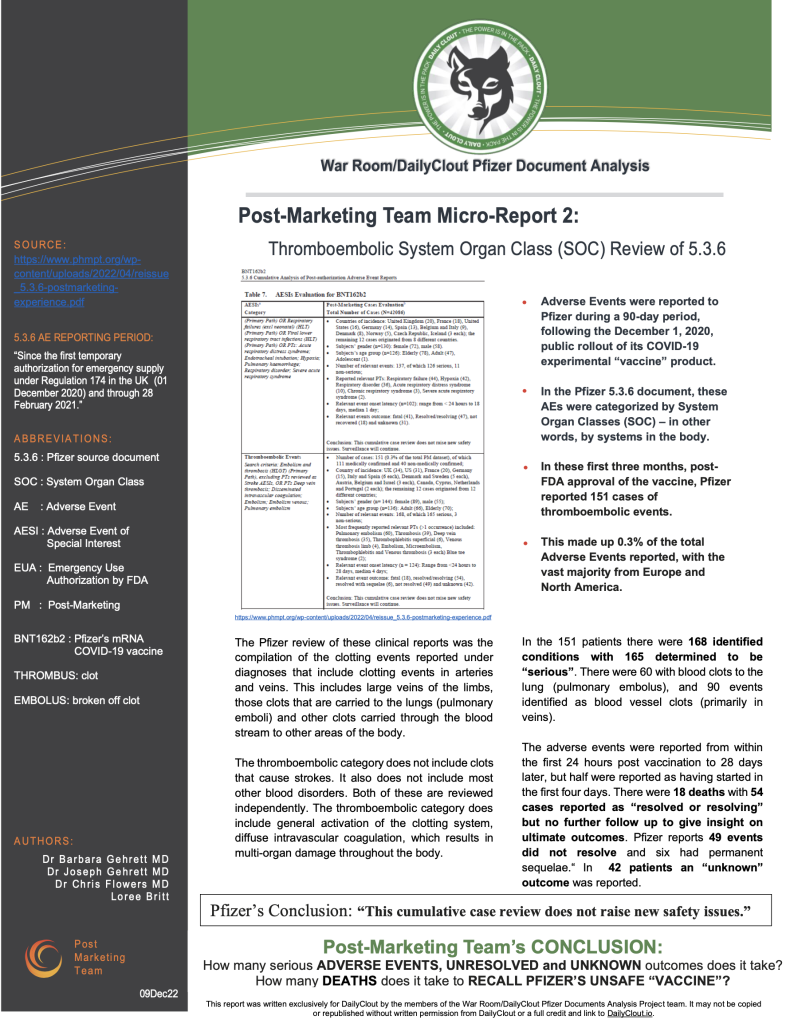
5.3.6 Cumulative Analysis of Post-authorization Adverse Event Reports
Table 7. AESIs Evaluation for BNT162b2
AESIs Category
(Primary Path) OR Respiratory failures (excl neonatal) (HLT)
(Primary Path) OR Viral lower respiratory tract infections (HLT)
(Primary Path) OR PTs: Acute respiratory distress syndrome; Endotracheal intubation; Hypoxia; Pulmonary haemorrhage; Respiratory disorder; Severe acute respiratory syndrome
Post-Marketing Cases Evaluation
Total Number of Cases (N=42086)
- Countries of incidence: United Kingdom (20), France (18), United States (16), Germany (14), Spain (13), Belgium and Italy (9), Denmark (8), Norway (5), Czech Republic, Iceland (5 each); the remaining 12 cases originated from 8 different countries.
- Subjects’ gender (n=130): female (72), male (58).
- Subjects’ age group (n=126): Elderly (78), Adult (47), Adolescent (1).
- Number of relevant events: 137, of which 126 serious, 11 non-serious.
- Reported relevant PTs: Respiratory failure (44), Hypoxia (42), Respiratory disorder (36), Acute respiratory distress syndrome (10), Chronic respiratory syndrome (3), Severe acute respiratory syndrome (2).
- Relevant event onset latency (n=102): range from <24 hours to 18 days, median 1 day.
- Relevant events outcome: fatal (41), Resolved/resolving (47), not recovered (18) and unknown (31).
Pfizer Conclusion:
“This cumulative case review does not raise new safety issues. Surveillance will continue.”
Thromboembolic Events
Search criteria:
Embolism and thrombosis (HLGT) (Primary Path), excluding PTs reviewed as Stroke AESIs, OR PTs Deep vein thrombosis; Disseminated intravascular coagulation; Embolism; Embolism venous; Pulmonary embolism
Pfizer Post-Marketing Cases Evaluation
- Number of cases: 151 (0.3% of the total PM dataset), of which 111 medically confirmed and 40 non-medically confirmed.
- Country of incidence: UK (34), US (31), France (20), Germany (15), Italy and Spain (6 each), Denmark and Sweden (5 each), Austria, Belgium and Israel (3 each), Canada, Cyprus, Netherlands and Portugal (2 each); the remaining 12 cases originated from 12 different countries.
- Subjects’ gender (n=144): female (89), male (55).
- Subjects’ age group (n=136): Adult (66), Elderly (70).
- Number of relevant events: 168, of which 165 serious, 3 non-serious.
- Most frequently reported relevant PTs (>1 occurrence) included: Pulmonary embolism (60), Thrombosis (39), Deep vein thrombosis (35), Thrombophlebitis superficial (6), Venous thrombosis limb (4), Embolism, Microembolism, Thrombophlebitis and Venous thrombosis (3 each), Blue toe syndrome (2).
- Relevant event onset latency (n=124): Range from <24 hours to 28 days, median 4 days.
- Relevant event outcome: fatal (18), resolved/resolving (54), resolved with sequelae (6), not resolved (49) and unknown (42).
Pfizer Conclusion:
“This cumulative case review does not raise new safety issues. Surveillance will continue.”
Micro-Report Summary
- Adverse Events were reported to Pfizer during a 90-day period, following the December 1, 2020, public rollout of its COVID-19 experimental “vaccine” product.
- In the Pfizer 5.3.6 document, these AEs were categorized by System Organ Classes (SOC) – in other words, by systems in the body.
- In these first three months, post-FDA approval of the vaccine, Pfizer reported 151 cases of thromboembolic events.
- This made up 0.3% of the total Adverse Events reported, with the vast majority from Europe and North America.
Explanation of the Thromboembolic Category
The Pfizer review of these clinical reports was the compilation of the clotting events reported under diagnoses that include clotting events in arteries and veins. This includes large veins of the limbs, those clots that are carried to the lungs (pulmonary emboli) and other clots carried through the blood stream to other areas of the body.
The thromboembolic category does not include clots that cause strokes. It also does not include most other blood disorders. Both of these are reviewed independently. The thromboembolic category does include general activation of the clotting system, diffuse intravascular coagulation, which results in multi-organ damage throughout the body.
Findings Among the 151 Patients
In the 151 patients there were 168 identified conditions with 165 determined to be “serious”. There were 60 with blood clots to the lung (pulmonary embolus), and 90 events identified as blood vessel clots (primarily in veins).
The adverse events were reported from within the first 24 hours post vaccination to 28 days later, but half were reported as having started in the first four days. There were 18 deaths with 54 cases reported as “resolved or resolving” but no further follow up to give insight on ultimate outcomes. Pfizer reports 49 events did not resolve and six had permanent sequelae. “In 42 patients an “unknown” outcome was reported.
Pfizer’s Conclusion:
“This cumulative case review does not raise new safety issues.”
Post-Marketing Team’s CONCLUSION:
How many serious ADVERSE EVENTS, UNRESOLVED and UNKNOWN outcomes does it take?
How many DEATHS does it take to RECALL PFIZER’S UNSAFE “VACCINE”?
AUTHORS:
Dr Barbara Gehrett MD
Dr Joseph Gehrett MD
Dr Chris Flowers MD
Loree Britt
Post Marketing Team
09Dec22
Publication Notice
This report was written exclusively for DailyClout by the members of the War Room/DailyClout Pfizer Documents Analysis Project team. It may not be copied or republished without written permission from DailyClout or a full credit and link to DailyClout.io.
One important correction to my first pass: the embedded Pfizer table adds quite a lot of information that wasn’t represented before, particularly the 111 medically confirmed cases, sex and age breakdowns, country counts, the individual thromboembolic diagnoses, and the separate respiratory AESI section. This version captures the readable informational content of the whole graphic.