



Strait of Hormuz Reopens as U.S. and Iran Move Toward Talks
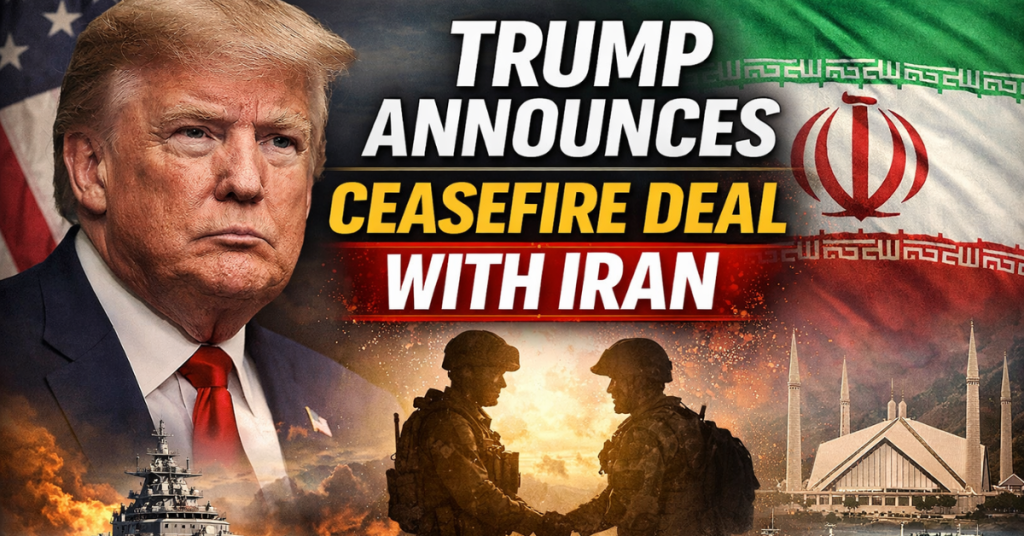
President Donald Trump announced Tuesday night that the United States will suspend military operations against Iran for two weeks, following a proposal brokered through Pakistan and contingent on the reopening of the Strait of Hormuz.
The announcement came after high-level discussions involving Pakistani Prime Minister Shehbaz Sharif and Field Marshal Asim Munir, who urged the U.S. to delay planned strikes in order to create space for diplomatic progress.
In a statement posted to Truth Social, Trump said the ceasefire is conditional on Iran ensuring the “complete, immediate, and safe opening” of the strategic waterway.
“Based on conversations with Prime Minister Shehbaz Sharif and Field Marshal Asim Munir… I agree to suspend the bombing and attack of Iran for a period of two weeks,” Trump wrote. “This will be a double-sided ceasefire.”
Iran Confirms Cooperation and Temporary Opening
Iranian officials quickly confirmed their participation in the arrangement. According to statements attributed to Foreign Minister Abbas Araghchi, Tehran has agreed to facilitate limited maritime access through the Strait of Hormuz during the two-week period.
Safe passage, however, will be subject to coordination with Iran’s armed forces and certain operational constraints.
Iran’s Supreme National Security Council also confirmed acceptance of the temporary ceasefire and indicated that formal negotiations with U.S. officials are scheduled to begin in Islamabad later this week.
Strategic Importance of the Strait
The Strait of Hormuz remains one of the world’s most critical energy chokepoints, with a significant portion of global oil shipments passing through the narrow corridor. Any disruption to traffic in the strait has immediate implications for global energy markets and economic stability.
The reopening—albeit temporary—signals a potential de-escalation after days of heightened tensions and military threats.
U.S. Signals Shift Toward Negotiation
Trump framed the ceasefire as a strategic pause following what he described as successful U.S. military objectives.
“We received a 10-point proposal from Iran and believe it is a workable basis on which to negotiate,” Trump said. “Almost all points of past contention have been agreed to… this two-week period will allow the agreement to be finalized.”
He also suggested that broader regional interests are at stake, noting that the U.S. is acting “on behalf of the countries of the Middle East” in pursuing a long-term resolution.
Escalation Preceded Agreement
The ceasefire announcement follows a series of stark warnings from the White House. Earlier in the week, Trump issued a deadline for Iran to reopen the strait, threatening sweeping military action targeting infrastructure, including power plants and bridges.
In one of his more dramatic statements, Trump warned that Iran’s “whole civilization” could face destruction if demands were not met.
The rapid shift from brinkmanship to negotiation underscores the volatile nature of the standoff—and the role of third-party intermediaries like Pakistan in facilitating dialogue.
What Comes Next
With talks expected to begin in Islamabad, attention now turns to whether the two-week window can produce a durable agreement.
Key questions remain, including:
- Whether Iran will maintain uninterrupted access through the Strait of Hormuz
- The specifics of the reported 10-point proposal
- And whether both sides can convert a temporary ceasefire into a longer-term framework
For now, the agreement offers a narrow but significant opening to avoid further escalation in a region already under intense geopolitical pressure.