



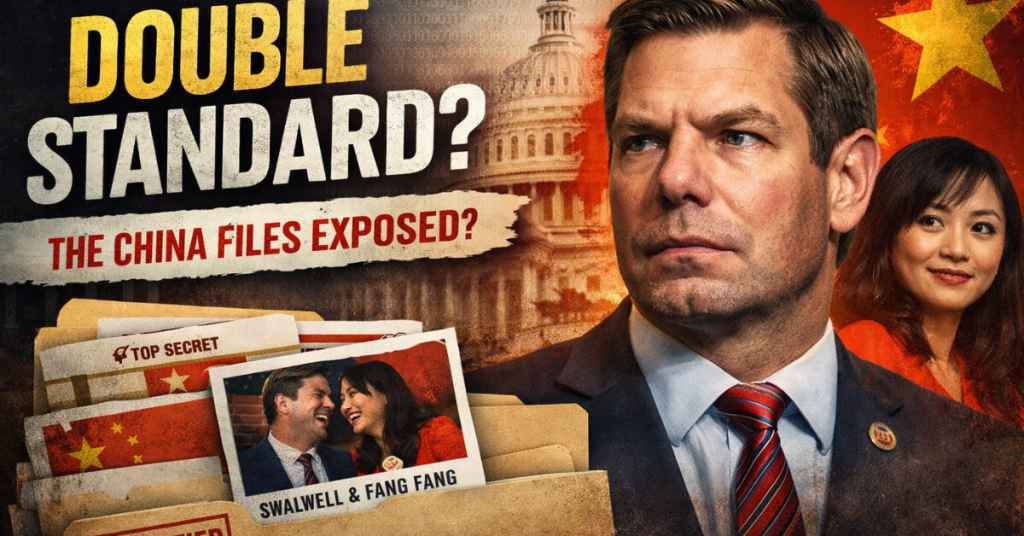
The debate over government transparency has taken a sharp and politically charged turn, as Rep. Eric Swalwell now finds himself on the opposite side of a principle he once championed. The unfolding controversy surrounding the Eric Swalwell China files raises a broader question: is transparency a consistent standard, or a selective weapon in Washington?
A Sudden Shift on Transparency
For years, Swalwell positioned himself as one of Congress’s most vocal advocates for full disclosure in high-profile investigations. From demanding the complete release of the Mueller report to pressing for unredacted Epstein documents, his stance was clear: the public deserved to see everything, even if it implicated individuals who were never charged.
That posture, however, appears to have shifted.
According to reports, Swalwell is now actively opposing the potential release of classified materials related to Chinese influence operations in U.S. politics—documents that may include references to his past interactions with Christine Fang, a suspected Chinese intelligence asset.
The Fang Connection
Christine Fang, also known as “Fang Fang,” was identified by U.S. intelligence officials as part of a broader Chinese political influence effort between 2011 and 2015. Her activities reportedly included cultivating relationships with rising political figures, including Swalwell.
While Swalwell has denied any wrongdoing, and a House Ethics Committee investigation ultimately took no action against him, the existence of an FBI counterintelligence probe has remained a point of public interest.
Now, with the possibility that these files could be released more broadly, Swalwell’s legal team is pushing back—arguing that such disclosure would be politically motivated and damaging.
A Double Standard?
The tension lies in contrast.
Swalwell previously argued that even unproven allegations should be exposed if transparency served the public interest. In the case of Epstein-related materials, he dismissed concerns about naming individuals who had not been charged, emphasizing accountability over privacy.
But when the situation potentially involves his own reputation, the argument changes.
Critics have seized on this reversal, framing it as a textbook case of selective transparency—where openness is demanded when politically advantageous, and resisted when personally risky.
Broader Implications: Transparency vs. Political Weaponization
The Eric Swalwell China files controversy is not just about one congressman. It touches on a deeper issue in American politics: whether transparency has become less about principle and more about leverage.
Key concerns include:
- National security vs. political exposure: Should intelligence files be released if they risk revealing sensitive methods or unverified associations?
- Due process vs. public curiosity: Where is the line between informing the public and damaging reputations without charges?
- Consistency in standards: Can lawmakers credibly demand transparency if they apply it selectively?
The China Influence Question
Beyond the political drama, the underlying issue remains serious. U.S. intelligence agencies have repeatedly warned about foreign influence operations, particularly from China, targeting local and national politicians.
If the files in question contain new or detailed insights into those efforts, their release could have implications far beyond Swalwell—potentially reshaping how the public understands foreign interference in American democracy.