



Trump Floats “Friendly Takeover” of Cuba
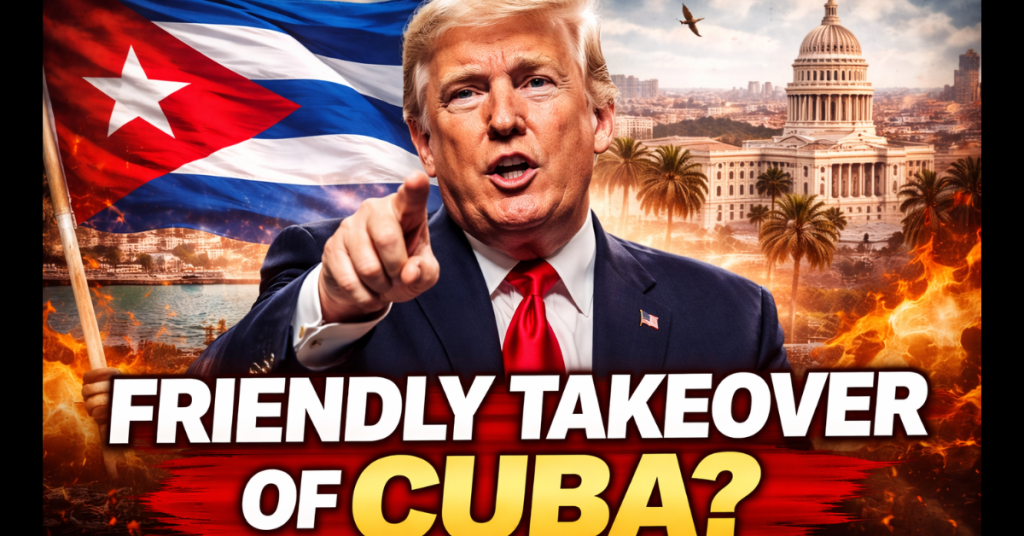
President Donald Trump sparked immediate international attention Friday after suggesting the United States could one day assume control of Cuba through what he described as a “friendly takeover,” a remark that signals a potentially dramatic shift in Washington’s approach toward the communist-run island.
Speaking to reporters outside the White House, Trump said the U.S. is currently engaged in high-level discussions with Cuban officials and portrayed the country as facing severe economic collapse.
“The Cuban government is talking with us,” Trump said. “They have no money. They have no anything right now… maybe we’ll have a friendly takeover of Cuba.”
The president did not clarify what such a takeover would entail, leaving analysts debating whether he was referring to economic integration, political transition, or a broader diplomatic restructuring of relations between the longtime adversaries.
Talks Emerging Amid Crisis on the Island
According to administration officials, Secretary of State Marco Rubio — himself the son of Cuban immigrants and a longtime critic of Havana’s communist leadership — has been involved in ongoing discussions with Cuban representatives at what Trump described as a “very high level.”
The comments come as Cuba faces one of its worst economic crises in decades. Fuel shortages, declining foreign currency reserves, and reduced energy supplies have strained the island’s economy, conditions the White House appears to view as creating leverage for negotiations.
Trump framed the situation as an opportunity for a positive outcome, particularly for Cuban exiles living in the United States who have long hoped for political change in their homeland.
A Relationship Defined by Conflict
U.S.–Cuba relations have remained tense for more than six decades, shaped by Cold War rivalries and ideological confrontation. After Fidel Castro’s 1959 revolution replaced the U.S.-backed Batista government, Washington imposed sweeping sanctions that evolved into a full trade embargo still largely in place today.
American attempts to remove the Cuban government historically included the failed 1961 Bay of Pigs invasion, a CIA-backed operation that deepened hostility and helped cement Cuba’s alliance with the Soviet Union.
While diplomatic relations briefly thawed during the Obama administration’s normalization efforts between 2015 and 2017, tensions later returned as sanctions tightened and political disagreements resurfaced.
Trump’s latest remarks therefore represent a striking rhetorical departure — invoking not regime pressure alone, but the possibility of some form of cooperative transition.
Mixed Reactions at Home and Abroad
Cuban officials have historically insisted that any negotiations must respect national sovereignty, and Trump’s language immediately raised concerns among observers wary of echoes from earlier eras of U.S. intervention in the Caribbean.
Foreign policy experts noted that the phrase “friendly takeover” has no clear diplomatic definition, making it difficult to assess whether the president was describing a serious policy proposal or negotiating rhetoric aimed at increasing pressure on Havana’s leadership.
Meanwhile, humanitarian and civil society groups warned that intensified economic pressure — including restrictions affecting fuel and trade — could worsen conditions for ordinary Cubans even as political talks continue.
Strategic Calculations
The administration’s Cuba posture appears tied to broader regional developments, including shifting alliances in Venezuela and changes in energy flows that have weakened Havana’s traditional economic lifelines.
Some analysts believe Washington may be attempting to encourage gradual political reforms through economic incentives rather than direct confrontation — a strategy blending sanctions pressure with negotiation.
Others see the comments primarily as political messaging aimed at domestic audiences, particularly Cuban-American voters who have historically supported a hardline stance toward the island’s government.