



The School Gender Policy Battle Goes National Tonight
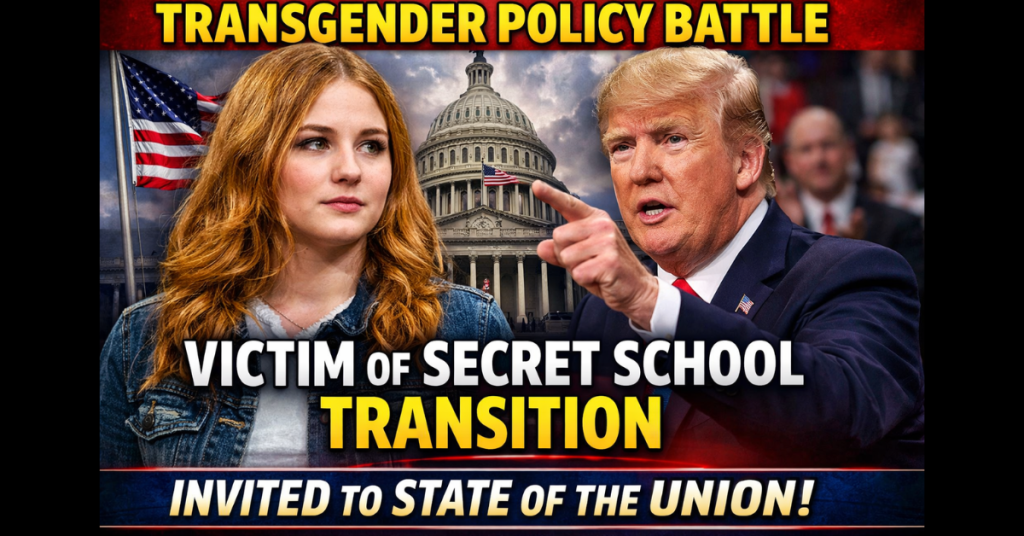
President Donald Trump is expected to spotlight one of the country’s most contentious education and parental-rights battles during his upcoming State of the Union address, inviting a Virginia college student whose family’s legal fight has become a flashpoint in the national debate over gender policies in public schools.
According to reporting confirmed by White House officials, Sage Blair — now a student at Liberty University — will attend the address alongside her mother, Michele Blair. The president is expected to reference her story while urging states to restrict medical gender transition procedures for minors and expand parental notification requirements in schools.
The invitation elevates a years-long legal dispute involving Appomattox County Public Schools into a national political moment, intertwining education policy, parental authority, and federal civil rights law.
A Lawsuit That Sparked National Attention
The controversy stems from events beginning in 2021, when Blair was a freshman at Appomattox County High School in Virginia.
According to federal court filings, school staff allowed the teenager to adopt a male name and pronouns and use male facilities without informing her legal guardian. The lawsuit alleges school officials continued affirming the student’s gender identity while failing to notify parents about both the identity change and reported harassment by classmates.
Michele Blair later sued the school board and several staff members, arguing that administrators violated her constitutional parental rights and showed deliberate indifference to ongoing bullying and safety concerns.
Court documents state the student experienced threats, harassment, and escalating psychological distress during the school year. After a series of incidents, she ran away from home and was later victimized by sex traffickers across multiple states before being recovered by authorities.
The case drew widespread media coverage and quickly became part of a broader national dispute over whether schools should disclose gender-identity issues to parents.
Appeals Court Revives Key Claim
In 2025, the U.S. Court of Appeals for the Fourth Circuit issued a mixed ruling that revived part of the family’s lawsuit.
While dismissing several constitutional claims, the appellate court ruled that the family’s Title IX allegation — asserting the school acted with “deliberate indifference” toward sexual harassment — was sufficiently supported to proceed. The case was sent back to lower court for further litigation.
Legal analysts noted the decision could influence how schools nationwide respond to student gender identity issues and harassment complaints under federal anti-discrimination law.
Title IX requires schools receiving federal funds to take meaningful steps to stop sex-based harassment once they are aware of it, a standard the court said may not have been met if allegations prove accurate.
Competing Narratives: Protection vs. Privacy
Supporters of the Blair family argue the case illustrates a growing conflict between parental authority and institutional policies designed to protect student privacy.
The lawsuit claims school personnel deliberately concealed information from parents, preventing early intervention during a period of mental health vulnerability.
Education advocates on the other side of the debate have argued that confidentiality policies are intended to protect students who fear rejection or harm at home — a tension increasingly playing out in legislatures and courtrooms nationwide.
The dispute has helped fuel legislative proposals sometimes referred to as “parental rights” or “notification” laws, requiring schools to inform guardians when students request gender-related accommodations.
Political Context Ahead of the Speech
Trump’s decision to feature Blair during the State of the Union signals that gender policy — particularly involving minors — will remain a central cultural and legislative priority during his second term.
Administration officials have already announced initiatives aimed at limiting gender transition procedures for minors and opposing policies allowing biological males to compete in women’s sports, framing both issues as matters of fairness and parental consent.
Presidents from both parties have historically invited guests whose personal stories reinforce policy themes, using the nationally televised address to humanize legislative agendas.
A Case Still Unfolding
Despite the political attention, the legal battle itself remains unresolved. The revived Title IX claim means courts will continue examining whether school officials acted reasonably in responding to harassment allegations and whether parents were improperly excluded from critical decisions affecting their child.
For now, Blair’s appearance at the State of the Union represents more than a personal milestone — it marks the transformation of a local school dispute into a national symbol within America’s ongoing culture and education debates.
As the courts weigh the legal questions, policymakers across the country are already using the case as a reference point in shaping future education laws — ensuring its impact will likely extend far beyond one Virginia school district.