



Watchdog group sues FBI for alleged Tom Homan “bribe tape” under FOIA
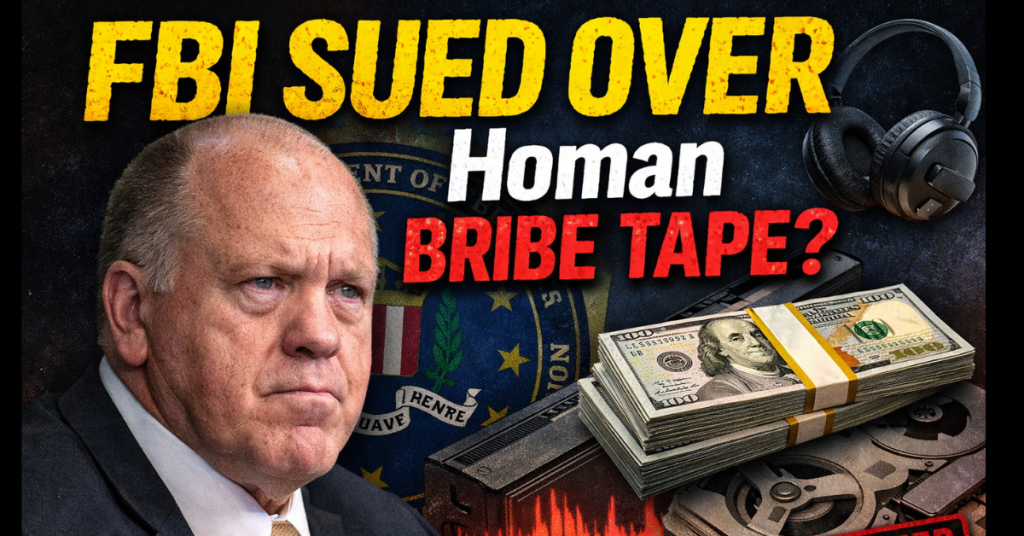
A government-transparency fight is landing in federal court after the Democracy Defenders Fund (DDF) sued the FBI in Washington, D.C., seeking records tied to an investigation into Trump administration “Border Czar” Tom Homan — including any “original and unedited” audio recordings and related investigative materials.
What DDF is asking for
According to the complaint, DDF submitted a FOIA request to the FBI on Sept. 23, 2025, seeking (among other items):
-
All original and unedited audio recordings, video footage, and/or photographs connected to Homan’s communications with FBI agents — including undercover agents — in a narrow window around September 2024.
-
All records related to any FBI investigation into Homan’s alleged bribery or related conduct, including investigative summaries, interview reports, and case-file materials across a broader time range (June 2024 through Sept. 21, 2025).
DDF argues the public interest is especially strong because Homan’s current role is a senior White House position influencing major policy and large federal spending decisions.
Why the lawsuit was filed
DDF’s lawsuit claims the FBI:
-
Denied the request in full on Jan. 5, 2026, relying on FOIA Exemptions 6 and 7(C) — commonly used to protect personal privacy in personnel/medical files (Exemption 6) and law-enforcement records (Exemption 7(C)).
-
Did not timely decide DDF’s administrative appeal, prompting DDF to argue it has “exhausted” administrative remedies and can ask the court to compel production.
In plain terms: DDF is asking a judge to order the FBI to search for and release the requested records (or at least justify any withholdings more granularly), rather than issuing a categorical denial.
The allegation behind the request: a reported undercover “cash” meeting
The suit is rooted in earlier reporting that alleged Homan was recorded in an undercover operation accepting $50,000 in cash from individuals posing as potential government contractors, with the money allegedly tied to promises of help securing future contracts.
DDF’s complaint cites that reporting and describes an investigation that began late in the Biden administration and was later dropped after Trump returned to office — a decision that has become a core political dispute in the story.
Homan has denied wrongdoing, and the White House has characterized the matter as politically motivated; some officials have publicly disputed the premise that a bribe occurred.
The broader politics: transparency demands vs. privacy exemptions
This case sits at the intersection of two recurring FOIA battlegrounds:
-
How much privacy protection applies when the requested records relate to alleged corruption involving a senior public official; and
-
How specific an agency must be when withholding records (for instance, whether it can “categorically” deny everything, or must describe what it has and why each portion is exempt).
DDF argues there is no legitimate privacy interest in concealing records of alleged public corruption and that the public has a right to understand both (a) what the FBI investigated and (b) why the investigation was ended.
What happens next
Procedurally, FOIA cases often move fast compared with other federal litigation, because the main issue is usually the legality of withholdings rather than witness testimony. The government typically must:
-
Answer the complaint,
-
Produce a “Vaughn index” or similar description of withheld materials (depending on the court’s orders), and
-
Justify exemptions with declarations.
Outcomes can range from full release, to partial release with redactions, to an order that the agency re-process the request more narrowly. (Sometimes the fight ends in a negotiated production schedule.)
Why this lawsuit matters even beyond Homan
Regardless of what the recording does or doesn’t show, the case is a live test of how far agencies can go in refusing access to records of alleged misconduct by top officials. It also underscores a broader reality: FOIA is frequently the only practical mechanism for the public to obtain underlying evidence when investigations are closed without charges — especially when reporting relies on anonymous sources and “internal documents,” and partisan narratives harden quickly.
Source links (labeled)
-
Democracy Defenders Fund press release (Feb. 17, 2026): https://www.democracydefendersfund.org/prs/02.17.26-pr
-
DDF v. FBI complaint (PDF via Just the News): https://justthenews.com/sites/default/files/2026-02/DDF%20v.%20FBI.pdf
-
Reuters (Sept. 21, 2025): https://www.reuters.com/world/us/trump-aide-homan-accepted-50000-bribery-sting-operation-sources-say-2025-09-21/
-
Associated Press (White House response): https://apnews.com/article/461cc66955e2ba25445a9bf931250580
-
POLITICO (report/denial context): https://www.politico.com/news/2025/09/20/tom-homan-department-of-justice-investigation-00574379