



Labor unions are leading the anti-ICE resistance
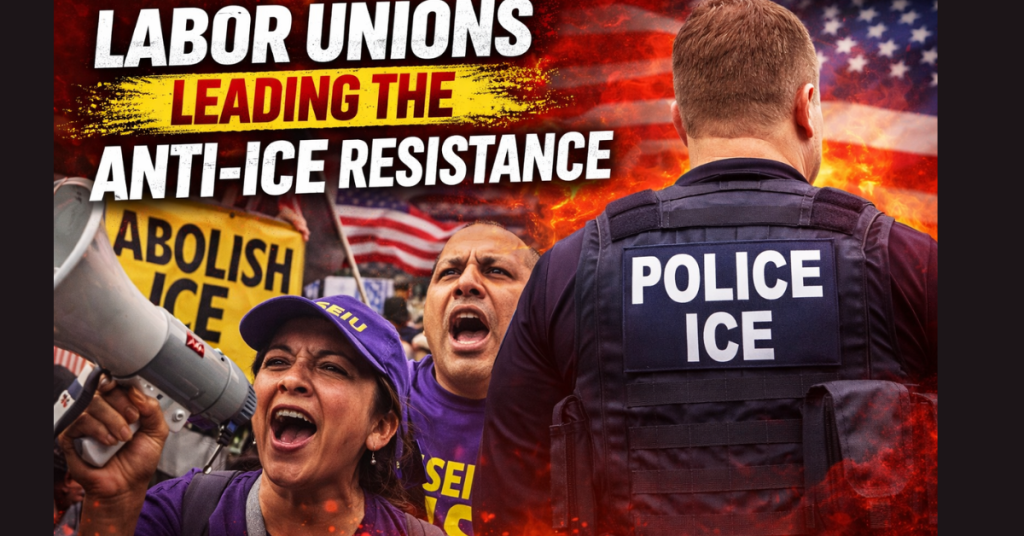
For much of American history, organized labor viewed mass immigration—especially illegal immigration—as a direct threat to wages, job security, and collective bargaining power. Today, that position has flipped almost entirely. Some of the nation’s largest and most influential unions are now among the most vocal opponents of immigration enforcement, leading protests, strikes, and training campaigns aimed at pushing Immigration and Customs Enforcement (ICE) out of workplaces and communities during the Trump administration’s renewed crackdown.
A New Role for Organized Labor
Since Donald Trump returned to office, unions including the Service Employees International Union (SEIU), United Auto Workers, and multiple affiliates of the AFL-CIO have mobilized against deportation operations. Their tactics have ranged from mass demonstrations and general strikes to “know-your-rights” trainings designed to limit cooperation with federal immigration authorities.
The AFL-CIO has gone so far as to host an online strike-tracking map highlighting work stoppages organized by its affiliates, many of which are explicitly tied to opposition to ICE actions. Union leaders argue that enforcement operations endanger workers, disrupt communities, and create fear in workplaces—particularly in healthcare, service, and manufacturing sectors with large immigrant labor forces.
Alliances With the Radical Left
Unlike earlier labor protests focused narrowly on wages and benefits, today’s anti-ICE actions often place unions in direct partnership with overtly ideological groups. Investigative reporting has documented union coordination with organizations such as the Party for Socialism and Liberation, the People’s Forum, the Revolutionary Communists of America, and local chapters of the Communist Party USA.
In Minnesota, these alliances culminated in a statewide general strike following two fatal shootings linked by federal authorities to interference with ICE operations. After the death of healthcare worker Alex Pretti—himself a member of an AFL-CIO-affiliated union—the AFL-CIO issued a statement demanding ICE leave the state entirely and calling on Congress to hold the agency “accountable.” Union-backed coalitions such as “ICE Out Now” organized a January shutdown that urged “no work, no school, no shopping,” drawing thousands into the streets.
Training Workers to Resist Enforcement
Beyond protests, unions have moved enforcement resistance inside the workplace. SEIU affiliates in Minnesota, Iowa, and California have hosted what they describe as “critical and confidential” trainings for healthcare workers, focused on how to respond if ICE agents appear at medical facilities. Promotional materials accuse ICE of creating “fear, chaos, and violence” and encourage workers to pressure employers to block cooperation with federal agents.
SEIU has been especially visible in this role. During immigration raids in Los Angeles last year, SEIU California president David Huerta was arrested and charged with conspiring to impede a federal officer after allegedly blocking a vehicle. The union claimed he was “peacefully bearing witness,” while prosecutors argued his actions crossed into obstruction. Subsequent protests escalated into riots that included assaults on federal officers, arson involving self-driving vehicles, and the shutdown of major highways.
A Sharp Break From Labor’s Past
This militancy represents a dramatic reversal from organized labor’s historical stance. As labor economist Vernon Briggs of Cornell University testified to Congress in 2007, few issues have caused more internal conflict within the labor movement than immigration. Early unions overwhelmingly favored restriction and enforcement, fearing that an oversupply of labor would undercut bargaining power.
The National Labor Union pushed for the Chinese Exclusion Act of 1882. The early American Federation of Labor, under founding president Samuel Gompers, supported literacy tests and backed the Immigration Acts of 1921 and 1924, which imposed strict numerical limits on immigration. Even the United Farm Workers, led by labor icon Cesar Chavez, actively opposed illegal immigration, at times organizing informal border patrols to prevent strikebreaking by undocumented laborers.
How the Reversal Happened
The pivot began in the late 20th century as unions like SEIU expanded into industries increasingly populated by undocumented workers. Leaders such as Eliseo Medina—now a senior SEIU official—argued that organizing these workers required abandoning opposition to illegal immigration itself. By 2000, the AFL-CIO formally reversed decades of policy and endorsed broad amnesty, reframing immigration enforcement as incompatible with labor rights.
That strategic shift reshaped union priorities. Where organized labor once lobbied Congress to limit immigration, it now often frames enforcement as a moral and political injustice—one intertwined with broader left-wing causes around race, identity, and state power.
What It Means Going Forward
The transformation of American unions into a core pillar of the anti-ICE movement highlights a deeper change in the labor movement’s identity. No longer focused solely on wages and contracts, major unions increasingly operate as political actors aligned with progressive and, in some cases, openly socialist organizations.
For supporters, this represents solidarity with vulnerable workers. For critics, it marks a departure from labor’s original mission—protecting American workers from labor market saturation—and raises questions about whether unions now serve ideology first and members second. Either way, the sight of unions leading nationwide strikes to shut down immigration enforcement would have been almost unthinkable just a generation ago.