



“Greenland’s Strategic Value Rises as Arctic Defense Heats Up”
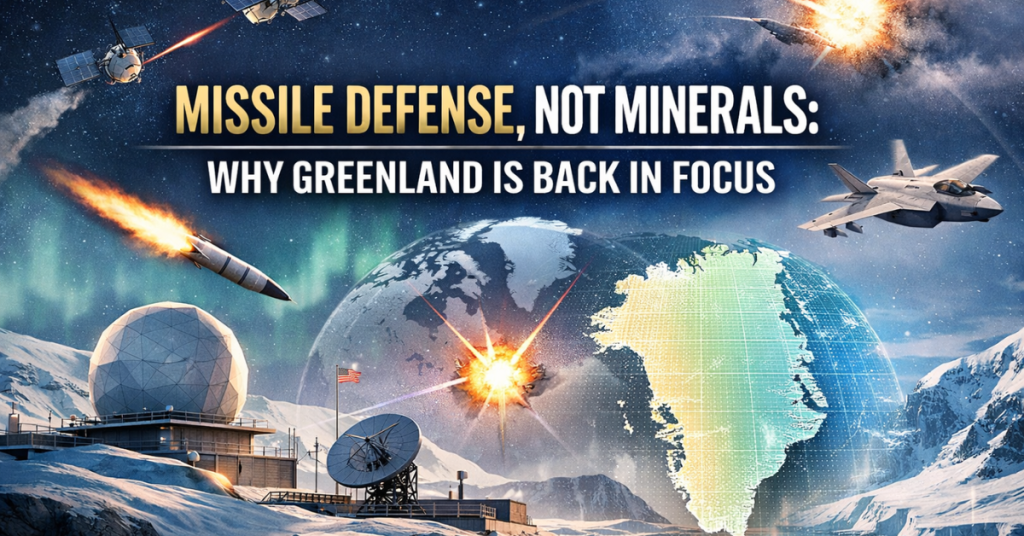
When President Donald Trump floated the idea of purchasing Greenland in 2019, the proposal was widely dismissed as unserious. Six years later, shifting military realities in the Arctic and renewed focus on missile defense and space-based surveillance have led U.S. defense planners and allied governments to revisit Greenland’s strategic importance—though not the prospect of outright acquisition.
At the center of renewed interest is geography. Greenland occupies a critical position along the shortest flight paths between Eurasia and North America, routes known as “great circle” trajectories. These paths are the most likely avenues for intercontinental ballistic missiles launched from Russia, China, or North Korea toward the continental United States.
That geographic reality has long shaped U.S. defense planning. During the Cold War, Washington built early-warning radar systems across the Arctic to detect Soviet missile launches. Today, that legacy infrastructure has evolved into Pituffik Space Base, a U.S. Space Force installation in northwest Greenland that supports missile warning, space surveillance, and communications.
Missile Defense and Space Architecture
The Pentagon is currently evaluating options for expanding layered homeland missile defense, including concepts sometimes referred to as a “Golden Dome”—a system that would combine ground-based interceptors, space-based sensors, and rapid data links to detect and respond to missile threats earlier in their flight.
Greenland’s high latitude makes it particularly valuable for this mission. Missile intercepts are most feasible during the midcourse phase, when warheads travel through space before reentering the atmosphere. Sensors and interceptors positioned far north increase the time window for detection and engagement.
In parallel, the U.S. is expanding its reliance on proliferated satellite constellations in low Earth orbit for missile tracking and communications. Polar-orbiting satellites pass over the Arctic on every revolution, allowing ground stations at high latitudes to maintain more frequent contact than facilities located in the continental United States. Greenland’s cold, dry climate is also well suited for advanced laser-based and high-frequency communications.
Arctic Competition and Allied Politics
U.S. interest in Greenland must also be viewed within the broader context of Arctic competition. Russia has expanded its military infrastructure along its northern coastline, while China has declared itself a “near-Arctic state” and increased scientific, commercial, and diplomatic activity in the region.
Despite this growing competition, both Greenlandic and Danish officials have consistently rejected the idea of transferring sovereignty. Greenland is an autonomous territory within the Kingdom of Denmark, with extensive self-rule and a legally recognized right to self-determination. Any change in sovereignty would require the consent of Greenland’s population, which political leaders say is not forthcoming.
Instead, Greenland’s government has emphasized strengthening defense cooperation through NATO and existing bilateral agreements, rather than unilateral U.S. control.
Svalbard and Treaty Constraints
Greenland is not the only Arctic territory drawing attention from defense planners. The Norwegian archipelago of Svalbard, located roughly halfway between mainland Norway and the North Pole, occupies a similarly advantageous latitude for satellite ground stations and missile detection.
However, Svalbard is governed by the 1920 Svalbard Treaty, which grants Norway sovereignty while requiring the islands to remain demilitarized and open to commercial activity by all signatory nations—including Russia and China. Russia maintains a longstanding commercial presence on the islands through state-linked mining operations, creating ongoing security concerns for Norway and its NATO allies.
In recent years, Norwegian authorities have intervened to block the sale of private land on Svalbard to foreign buyers, citing national security concerns. These actions highlight the legal and diplomatic constraints that complicate any effort to expand military activity in the High Arctic.
Access Over Ownership
Taken together, Greenland and Svalbard illustrate the changing strategic importance of the Arctic as missile defense, space surveillance, and great-power competition increasingly converge at high latitudes. While the idea of purchasing Greenland remains politically and legally implausible, U.S. officials appear focused on more practical objectives: expanded basing rights, upgraded sensors, and deeper integration of Arctic infrastructure into NATO defense planning.
As missile technology advances and polar routes grow more central to global security calculations, access—rather than ownership—has become the operative priority. The top of the world is no longer peripheral, but it remains governed by a complex web of alliances, treaties, and sovereignty that limits how far any single power can go.