



The Global Health Plan That Assumes You’ll Comply
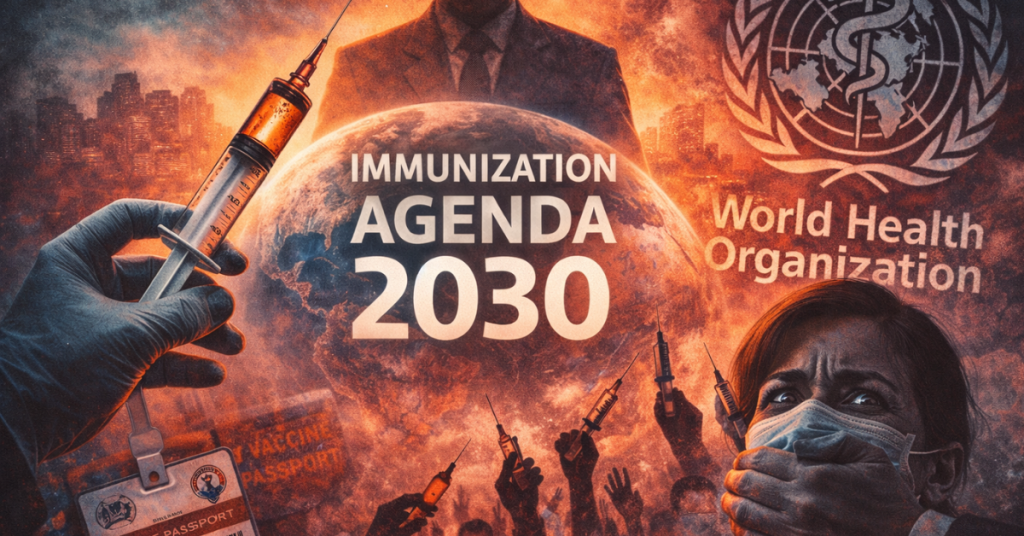
A short clip circulating online has reignited a familiar debate: who decides what “health” means—and how far that authority extends? The remarks, tied to World Health Organization’s Immunization Agenda 2030, were welcomed by pediatric leaders including Lee Savio Beers of the American Academy of Pediatrics. The language was upbeat and familiar: “no adult or child left behind,” “everyone, everywhere,” “fully benefits from vaccines.”
On its face, IA2030 is presented as a framework to expand vaccine access worldwide, particularly in poorer countries where routine childhood immunization has lagged. But for many observers—especially after the last four years—this kind of language raises red flags rather than reassurance.
From Access to Assumption
The core concern isn’t whether vaccines can be beneficial in specific contexts. It’s the assumption of universality embedded in global health rhetoric. IA2030 doesn’t merely emphasize access; it reframes immunization as a lifelong expectation, spanning childhood, adolescence, adulthood, and old age. Once that premise is accepted, dissent becomes deviation—and opting out becomes a problem to be “solved.”
That shift matters. When health authorities move from offering medical tools to normalizing permanent compliance, the burden of proof subtly flips. The question is no longer “Should this intervention be used here?” but “Why aren’t you participating?”
Who Decides—and Who Enforces?
IA2030 is not a law. It does not, on paper, mandate injections. But global frameworks rarely remain abstract. They are designed to be translated into national policy, funding requirements, school standards, workplace rules, and insurance incentives. What begins as guidance becomes leverage—especially when tied to international aid, accreditation, or emergency powers.
Critics point out that the same institutions now calling for lifelong immunization were deeply involved in pandemic policies that sidelined informed consent, suppressed debate, and punished dissenting scientists and physicians. Trust, once broken, is not restored by slogans.
“No One Left Behind” Sounds Comforting—Until It Isn’t
The phrase “no one left behind” has a moral weight that discourages questioning. Who wants to be seen as opposing children’s health? But the phrase also erases individual risk, medical nuance, and personal conscience. It treats the human body as a site for standardized intervention rather than a domain of personal autonomy.
After COVID, many people learned the hard way that “emergency” frameworks expand quickly and contract slowly—if at all. Temporary measures became semi-permanent systems. Data collection expanded. Liability was shielded. Debate was labeled dangerous.
Against that backdrop, skepticism isn’t paranoia—it’s memory.
A Pattern, Not an Isolated Plan
IA2030 fits neatly into a broader pattern: centralized health governance, harmonized standards, and diminished national discretion, all justified by crisis preparedness. Whether the next emergency is real or declared, the infrastructure is being built now.
Supporters say this is about saving lives. Skeptics ask a different question: saving lives on whose terms, with whose authority, and at what cost to freedom?
The Question That Matters
The real issue is not whether vaccines exist, but whether medical decisions are drifting away from patients and toward permanent global policy regimes. Once “everyone, everywhere” becomes the operating principle, opting out stops being a choice—and starts looking like noncompliance.
For a public that has already seen how quickly public health can become political power, IA2030 deserves scrutiny, not applause.
Because the most dangerous phrase in modern governance is not “mandate.”
It’s “for your own good.”