



House Oversight Panel votes to advance contempt resolutions against the Clintons
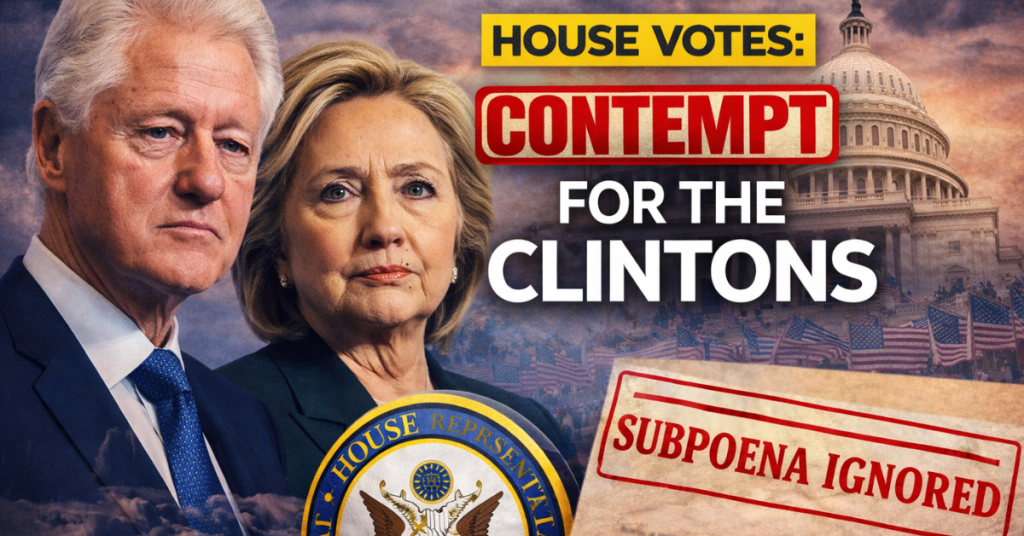
The House Oversight and Accountability Committee voted Wednesday to advance resolutions holding former President Bill Clinton and former Secretary of State Hillary Clinton in contempt of Congress after both declined to comply with subpoenas compelling testimony before the panel.
In two separate votes, committee members approved the Bill Clinton contempt resolution by a margin of 34–8 and the Hillary Clinton resolution by 28–15. The measures now move to the full House of Representatives, where a simple majority vote would authorize referrals to the Department of Justice for potential criminal contempt proceedings.
If approved by the House, the referrals would place the Justice Department in the position of deciding whether to prosecute two of the most prominent figures in modern Democratic Party history—a step that carries both legal and political significance.
Epstein Inquiry at the Center of the Dispute
The subpoenas stem from the Oversight Committee’s investigation into the federal government’s handling of the Jeffrey Epstein case, particularly lingering questions about Epstein’s network of powerful associates and the Department of Justice’s past decisions related to prosecution, plea agreements, and investigative scope.
Committee members have expressed frustration with what they describe as years of institutional opacity surrounding Epstein’s relationships with political, financial, and international elites. Bill Clinton’s documented past association with Epstein, including travel on Epstein-linked aircraft, and Hillary Clinton’s role as Secretary of State during a period when Epstein-related matters intersected with diplomatic and prosecutorial decisions, prompted the panel to seek sworn testimony.
Neither Clinton appeared before the committee, nor did their legal teams negotiate an alternative accommodation such as a closed-door deposition—an option sometimes used to resolve subpoena disputes.
Contempt of Congress: A Rare but Serious Step
Criminal contempt of Congress is governed by federal statute and applies when a witness willfully refuses to comply with a lawful subpoena. Once referred, the case is sent to the U.S. Attorney for the District of Columbia, who has discretion over whether to pursue prosecution.
Historically, DOJ prosecution of contempt referrals has been inconsistent and often influenced by executive branch priorities. According to reporting by Reuters and The Associated Press, the Justice Department has declined to prosecute several contempt referrals in recent decades, particularly when executive privilege or separation-of-powers issues are asserted.
However, during the Biden administration, DOJ pursued criminal contempt charges against former Trump advisers Peter Navarro and Steve Bannon after they refused subpoenas from the House January 6 Committee. Both were convicted and received prison sentences—establishing a modern precedent for enforcement.
Oversight Committee members supporting the Clinton resolutions argue that equal application of the law requires similar treatment across administrations and political affiliations.
Political and Institutional Ramifications
The votes are likely to intensify debates over selective enforcement and institutional credibility. Critics of the move argue that compelling testimony from former presidents and secretaries of state risks politicizing congressional oversight, while supporters counter that high office cannot confer immunity from lawful inquiry.
Legal analysts cited by Politico and Congressional Quarterly note that even if the House approves the contempt resolutions, DOJ prosecution is far from guaranteed—particularly given the department’s long-standing reluctance to pursue cases involving former senior officials absent clear evidence of criminal intent.
Still, the advancement of the resolutions alone marks a rare escalation and signals a willingness by House Republicans to test the boundaries of congressional authority.
What Happens Next
The full House is expected to consider the contempt resolutions in the coming weeks. If passed, the referrals would formally land on the desk of the Justice Department, setting up a politically fraught decision with implications for future oversight enforcement.
Whether DOJ acts or declines, the episode underscores a broader institutional question confronting Congress: can oversight retain legitimacy if subpoenas are enforced selectively, or ignored by the most powerful figures in American politics?
DailyClout will continue monitoring House action and DOJ responses as the situation develops.