



Big Pharma Update: What Matters Most Right Now
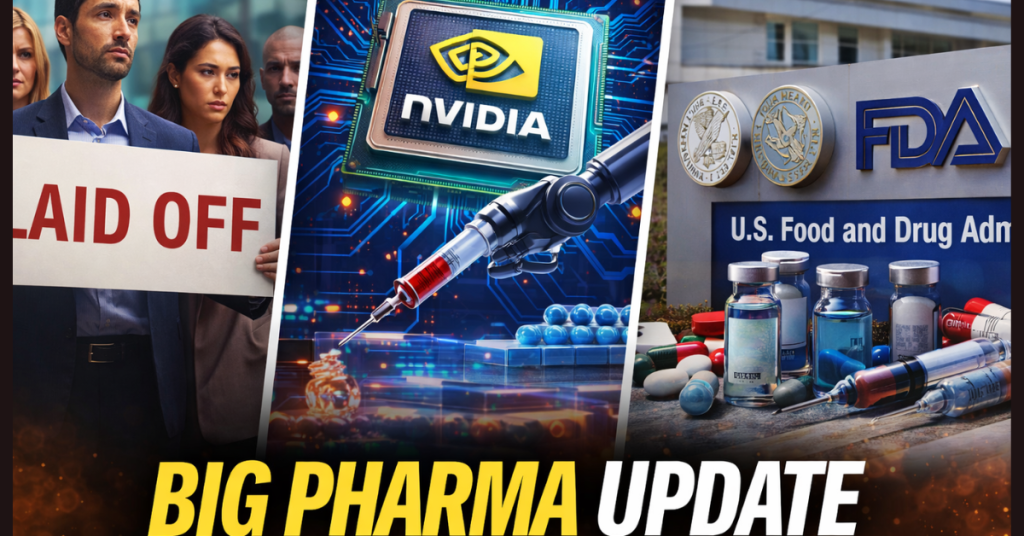
1. Big Pharma Goes All-In on AI With Billion-Dollar Bets
Two of the world’s largest drugmakers are doubling down on artificial intelligence, signaling where the industry believes power—and profit—will come from next.
-
Eli Lilly and Company and NVIDIA announced a $1 billion, five-year AI research lab in the San Francisco Bay Area.
-
AstraZeneca also acquired AI firm Modella AI to expand “agentic” and generative AI capabilities in oncology research.
Why it matters:
This marks a major shift away from traditional drug discovery toward algorithm-driven medicine, raising questions about transparency, accountability, and whether patient outcomes—or speed to market—are the real priority.
2. Mass Layoffs Expose Pharma’s Boom-Bust Reality
While executives announce record investments and acquisitions, tens of thousands of workers are being cut.
-
25,367 U.S. pharma jobs were eliminated in 2025, nearly double the prior year.
-
Companies like Lyra Therapeutics halted drug development and laid off most of their staff, even as capital continues to flood into AI and acquisition deals elsewhere.
Why it matters:
Big Pharma is increasingly financialized—cutting human labor while funneling capital into speculative tech and mergers. The contrast between layoffs and billion-dollar deals highlights an industry prioritizing shareholder value over workforce stability.
3. FDA Blocks Drugs—Even as Pharma Pushes Faster Approvals
The regulatory system is showing signs of strain as the FDA pushes back against weak clinical evidence.
-
Atara Biotherapeutics received an FDA Complete Response Letter, rejecting accelerated approval for EBVALLO due to insufficient trial design.
-
At the same time, regulators are publishing new guidance on AI use across the drug lifecycle, potentially reshaping how future drugs are evaluated.
Why it matters:
This exposes tension between speed and safety. While companies push for faster approvals—often citing “emergency” or “accelerated” pathways—regulators are signaling limits, even as AI threatens to further compress timelines.
The Bigger Picture
Taken together, these developments show an industry consolidating power, automating decision-making, and cutting labor, all while demanding faster regulatory approval and public trust. For patients, investors, and policymakers, the key question remains: who benefits most from this transformation—public health or corporate control?