



Europe Is Not Ready for a Long War
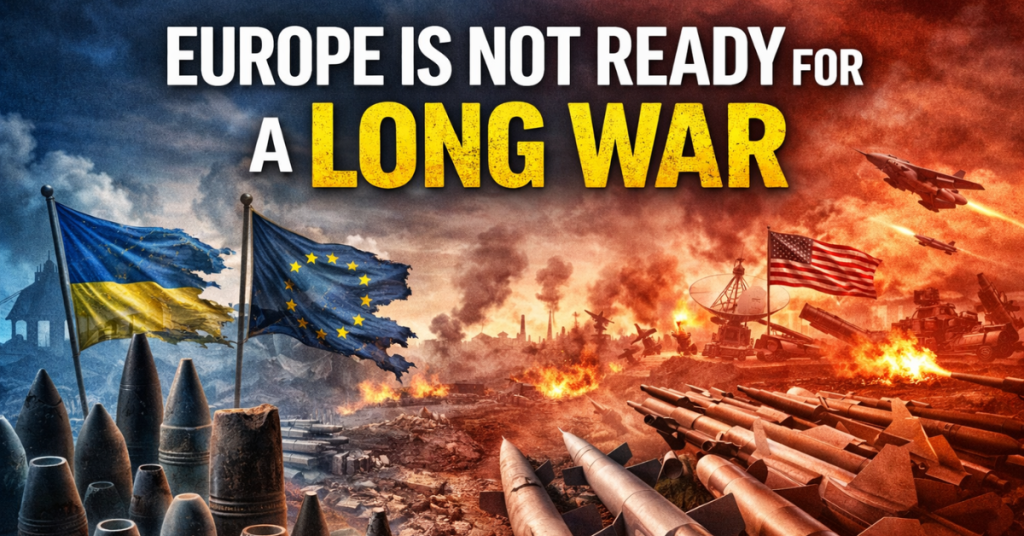
For three years, the war in Ukraine has exposed an uncomfortable truth Western leaders once preferred to avoid: wars are not won by declarations, summits, or strategy papers. They are won by factories, supply chains, logistics, and endurance. Ammunition stocks, air defenses, drones, spare parts, energy security, and trained labor matter far more than rhetorical unity.
Ukraine’s battlefield has become a stress test not just of armies, but of industrial systems. And Europe, despite being the primary geographic theater of the conflict, is discovering that its defense economy was never designed for sustained war.
That reckoning has now been sharpened by a second shock: the release of President Donald Trump’s new National Security Strategy. The document makes explicit what had been implicit for years—U.S. security commitments are no longer unconditional expressions of shared destiny. They are increasingly transactional, interest-driven, and politically contested at home.
Taken together, these forces are forcing Europe to confront a reality it has postponed since the Cold War ended. If Europe wants to remain strategically relevant, it cannot continue to outsource the material foundations of its own defense. It needs something far more demanding than higher budgets. It needs a war economy.
Europe’s Endurance Gap
High-intensity conflict in the 21st century is brutally consumptive. Ukraine fires artillery at rates that would have been considered unsustainable in NATO planning circles a decade ago. Air defense interceptors are expended faster than they can be replaced. Drones are destroyed by the thousands. Armored vehicles, electronics, sensors, and artillery barrels wear out rapidly under combat conditions.
Victory in such an environment depends less on exquisite platforms than on the ability to replace losses continuously. Endurance, not elegance, decides outcomes.
Europe’s defense-industrial base is ill-suited to this reality. It was optimized for efficiency, specialization, and short production runs in an era when prolonged industrial warfare was considered obsolete. Stockpiles were allowed to shrink after the Cold War. Production lines were kept warm, not hot. Skilled labor migrated to civilian industries. Energy-intensive heavy manufacturing was hollowed out by regulation, cost pressures, and environmental policy trade-offs.
As a result, even after years of war on its doorstep, Europe still struggles to produce basic military goods at the speed required for a sustained conflict. This is not primarily a question of money. Defense spending is rising across the continent. It is a production problem.
Without long-term contracts, predictable energy access, secure supply chains, and trained workforces, increased spending often translates into delays, cost overruns, and paper capacity rather than physical output. A true war economy is not something improvised during crisis. It is an industrial posture built in advance, with surge capacity embedded before the shooting starts.
The Depth of Europe’s U.S. Dependence
Europe’s industrial weakness is compounded by structural dependence on the United States across multiple strategic layers.
At the most basic level is space and intelligence. Modern warfare depends on satellite navigation, targeting, surveillance, and secure communications. While Europe operates some independent systems, much of its high-end battlefield awareness remains tied to U.S.-controlled military and commercial infrastructure. The nervous system of European military power is therefore not fully European.
Weapons servicing and logistics form the second layer. Many of Europe’s most advanced platforms—from aircraft to missile systems—depend on U.S.-supplied components, software updates, and maintenance chains. Sustained high-intensity operations often require ongoing American authorization and technical support, turning battlefield endurance into a political question.
At the strategic apex sits nuclear deterrence. With the partial exception of France, and with Britain now outside the European Union, Europe relies overwhelmingly on U.S. extended deterrence for ultimate protection. Escalation control at the highest level remains, in practice, an American decision.
A fourth layer is often overlooked: financial and digital infrastructure. Sanctions regimes, payment systems, cloud services, data centers, and software platforms have become instruments of power as consequential as missiles. Much of Europe’s financial and digital ecosystem remains embedded in legal and technical frameworks governed outside European jurisdiction. In peacetime, these arrangements appear efficient and benign. In crisis, they become leverage points.
For decades, these dependencies were treated as the natural dividends of alliance integration. In a world shaped by prolonged war and a more conditional U.S. security posture, they increasingly look like strategic constraints.
Fragmentation as a Structural Weakness
Europe’s defense industry remains fragmented along national lines. Multiple countries produce overlapping platforms with incompatible standards, limited interoperability, and small production volumes. Procurement remains politically national even when threats are continental.
The United States, by contrast, benefits from a relatively unified defense-industrial base dominated by a small number of large contractors capable of shifting production and scaling output more rapidly. The result is an uncomfortable imbalance. Europe is far better at buying advanced weapons than at producing them at scale.
In a short conflict, that imbalance can be masked. In a prolonged war of attrition, it becomes a liability.
A genuine European war economy would reverse this logic. It would prioritize continuous output over crisis-driven procurement. It would standardize platforms and narrow production lines to a limited number of systems produced in volume. And it would integrate defense production with energy policy, transport infrastructure, workforce training, and industrial innovation.
A Transactional Transatlantic Relationship
The new U.S. National Security Strategy does not signal an American withdrawal from Europe. U.S. forces, intelligence, logistics, and nuclear guarantees remain the backbone of NATO. But it does formalize a shift already visible in U.S. domestic politics.
Security commitments are increasingly framed as transactions rather than inheritances. Burden-sharing is no longer a diplomatic talking point; it is a political demand. Support is no longer assumed to be automatic, unlimited, or cost-free.
For much of the post-Cold War era, Europe could afford industrial complacency because U.S. power filled the gaps. The new strategic posture makes clear that American power will be applied first and foremost to American priorities. That turns European dependence from a comfort into a vulnerability.
Why Waiting Is the Riskiest Option
Some European leaders hope for a future U.S. administration that restores a more traditional alliance narrative. That may happen. But building a security posture around American electoral cycles is not a strategy.
Greater European industrial autonomy would not weaken the transatlantic alliance. It would strengthen it. Partnerships between near-equals are inherently more stable than relationships built on dependency. Strategic autonomy, in this sense, is not separation from the United States. It is the material condition for durable cooperation across changing political climates in Washington.
Europe now faces an interlocking set of risks: a grinding war in Ukraine, intensifying great-power competition, and a transatlantic bargain whose terms are being openly renegotiated. Yet its defense economy still reflects assumptions from a post-Cold War world that no longer exists.
The choice is not between abstract notions of dependence and independence. It is between remaining structurally reliant on external industrial, nuclear, and digital power—or investing in the material foundations of its own security.
A war economy does not guarantee peace. But without one, deterrence rests on fragile assumptions about access, permission, and political alignment. Ukraine has already demonstrated what happens when those assumptions fail.
Europe can remain a consumer of security. Or it can become a producer of security at scale.