



R&D Tax Credits, Rural Resilience, and Cybersecurity Coordination Lead 2025 Business Agenda
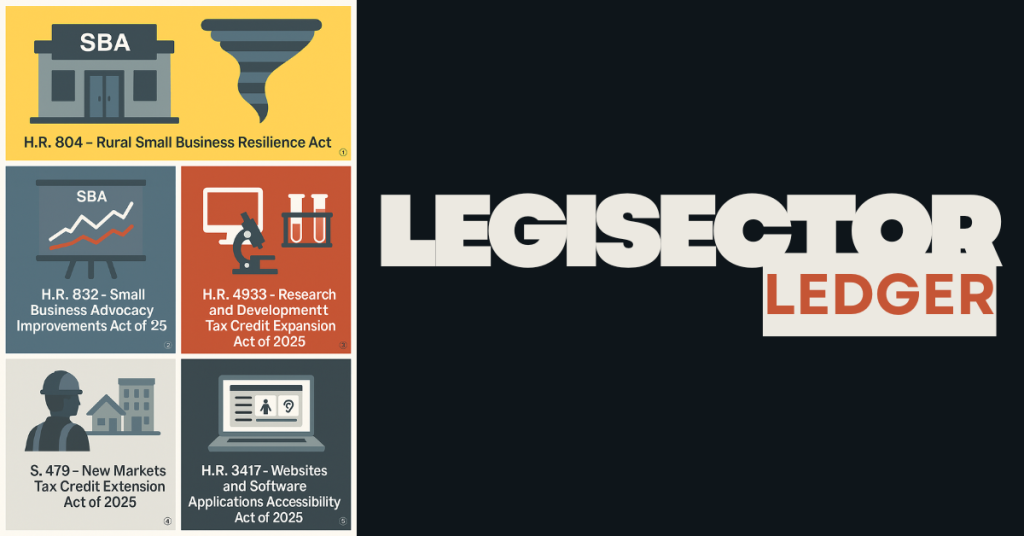
Several targeted business bills moving through Congress this session reflect a strategic shift toward modernization, resilience, and inclusion. From expanding R&D incentives to strengthening small-business advocacy and cybersecurity coordination, these developments collectively signal an effort to equip U.S. businesses—especially smaller firms—with the tools to compete and thrive in a more connected, risk-prone global economy.
Key Takeaways
• Broader R&D tax credits could fuel small-business innovation and tech development.
• Expanded disaster recovery and advocacy measures aim to strengthen rural and small-business resilience.
• National cybersecurity and accessibility standards could reshape digital compliance requirements across industries.
At a Glance
• H.R. 804 – Rural Small Business Resilience Act
• H.R. 832 – Small Business Advocacy Improvements Act
• H.R. 4933 – R&D Tax Credit Expansion Act
• S. 479 – New Markets Tax Credit Extension Act
• H.R. 3417 – Websites and Software Accessibility Act
• S. 2049 – NTIA Policy and Cybersecurity Coordination Act
H.R. 804 – Rural Small Business Resilience Act
Summary:
Directs the Small Business Administration to enhance disaster assistance for rural communities by improving outreach, communication, and access to federal aid programs.
Potential Business Impacts:
• Eases post-disaster loan and grant access for rural firms.
• Expands SBA engagement with local lenders and chambers.
• Reduces downtime and recovery gaps following natural disasters.
• Improves coordination between federal and local economic agencies.
Why It Matters:
For rural businesses often facing infrastructure and communication challenges, streamlined disaster assistance could mean faster recovery and continuity—critical for sectors such as agriculture, retail, and regional manufacturing.
H.R. 832 – Small Business Advocacy Improvements Act of 2025
Summary:
Modernizes the SBA Office of Advocacy to address how global economic and regulatory trends affect U.S. small businesses.
Potential Business Impacts:
• Expands the Office’s representation in trade and international policy discussions.
• Increases data collection on small-business regulatory burdens.
• Strengthens feedback channels between business owners and policymakers.
Why It Matters:
By ensuring that small businesses have a voice in global economic policy, this bill helps level the playing field for American entrepreneurs navigating complex international supply chains and trade frameworks.
H.R. 4933 – Research and Development Tax Credit Expansion Act of 2025
Summary:
Raises eligibility for R&D tax credits to include firms with up to $10 million in annual receipts and allows credits to offset unemployment taxes.
Potential Business Impacts:
• Makes innovation incentives more accessible to startups and mid-sized firms.
• Simplifies credit calculation and increases rates.
• Encourages reinvestment in new products, patents, and technology development.
Why It Matters:
With inflation-adjusted thresholds and broader applicability, this bill could stimulate innovation in key growth sectors while reducing tax pressure on early-stage companies.
S. 479 – New Markets Tax Credit Extension Act of 2025
Summary:
Makes the federal New Markets Tax Credit permanent and adjusts its value for inflation to promote long-term investment in distressed communities.
Potential Business Impacts:
• Increases capital flow into underserved markets.
• Strengthens public-private development partnerships.
• Enhances investor confidence through program permanency.
Why It Matters:
This measure secures a proven tool for revitalizing struggling areas, supporting both local economies and corporate social investment strategies.
H.R. 3417 – Websites and Software Applications Accessibility Act of 2025
Summary:
Requires DOJ and EEOC to set national accessibility standards for digital platforms used by businesses and public entities.
Potential Business Impacts:
• Establishes uniform compliance rules for websites and software.
• Reduces litigation risk related to accessibility disputes.
• Creates demand for accessibility consultants and technology updates.
• May involve upfront compliance costs for smaller organizations.
Why It Matters:
With digital commerce and employment systems at the center of business operations, clarity on accessibility expectations could improve consistency, reduce uncertainty, and expand customer reach.
S. 2049 – NTIA Policy and Cybersecurity Coordination Act
Summary:
Creates an Office of Policy Development and Cybersecurity within the NTIA to advance cybersecurity, innovation, and equitable digital access.
Potential Business Impacts:
• Encourages collaboration between industry and government on cyber resilience.
• Provides advisory input on broadband, spectrum, and emerging tech policy.
• May lead to new compliance or reporting requirements for network operators.
Why It Matters:
As cyber threats escalate, a coordinated federal hub for policy and data exchange could improve both preparedness and competitiveness in the digital economy.
LegiSector will continue tracking these bills as they advance through Congress. Collectively, they represent a pragmatic effort to modernize the regulatory and economic landscape—linking innovation incentives, cybersecurity readiness, and small-business resilience to long-term U.S. competitiveness.