



Operation Midway Blitz: Chicago raids, Tren de Aragua ties, and the politics of deportation
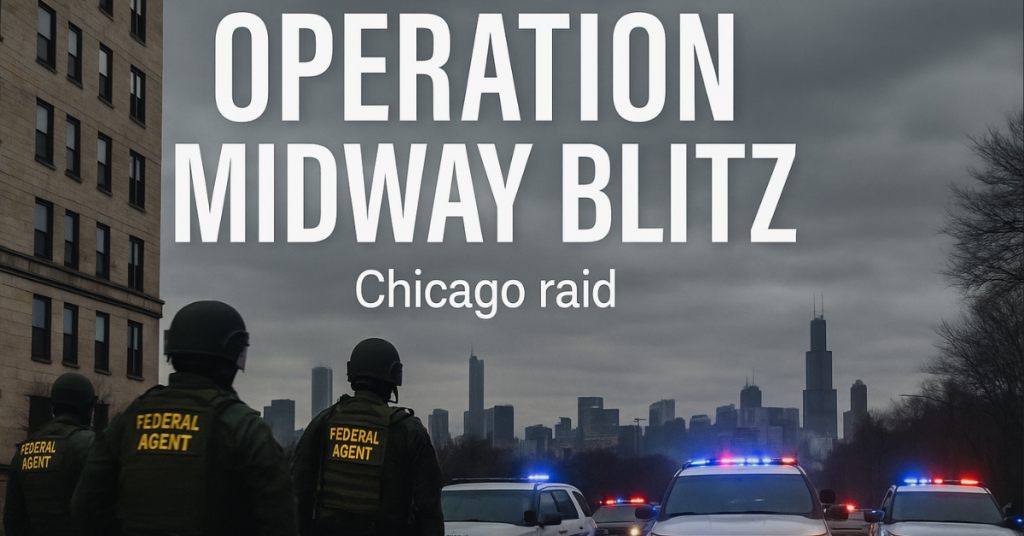
A major federal immigration operation known as Operation Midway Blitz — announced in early September and named in honor of Katie Abraham — continued this week with a dramatic show of force in Chicago’s South Shore neighborhood. Federal agents from ICE, Border Patrol, the FBI and ATF carried out a multi-agency raid that included agents rappelling from Black Hawk helicopters and the detention of roughly 30 people, officials and press reports say.
What happened in Chicago
Federal law-enforcement officers surrounded a multi-story apartment complex Tuesday morning in South Shore as part of the ongoing enforcement surge. News outlets reported that nearly 300 federal agents — from ICE, Border Patrol, the FBI and the ATF — took part in the operation, and that about 30 undocumented immigrants were taken into custody, some of whom are suspected of having links to the Venezuelan gang Tren de Aragua. Several accounts and video from the scene described agents lowering from helicopters and executing coordinated entries.
The Department of Homeland Security and ICE say the campaign targets “criminal illegal aliens” and was launched in honor of Katie Abraham, a young Illinois woman killed earlier this year; DHS officials and spokespeople framed the blitz as a response to sanctuary policies they say allowed violent offenders to remain at large.
Why Tren de Aragua matters here
The federal government designated Tren de Aragua — a violent Venezuelan gang that emerged within prisons and expanded across borders — as a Foreign Terrorist Organization earlier this year under the Trump administration’s broader policy of labeling transnational criminal groups and cartels. That designation has reshaped both the legal tools available to authorities and the rhetoric used to justify escalated enforcement.
Officials have pointed to suspected Tren de Aragua members among those detained as part of the operation. Supporters of the crackdown argue that designation and follow-up enforcement are necessary to disrupt transnational criminal networks that traffic drugs, people and weapons and to remove violent actors from U.S. streets.
Political fallout and local reaction
President Trump framed the operations as a response to sanctuary cities, calling enforcement a way to “straighten out” cities he said have become unsafe. Local leaders pushed back strongly: Illinois Governor J.B. Pritzker criticized the use of federal forces in local communities and framed the raids as politically motivated and harmful to civil liberties. The clash has escalated beyond policy debate to protests in Chicago and calls from state officials for more transparency and oversight of detention conditions and tactics.
Lawmakers and the Illinois congressional delegation have sought briefings and access to federal detention sites after reports of overcrowding and poor conditions — and at least one planned meeting with ICE was publicly canceled while questions remain about detainee treatment and operational transparency.
Bigger-picture context: policy, public safety, and legal questions
Operation Midway Blitz fits into a broader shift in federal immigration enforcement that mixes traditional removals with national-security framing (designation of criminal networks as terrorist actors) and more aggressive on-the-ground tactics. That shift raises several consequential policy questions:
-
Effectiveness vs. community trust: Aggressive raids can remove dangerous individuals from the streets, but they can also deter immigrants — including crime victims and witnesses — from cooperating with local police or reporting crimes, complicating public-safety goals.
-
Legal and humanitarian oversight: Critics ask whether detainees are being treated in accordance with legal standards, and local officials have pressed DHS for access and answers about detention conditions and use of force.
-
International and diplomatic implications: Using an FTO designation for a transnational gang changes diplomatic and legal posture toward countries associated with those groups and may enable more powerful sanctions and counter-terrorism tools.
What to watch next
-
Follow-up reporting on detainees: News outlets and local officials are seeking verification of who was detained, the charges they face, and whether evidence links them to Tren de Aragua or other criminal networks.
-
Federal briefings and oversight hearings: The Illinois congressional delegation and state leaders are pressing for information on detention conditions and operations; scheduled hearings or new information from ICE/DHS could shift public opinion and legal scrutiny.
-
Legal challenges and court actions: Civil-rights groups or local governments may pursue litigation if they conclude tactics violated rights or exceeded legal authority.
-
Further escalation or de-escalation: The presence of National Guard or troop-deployment requests and the federal government’s broader enforcement timeline will shape whether the standoff eases or intensifies.
Bottom line
Operation Midway Blitz is more than a series of targeted arrests — it is a policy statement that ties immigration enforcement to national-security tools and a political strategy that pits federal priorities against local officials and civil-liberties concerns. The dramatic South Shore raid underscores how that strategy plays out on city streets: heavy federal force, political headlines, and contested accounts of safety, legality and community impact. As reporting continues, the facts on who was detained, the strength of any gang-affiliation evidence, and the legal justification for tactics used will determine whether the operation is seen as a decisive public-safety measure or an overreach with lasting community costs.