



Trump Threatens to Send Troops to Portland to Confront “Domestic Terrorists”
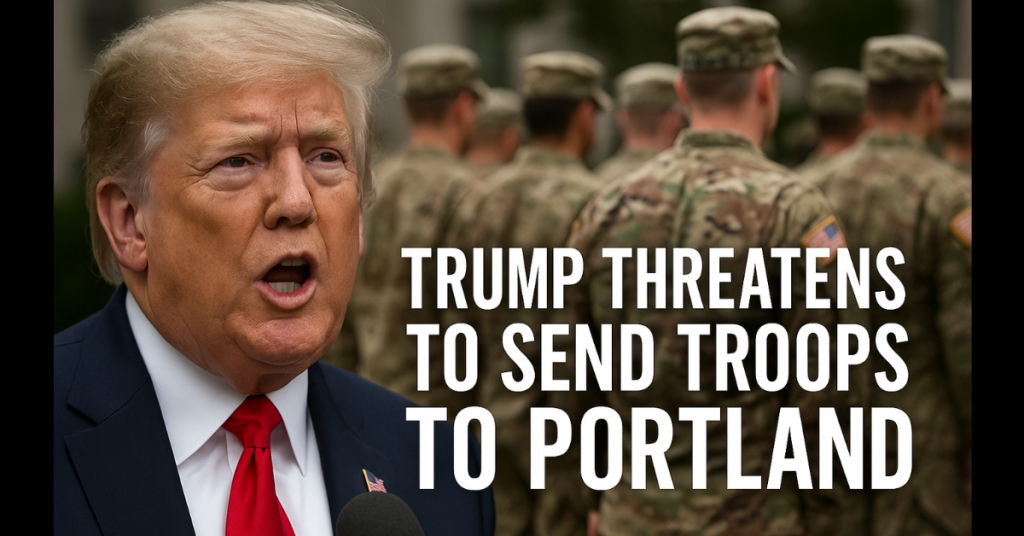
President Donald Trump announced on Saturday that he is directing the Department of Defense to send troops into Portland, Oregon, with what he called “Full Force, if necessary.” The former president framed the decision as a necessary step to defend U.S. Immigration and Customs Enforcement (ICE) facilities from attacks by Antifa and other so-called “domestic terrorists.”
Trump posted the announcement on social media, describing Portland as “war ravaged” and claiming federal property was under siege. His statement comes amid his broader campaign to escalate federal intervention in cities he argues are plagued by left-wing violence.
Pushback From Oregon Leaders
Portland Mayor Keith Wilson, a Democrat, responded sharply, rejecting the idea that troops are needed in the city. “Our nation has a long memory of acts of oppression, and the president will not find lawlessness or violence here unless he plans to perpetrate it,” Wilson said.
Oregon Governor Tina Kotek also disputed Trump’s characterization of Portland, stating, “There is no national security threat in Portland. Our communities are safe and calm.”
Both officials argued that sending in federal troops would inflame tensions rather than protect residents.
Context: Trump’s Deployment Strategy
This latest announcement is part of Trump’s broader push to send federal forces into Democratic-led cities. Earlier this year, he floated sending the National Guard into Chicago but has not followed through. A smaller deployment is expected in Memphis, Tennessee, with roughly 150 troops—far fewer than the numbers used in Washington, D.C., or Los Angeles during previous Trump-ordered crackdowns.
A Pentagon official, speaking anonymously, said the Department of Defense would provide updates as available but declined to confirm whether Trump was referring to local National Guard units or active-duty forces.
Portland’s History With Federal Forces
Portland became a flashpoint in 2020 after the murder of George Floyd, when protests erupted across the city, some turning violent. The Trump administration at the time sent hundreds of federal agents to Portland to protect courthouses and federal buildings. The deployments drew controversy, with critics accusing Trump of escalating violence rather than calming it.
Today, demonstrations are smaller and mostly centered around the ICE building on Portland’s outskirts. The facility’s windows are boarded up and marked with graffiti, but on Saturday morning, reporters observed no active protests or police presence outside.
Recovery and Crime Trends in Portland
Despite Trump’s framing of Portland as “war ravaged,” local data paints a more complex picture. According to the Major Cities Chiefs Association, violent crime in Portland dropped 17% from January through June compared to the same period in 2024. Downtown Portland has also seen a rebound in pedestrian traffic and a decline in homeless encampments since the pandemic years.
City officials argue these trends demonstrate recovery rather than decline.
Trump’s Rhetoric After Charlie Kirk Assassination
Trump’s latest troop threats come just weeks after the Sept. 10 assassination of conservative activist Charlie Kirk, an event he has tied to what he calls “radical left violence.” Speaking in the Oval Office Thursday, Trump described Portland activists as “professional agitators and anarchists” and vowed to “do a pretty big number on those people.”
This rhetoric underscores how Trump is positioning law-and-order politics as central to his strategy heading into 2026, once again putting Portland at the center of a national debate over protests, policing, and federal authority.
DailyClout.IO will continue to cover this story.