



Will AI Take Our Jobs? The Economics of Knowledge and Creative Destruction
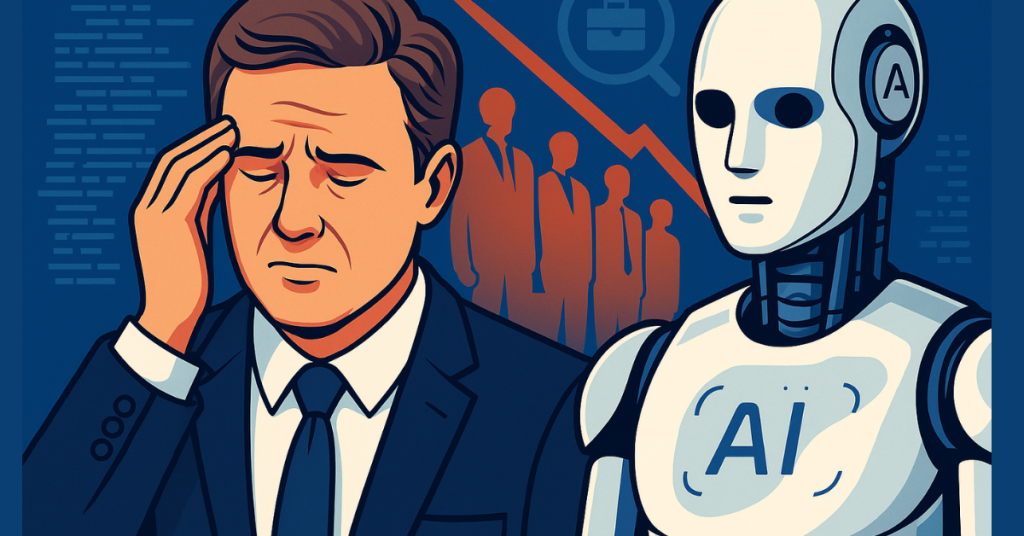
Many today are haunted by the question: Will AI take our jobs? From software engineers to truck drivers to call center workers, occupations across the spectrum appear threatened. Exaggerated warnings of mass unemployment circulate daily, and AI is often blamed for a sluggish job market for recent graduates despite an otherwise healthy economy.
But to understand AI’s impact, we need to reframe this fear. Every great technological leap—from the Industrial Revolution to the computer age—was disruptive. Economist Joseph Schumpeter called this “creative destruction”: the painful but necessary process of old jobs disappearing so new industries can emerge.
The key to optimism lies in seeing AI not just as a destroyer of jobs but as a generator of knowledge, the very fuel of long-term economic growth.
Knowledge as a Factor of Production
Economists from Robert Solow to Paul Romer, Friedrich Hayek, Claudia Goldin, and Lawrence Katz have shown how knowledge drives prosperity. AI accelerates knowledge in two critical ways:
-
Expanding personal capacity – helping individuals learn more and use knowledge they don’t already have.
-
Scaling social capacity – accelerating discovery, reducing costs of storage, and unlocking collective intelligence.
Like literacy once weakened memorization but strengthened reasoning, AI will cause some skills to atrophy while vastly enlarging intellectual reach. Net result: a more productive, knowledge-rich society.
Solow’s Growth Model and the AI Paradox
Robert Solow’s 1956 model explained growth through technology, with knowledge as the multiplier that keeps productivity rising. While physical capital eventually hits diminishing returns, new knowledge can trigger cascades of investment and growth.
AI may be at its own “Solow Paradox” moment—everywhere in conversation, but not yet in productivity statistics. Just as computers underwhelmed in the 1980s before fueling the 1990s boom, AI’s productivity revolution may arrive only after organizations routinize its use. Job churn will be part of this adjustment.
Romer’s Optimism: Knowledge That Doesn’t Decay
Paul Romer’s theory of endogenous technological change highlighted how capitalism itself generates knowledge through innovation and intellectual property. His optimism hinged on the idea that ideas don’t depreciate the way machines do.
The problem was maintenance: schools, libraries, and infrastructure made knowledge costly to sustain. But AI changes that equation. By making knowledge storage and retrieval nearly costless, AI brings Romer’s optimism closer to reality. Every smartphone user now has access to a vast knowledge base, making exponential growth possible again.
Hayek’s Local Knowledge and AI in the Marketplace
Friedrich Hayek emphasized the value of local knowledge—the tacit, decentralized information that markets capture through prices. AI complements this process.
Farmers use AI-driven weather forecasts, small businesses optimize logistics, and ordinary citizens navigate bureaucracy with AI tools. Far from centralizing control, AI spreads local problem-solving power widely.
The challenge is noise—too many job applications generated by AI, for instance, can make labor markets less efficient. But with best practices, AI will deepen the division of labor and smooth coordination.
Education, Inequality, and the Race with Technology
Claudia Goldin and Lawrence Katz argued in The Race Between Education and Technology that inequality depends on whether education keeps up with new technologies. In the past, widespread access to high schools and colleges helped balance wage gaps.
AI complicates this dynamic. It threatens many white-collar, cognitive roles once shielded by education, while leaving manual labor relatively untouched. This could invert the 20th-century trend, creating both deskilling and new opportunities for a “cognitive elite” who work alongside AI.
History suggests both outcomes are possible: Ford’s assembly line once deskilled labor but also raised wages. AI may produce a similar blend of disruption and opportunity.
Creative Destruction and the Future of Work
So, will AI take our jobs? The answer is both yes and no. Jobs will disappear, but new ones will be created. Skills will shift, but productivity will rise. Career disruptions are painful, but technological unemployment has always been temporary.
AI is a force of creative destruction, not permanent decline. By enlarging the world’s stock of knowledge, AI raises productivity, investment, and ultimately prosperity. The short-term turbulence should be met with long-term optimism: AI is not just an economic challenge—it is the next chapter in human progress.
Key Takeaway
Job losses are real, but so is economic growth. AI is knowledge, and knowledge is the ultimate driver of wealth. Just as with past revolutions, adaptation will determine who benefits most. The right mindset is not fear, but preparation.
DailyClout.IO will continue to follow this story.
Sources and further reading:
-
Brookings Institution – Automation and Artificial Intelligence: How machines are affecting people and places
brookings.edu -
World Economic Forum – The Future of Jobs Report
weforum.org -
MIT Technology Review – Will AI Take Your Job? It Depends.
technologyreview.com -
OECD – The Impact of Artificial Intelligence on the Labour Market
oecd.org