



Nadler’s Fall: From Pro-Israel Voice to Party Line
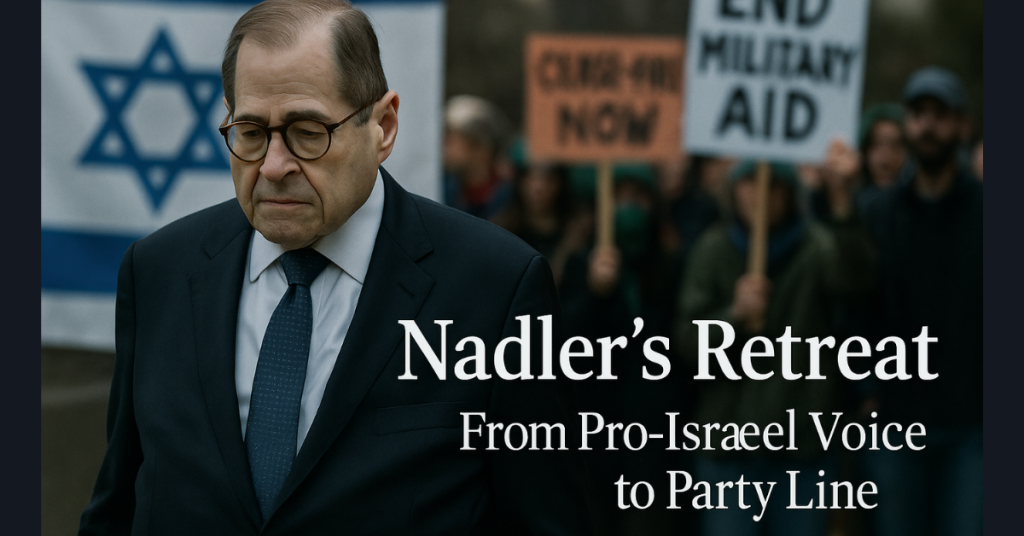
There was a time when Jerrold Nadler (D-N.Y.) could be relied upon as a defender of Israel. In the late 1980s, during the First Intifada, Nadler stood at a pro-Israel rally across from the United Nations, openly rejecting the fashionable hostility to Israel that was gaining traction in liberal media and political circles. He was defiant and unapologetically on Israel’s side.
Fast forward nearly four decades, and Nadler’s political posture looks unrecognizable. As he announced this week that he will not seek a 17th term in Congress, his legacy is being re-examined. For many, it is defined not by his early solidarity with the Jewish state, but by his recent embrace of positions and allies openly hostile to it.
From Pro-Israel to Protests
In July, instead of defending Israel’s war of self-defense against Hamas, Nadler appeared outside the Israeli consulate in New York at a protest organized by the anti-Israel group T’ruah. It was a striking reversal for a man who once prided himself on supporting Jewish security.
His time as chairman of the House Judiciary Committee (2019–2023) cemented his reputation as a staunch partisan fighter, particularly through his leadership of two Trump impeachments. But it also revealed a shift: Nadler increasingly prioritized staying aligned with the Democratic left, even when it meant turning away from Israel and ignoring rising antisemitism in his own backyard.
Endorsing the Wrong People
The most troubling example came this summer, when Nadler endorsed New York Assemblyman Zohran Mamdani—a Democratic Socialist who has defended chants calling for Jewish genocide. At a moment when American Jews were facing unprecedented harassment and violence following Hamas’s Oct. 7 massacre, Nadler lent credibility to a politician who openly echoes anti-Israel slogans.
That was not an isolated incident. He defended Columbia University activists who organized pro-Hamas mobs, and opposed stronger enforcement against antisemitism on campuses. He even supported an arms embargo against Israel, parroting Hamas talking points about “war crimes.”
The Broader Trend
Nadler’s trajectory mirrors a larger shift in the Democratic Party. Once, being both pro-Israel and progressive was not only possible but expected. Today, the intersectional left frames Israel as an “oppressor,” branding Jews as privileged colonizers rather than a vulnerable minority. Nadler, like other Democrats, adjusted to this trend rather than resisting it.
It’s telling that when Donald Trump moved the U.S. embassy to Jerusalem—a position Nadler once supported—he joined the critics instead. Similarly, he abandoned his support for the IHRA definition of antisemitism after Trump endorsed it, a move that cleared the way for Ilhan Omar and Rashida Tlaib to continue their rhetoric without consequence.
A Political Choice
Nadler’s story is less about principle than about political survival. For decades, his seat was safe, but the threat of a younger, more radical challenger loomed. To stay relevant, he chose to shift with his base rather than stand against it.
For American Jews, his retirement highlights a painful dilemma. Do they stay loyal to a Democratic Party increasingly aligned with anti-Israel activism, or do they cross partisan lines in defense of their own security? Nadler made his choice.
Conclusion
Jerrold Nadler Israel once stood as a symbol of bipartisan support for the Jewish state. Today, his legacy is one of retreat—a politician who allowed party loyalty to eclipse principle. His fall is not only a personal story but also a warning about the trajectory of American liberalism and its abandonment of the Jewish cause.
DailyClout.IO will continue to cover this story.
Sources and further reading:
https://nadler.house.gov/news/documentsingle.aspx?DocumentID=397402
https://nadler.house.gov/uploadedfiles/jn_remarks_for_jews_cry_out-_let_food_into_gaza_rally.pdf
https://clerk.house.gov/Votes/2024172
https://truah.org/press/nyc-rabbis-stand-against-hunger-in-gaza/