



U.S. Recalibrates Childhood Vaccine Schedule
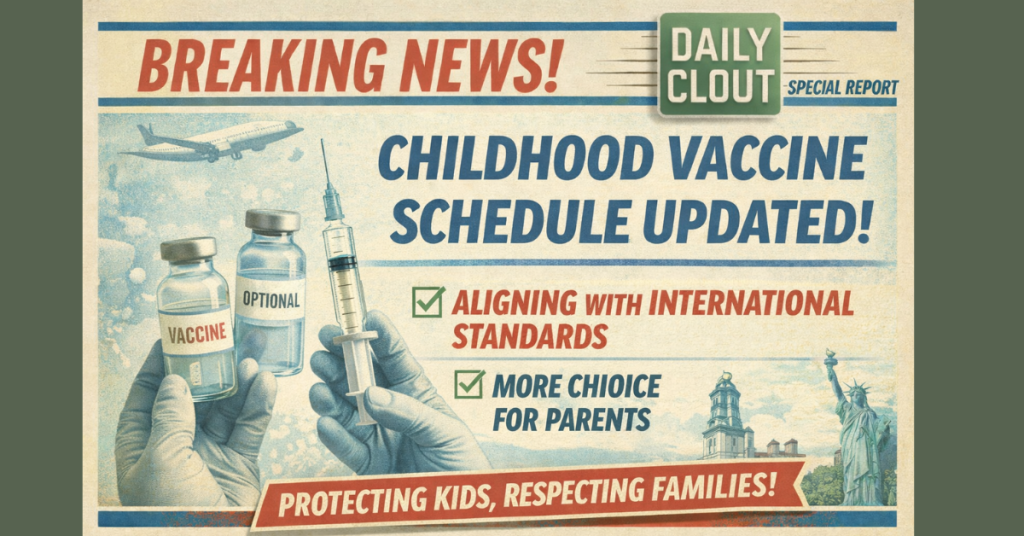
Federal health officials have announced a major update to the U.S. childhood vaccination schedule, reducing the number of diseases for which vaccines are routinely recommended from 17 to 11. Supporters of the change say it represents a thoughtful recalibration of public health guidance—one aimed at restoring trust, improving clarity, and aligning U.S. practices more closely with those of other developed nations.
The revisions were issued by the Centers for Disease Control and Prevention under Health and Human Services Secretary Robert F. Kennedy Jr., following a review ordered by President Donald Trump. The new schedule takes effect immediately.
What the updated schedule does—and does not—do
Contrary to some early characterizations, the revised schedule does not eliminate vaccines, nor does it restrict access to them. Vaccines remain available, covered by insurance, and recommended where evidence shows clear and consistent benefit.
Routine vaccination continues for diseases widely regarded as serious public-health threats, including measles, polio, tetanus, diphtheria, and whooping cough. Other vaccines—such as those for RSV, influenza, hepatitis A, and rotavirus—are now recommended based on individual risk or in consultation with a health-care provider.
Federal officials emphasized that the update shifts the focus toward informed decision-making, allowing families and physicians greater flexibility while maintaining strong protections against dangerous infectious diseases.
Aligning with international norms
A central rationale for the change is alignment with international standards. Health agencies under Kennedy reviewed vaccine schedules in approximately 20 peer nations, including Denmark, Germany, Japan, Canada, the United Kingdom, and Australia.
Officials noted that while the United States had recommended more routine childhood vaccines than many comparable countries, outcomes abroad remain strong—suggesting that different approaches can still achieve effective disease control.
“President Trump directed us to examine how other developed nations protect their children,” Kennedy said in a statement. “After an exhaustive review of the evidence, we are aligning the U.S. childhood vaccine schedule with international consensus while strengthening transparency and informed consent.”
Preserving access and cancer prevention gains
Key public-health advances remain untouched by the update. Vaccination against chickenpox is still recommended, and at least one dose of the HPV vaccine—credited with sharply reducing cervical cancer rates—remains part of the routine schedule.
Federal officials also stressed that insurance coverage will not change. All CDC-recommended vaccines will continue to be covered without cost-sharing, according to the Centers for Medicare & Medicaid Services.
“No family will lose access,” said CMS Administrator Dr. Mehmet Oz. “Parents and physicians retain the ability to choose what’s best for each child.”
A shift toward rebuilding trust
Supporters of the policy say the update reflects a broader effort to address declining public confidence in health institutions—an issue that intensified during the COVID-19 pandemic.
By simplifying the schedule and clearly distinguishing between universally recommended vaccines and those best tailored to individual circumstances, the administration argues it can reduce confusion and polarization around childhood immunization.
Some public-health experts have raised concerns about the speed and process of the changes, arguing that long-standing advisory mechanisms should remain central to vaccine policy. However, others acknowledge that public trust—not just scientific consensus—plays a critical role in successful vaccination programs.
Legal and procedural questions remain
Legal scholars have noted that major shifts in federal health guidance can invite scrutiny under administrative law. The Department of Health and Human Services has maintained that the changes were lawful and grounded in a broad review of international evidence and domestic data.
Whether formal challenges emerge remains to be seen, but officials say they are prepared to defend the process.
Looking ahead
The revised vaccine schedule represents a notable evolution in U.S. public-health policy—one that prioritizes clarity, parental involvement, and international alignment while preserving access and protection.
As states, physicians, and families adapt to the changes, the administration argues that success should be measured not only by vaccination rates, but by renewed confidence in public-health guidance itself.
Whether the update achieves that goal will unfold over time, but supporters say it marks a constructive step toward a calmer, more transparent conversation about childhood health.