



Supreme Court Takes On Birthright Citizenship
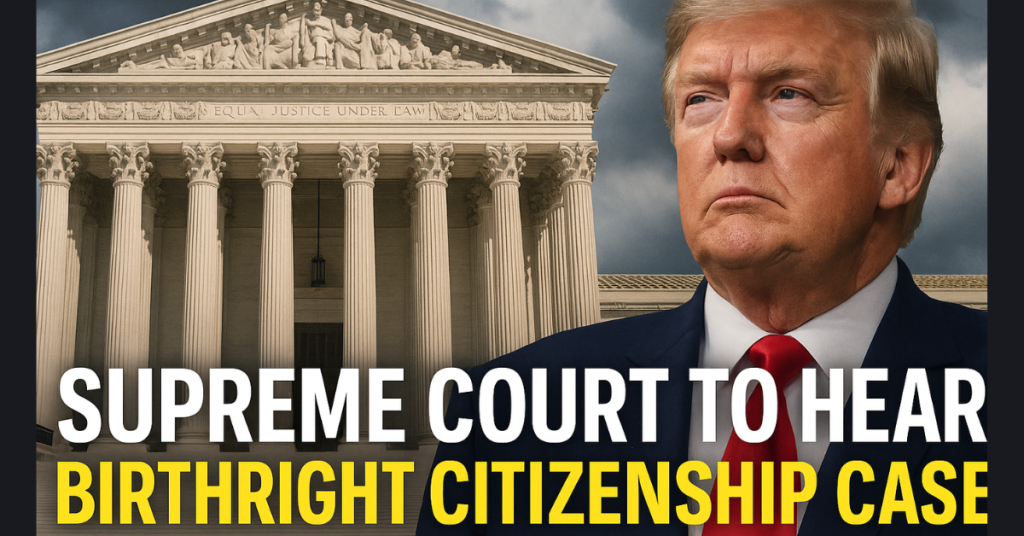
In one of the most consequential immigration cases in over a century, the U.S. Supreme Court announced Friday that it will hear arguments on President Donald Trump’s executive order seeking to end birthright citizenship for children born on American soil to parents who are in the country illegally.
The Court’s decision to take up the dispute fast-tracks a high-stakes constitutional showdown over the meaning of the 14th Amendment and could overturn a precedent that has guided U.S. citizenship policy since 1898.
Trump’s executive order—signed on his first day of his second term—has been blocked by lower courts and never went into effect. But Friday’s announcement indicates that the justices are willing to revisit a deeply embedded legal assumption: that any child born on U.S. soil is automatically a citizen, regardless of parental immigration status.
“This is a massive step forward,” Trump said after the ruling, arguing that “radical-left judges have attempted to dictate the law for the entirety of the nation,” and celebrating the Court’s decision to lift a lower-court injunction that had frozen the policy.
The brief order from the Court stated simply: “The petition for a writ of certiorari before judgment is granted.” Oral arguments are expected next year, with a ruling likely by late June.
A Direct Challenge to a 127-Year-Old Supreme Court Precedent
At the center of the legal battle is the Supreme Court’s 1898 decision in United States v. Wong Kim Ark, which held that the 14th Amendment confers citizenship on nearly anyone born in the United States. That ruling has long been understood as the foundation of modern birthright citizenship.
The 14th Amendment’s Citizenship Clause reads:
“All persons born or naturalized in the United States, and subject to the jurisdiction thereof, are citizens of the United States…”
Trump’s legal team argues that the phrase “subject to the jurisdiction thereof” has been misinterpreted for over a century and was never intended to grant citizenship to the children of foreign nationals who entered or remained in the country illegally.
Solicitor General D. John Sauer has stated that the 19th-century Court expanded the clause far beyond the intent of the Reconstruction Congress, which drafted the amendment to ensure citizenship rights for formerly enslaved Americans—not to incentivize illegal migration or birth tourism.
More than 22 states and multiple immigration-activist groups have sued to block Trump’s order, calling it unconstitutional, “unprecedented,” and a threat to longstanding immigration norms.
A Nation Split on Immigration Policy
Polling in 2025 has shown that Americans broadly support tighter immigration controls, and Trump has made immigration enforcement a central pillar of his administration. Birthright citizenship, he argues, has become a magnet for illegal entry and has strained public resources, particularly in border states.
Opponents contend that ending automatic citizenship would create a large population of stateless individuals and undermine a fundamental constitutional guarantee.
The case is already shaping up to be one of the defining legal battles of Trump’s second term—and one of the most significant constitutional questions to reach the Court in decades.
What Happens Next
The Supreme Court’s decision to grant review before the appeals process had concluded is rare and signals that the justices see extraordinary national importance in resolving the issue quickly.
Oral arguments will likely take place early next year, with a final ruling expected by the end of June.
If the Court sides with the Trump administration, it could fundamentally reshape U.S. immigration law and redefine who is entitled to American citizenship going forward.
This is a developing story. More updates will follow as legal filings and argument dates are released.